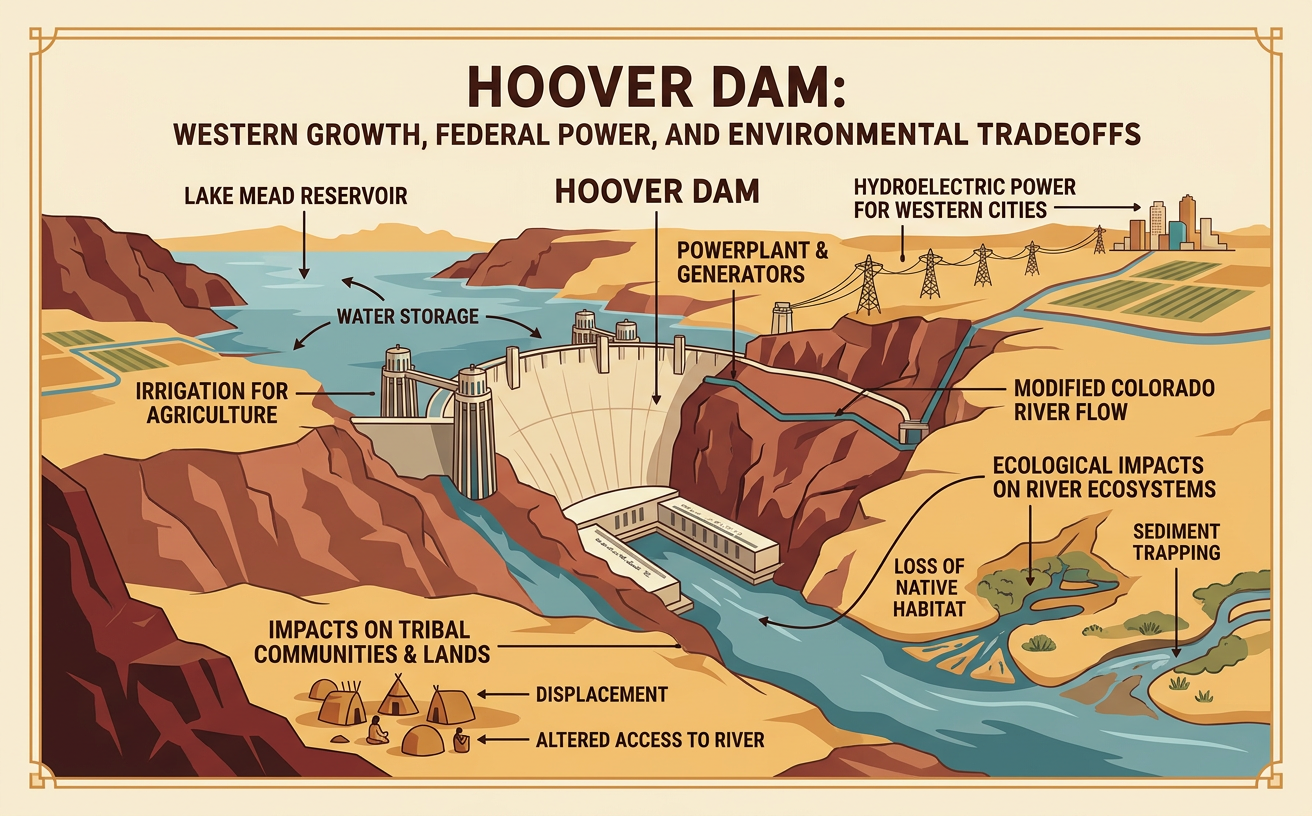
Hoover Dam: Western Growth, Federal Power, and Environmental Tradeoffs
Students analyze historical sources and quantitative evidence to evaluate how Hoover Dam promoted economic growth while affecting Tribal communities, water access, and Colorado River ecosystems.
Illustrations are auto-generated and may be placeholders. They can be refreshed to match the narration.
Why Build Hoover Dam?
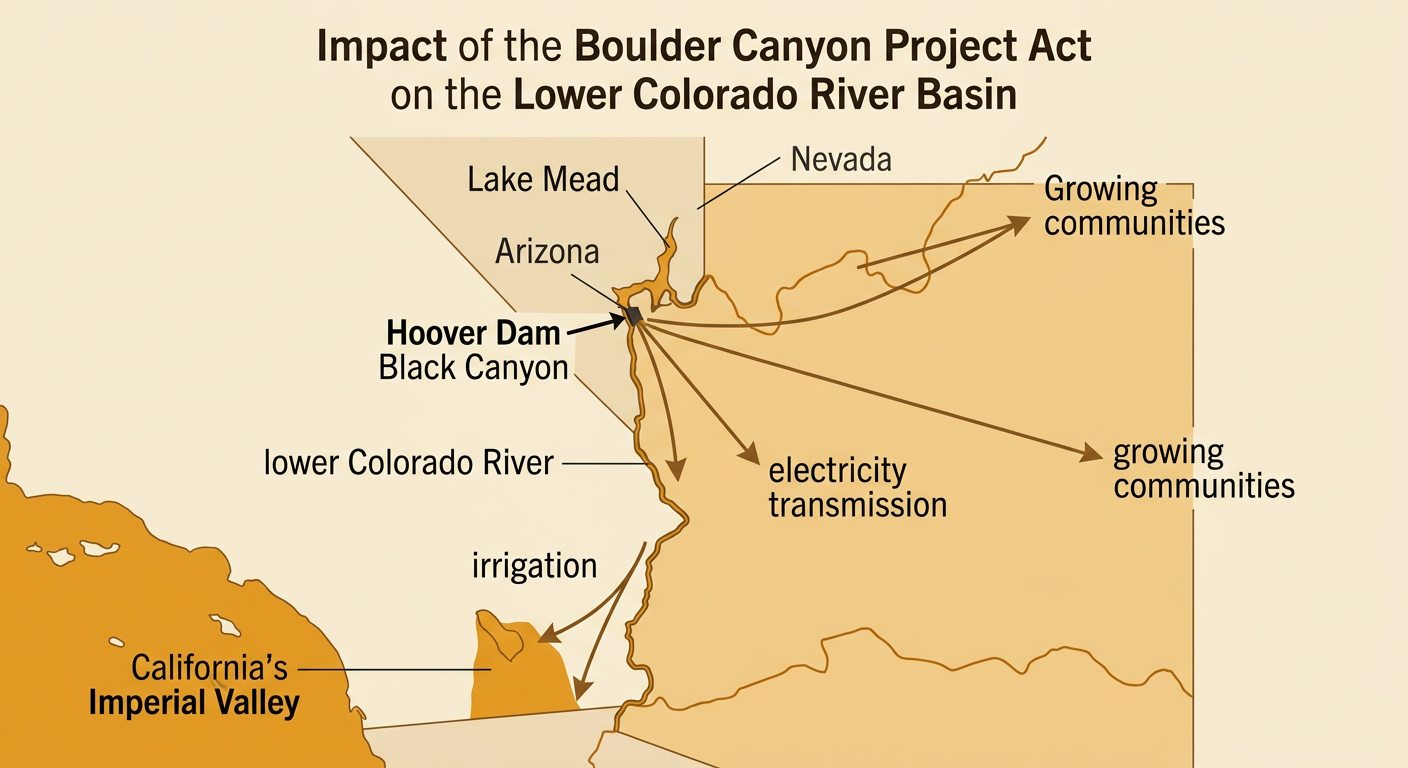
Before Hoover Dam, the lower Colorado River could bring destructive floods in wet years and water shortages in dry years. Farmers and growing communities wanted reliable irrigation water, flood control, and electricity. Congress authorized the Boulder Canyon Project in 1928, and construction began in 1931. The dam was built in Black Canyon on the Arizona-Nevada border, creating Lake Mead. Its stored water could be released according to schedules rather than the river’s natural seasonal flow. For example, irrigation districts in California’s Imperial Valley gained greater protection from floods and a more dependable water supply. However, the project also strengthened federal control over a river shared by states, Mexico, and Tribal nations. When analyzing the decision, students should cite evidence from the 1928 law, government reports, and accounts from affected communities, noting that different sources described the project’s purposes differently.
New Deal Jobs and Federal Power
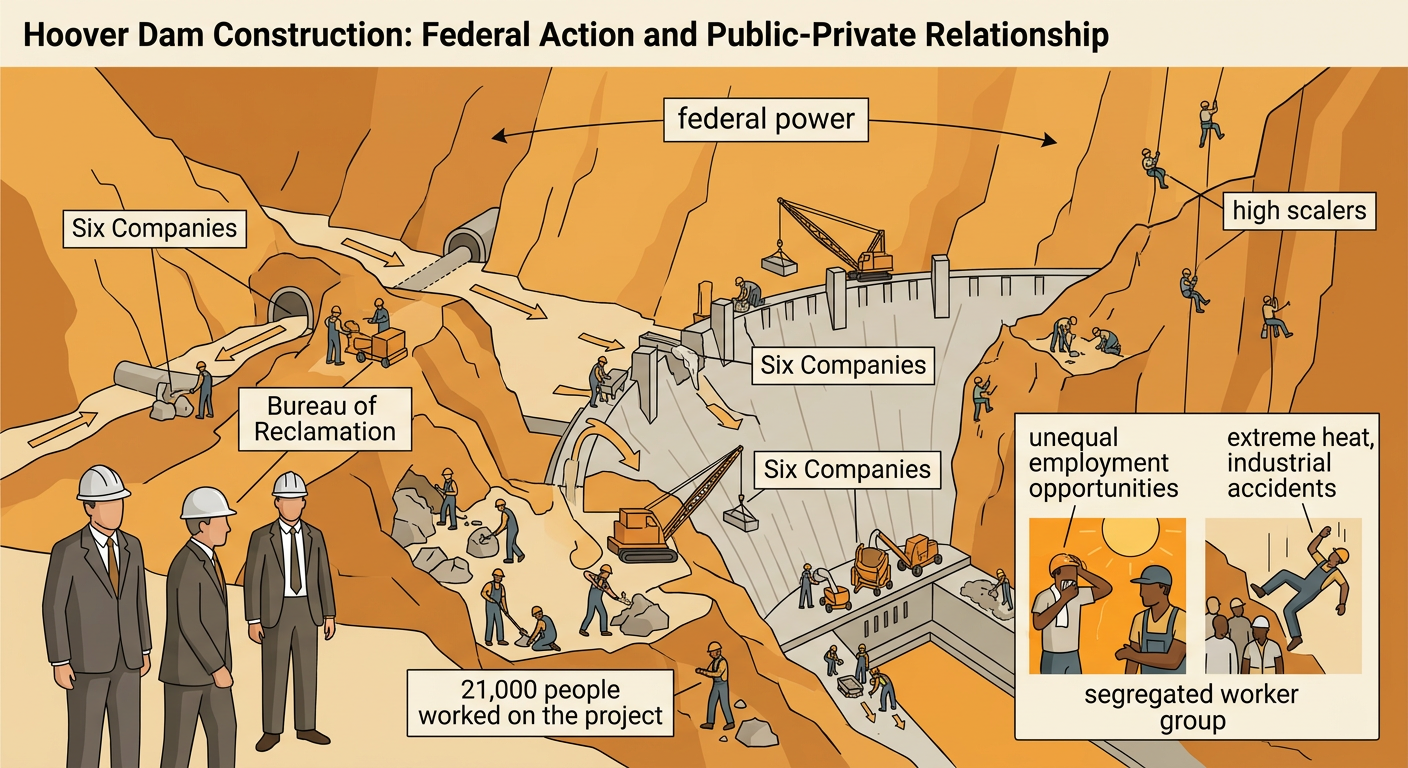
Hoover Dam became a major symbol of federal action during the Great Depression, although Congress authorized it before Franklin D. Roosevelt’s New Deal began. The federal Bureau of Reclamation directed the project, while a private consortium called Six Companies carried out much of the construction. About 21,000 people worked on the project over its construction period, with several thousand employed at one time. Workers built tunnels, removed rock, poured concrete, and installed generating equipment under dangerous desert conditions. For example, high scalers suspended by ropes cleared loose rock from canyon walls. Wages supported families, but workers faced extreme heat, industrial accidents, and unequal employment opportunities. The project demonstrates expanding federal power because the national government financed, planned, and managed infrastructure affecting several states. Students should compare official descriptions celebrating employment with worker testimony about safety and working conditions.
Water, Electricity, and Western Growth
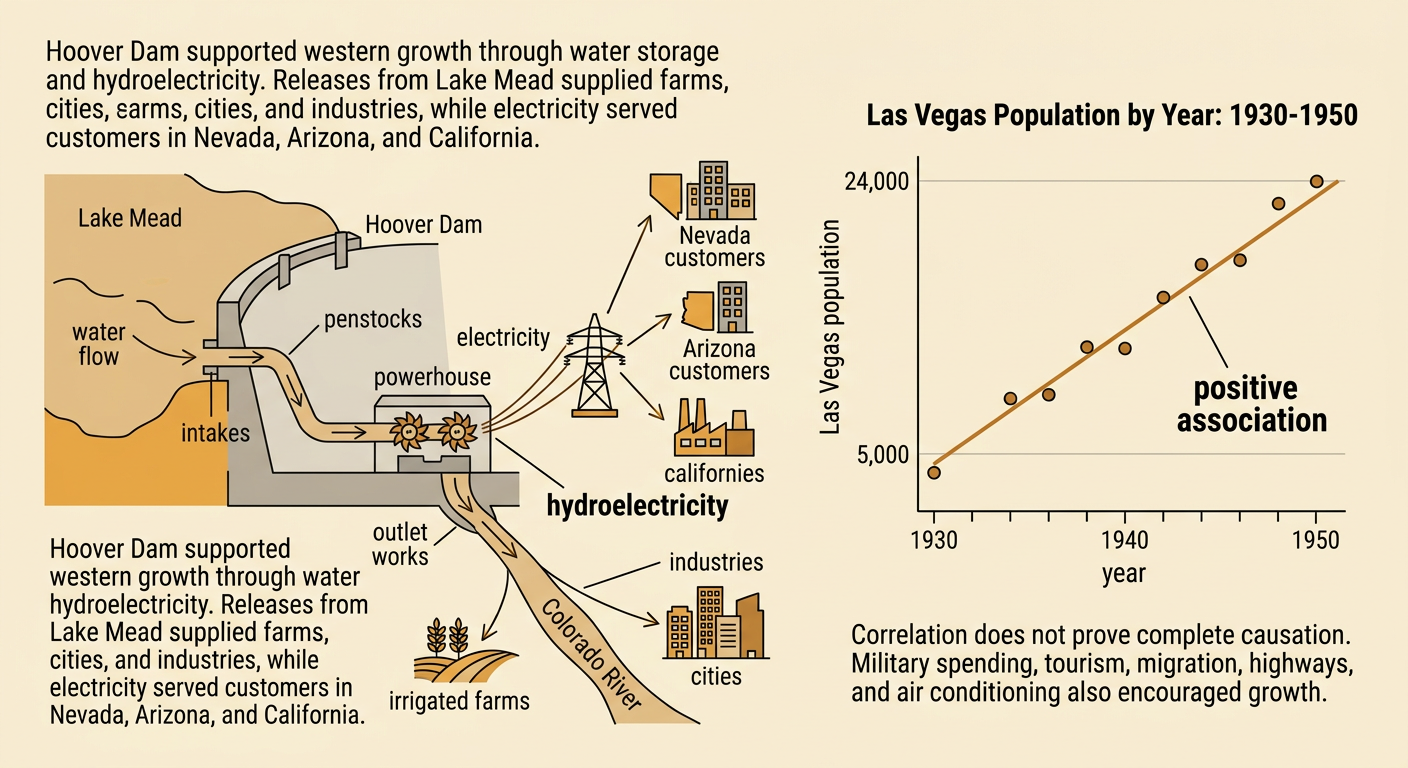
Hoover Dam supported western growth by storing water and generating hydroelectricity. Water released from Lake Mead helped farms, cities, and industries in the lower Colorado River Basin, while power from the dam served customers in Nevada, Arizona, and California. Las Vegas grew from about 5,000 residents in 1930 to more than 24,000 in 1950, although the dam was only one of several causes of that growth. Students can create a scatterplot with year on the horizontal axis and Las Vegas population on the vertical axis, then add information about electricity use or Lake Mead deliveries. A positive association may appear, but correlation alone does not prove that the dam caused every increase. Military spending, tourism, migration, highways, and air conditioning also mattered. Quantitative evidence should therefore be interpreted alongside laws, business records, maps, and population reports.
Tribal Communities and Water Rights
Colorado River development affected Tribal nations whose homelands and cultures had long depended on the river. Tribes were largely excluded from major negotiations such as the 1922 Colorado River Compact, even though federal law recognized that reservations could hold reserved water rights. In Winters v. United States in 1908, the Supreme Court established that creating a reservation could also reserve enough water to fulfill its purposes. Yet many Tribal rights remained unquantified or lacked pipelines and other infrastructure needed to use the water. For example, the Fort Mojave Indian Tribe and the Colorado River Indian Tribes hold rights connected to farming and community needs along the lower river, but broader allocation systems often developed without equal Tribal participation. Students should compare compact language, court rulings, Tribal testimony, and maps. This reveals that legal recognition, actual access, and decision-making power are related but not identical.

Colorado River Environmental Effects
Hoover Dam changed the Colorado River from a seasonally variable system into a more regulated one. Lake Mead traps sediment that would otherwise move downstream, and releases can alter water temperature, timing, and volume. These changes affect riverbanks, wetlands, native fish, and the Colorado River Delta. Native species such as the razorback sucker evolved with warm, silty water and seasonal floods; clearer and more controlled flows can favor nonnative species and change spawning habitat. Water diversions throughout the basin, not Hoover Dam alone, have also reduced the amount of water reaching the delta in Mexico. Students can graph annual river flow against the area of connected wetland habitat and examine whether lower flows are associated with habitat decline. Because drought, climate change, other dams, and water withdrawals also influence the ecosystem, conclusions should identify multiple interacting causes rather than assigning every effect to one structure.

Evaluating the Dam’s Legacy
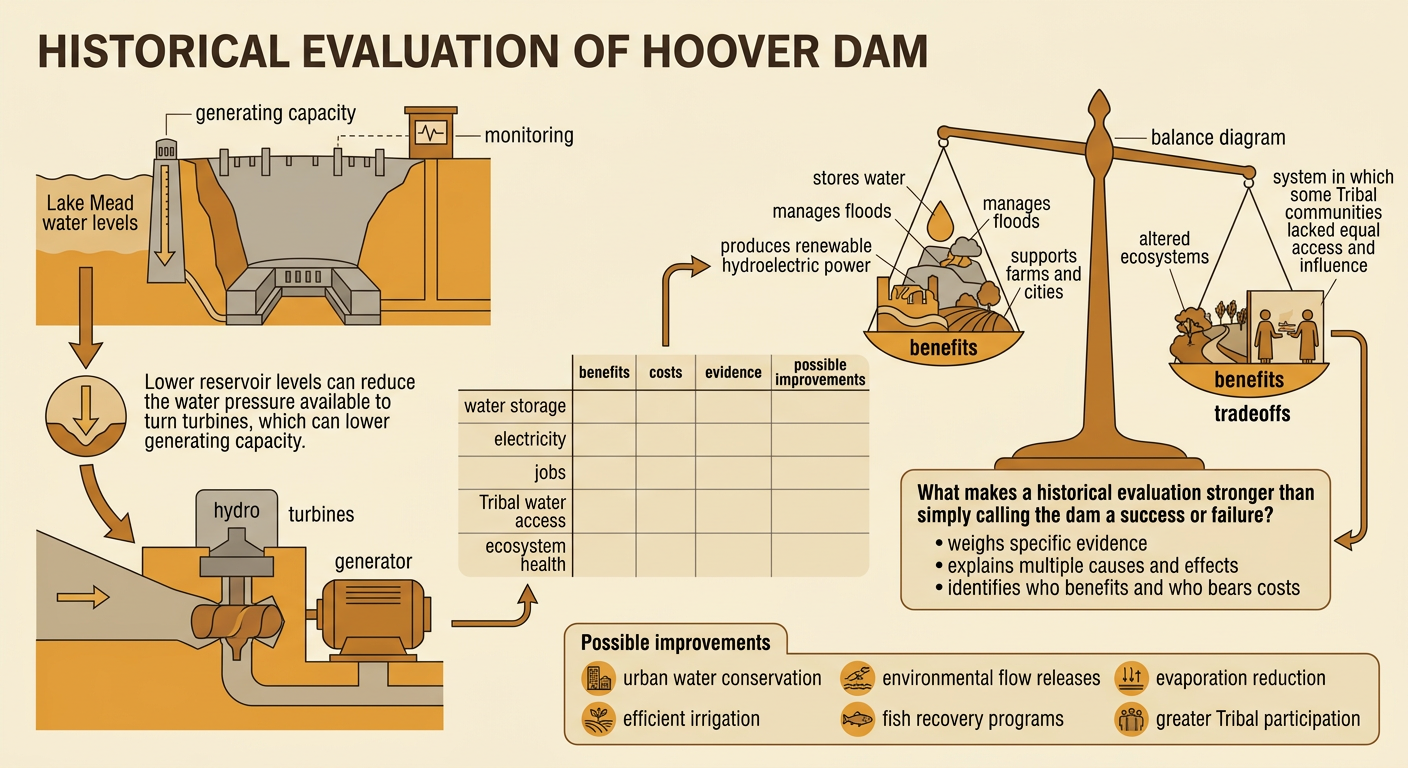
Hoover Dam’s legacy includes major benefits and serious tradeoffs. It provides water storage, flood management, renewable hydroelectric power, and infrastructure that supported farms and cities. It also contributed to altered ecosystems and a system in which some Tribal communities lacked equal access and influence. Evaluation requires weighing evidence rather than labeling the dam simply a success or failure. For example, students might compare annual electricity generation with Lake Mead water levels, then investigate whether lower reservoir levels reduce generating capacity. They can also evaluate possible improvements, including urban water conservation, more efficient irrigation, environmental flow releases, fish recovery programs, reduced evaporation, and Tribal participation in river management. A strong final claim should cite specific sources, interpret quantitative relationships carefully, and explain multiple causes and effects. The best proposal should identify who benefits, who bears costs, and how the solution could be monitored and revised.