
Hot or Cold? Energy Changes in Chemical Reactions
Students analyze temperature data from exothermic and endothermic reactions and use the evidence to propose a safe hot-pack or cold-pack design.

Illustrations are auto-generated and may be placeholders. They can be refreshed to match the narration.
Chemical Reactions and Energy Transfer
Chemical reactions rearrange atoms to form new substances. During a reaction, energy is transferred between the reacting materials, called the system, and everything around them, called the surroundings. Breaking chemical bonds requires energy, while forming new bonds releases energy. The overall energy change depends on which amount is greater. If more energy moves from the system to the surroundings, the surroundings warm. If the system takes in energy from the surroundings, the surroundings cool. For example, iron in a disposable hand warmer reacts with oxygen to form iron oxide. This reaction transfers thermal energy to the pack and then to a person’s hand. Temperature measurements provide evidence of energy transfer, but they do not directly measure all the energy stored in the reacting substances.

Reading Temperature-Change Data
To analyze a reaction, follow the procedure in order and record the starting and final temperatures under the same conditions. Calculate temperature change by subtracting the starting temperature from the final temperature: ΔT = final temperature − starting temperature. Suppose 1.0 gram of iron in a test pack raises the temperature from 20.0°C to 24.0°C. The change is +4.0°C. If 2.0 grams under similar conditions raises it from 20.0°C to 28.0°C, the change is +8.0°C. Doubling the iron produced twice the temperature change in these sample trials, showing a proportional relationship. Real data may not be perfectly proportional because heat can escape or oxygen can become limited. A graph of reactant amount versus temperature change helps reveal the pattern and identify unusual results that should be tested again.

Exothermic Versus Endothermic Reactions
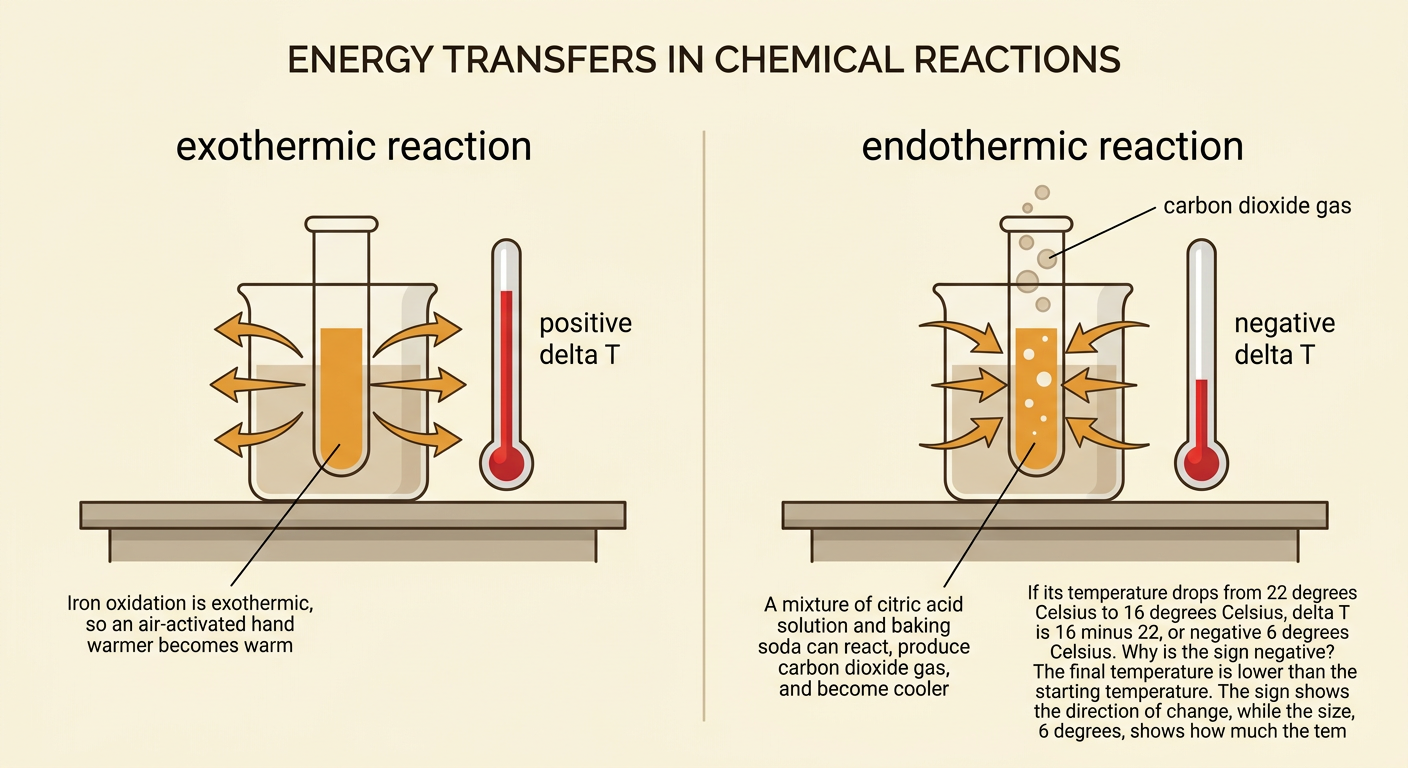
An exothermic reaction transfers thermal energy from the reacting system to the surroundings. Its temperature usually rises in an insulated classroom test, so ΔT is positive. Iron oxidation is exothermic, which is why air-activated hand warmers become warm. An endothermic reaction absorbs thermal energy from the surroundings. Its temperature usually falls, so ΔT is negative. For example, a mixture of citric acid solution and baking soda can become cooler as the substances react and produce carbon dioxide gas. If the temperature drops from 22°C to 16°C, ΔT is −6°C. The positive or negative sign tells the direction of the temperature change. The size of the change, 6°C in this example, helps compare how strongly different systems warm or cool under the same testing conditions.
Comparing Hot-Pack and Cold-Pack Materials
Pack materials should be compared using the same reactant amounts, starting temperature, container, and testing time. Iron powder is useful for a hot pack because oxidation releases energy gradually and the materials are fairly inexpensive. However, the pack requires oxygen, may take time to warm, and must prevent powder from escaping. A citric acid and baking soda system can provide cooling, but it produces carbon dioxide gas. A sealed cold pack would need expansion space or another way to prevent dangerous pressure buildup. Designers should compare maximum temperature change, time at a useful temperature, cost, waste, availability, and safety. For example, a material that heats quickly but reaches 60°C would be less suitable for direct skin contact than one that remains near 40°C. The best choice balances performance with health, environmental, and economic costs rather than simply producing the largest temperature change.

Proposing a Safe Pack Design
A safe design proposal should name its purpose, materials, structure, criteria, and testing plan. One option is an air-activated hot pack containing iron powder, a small amount of salt water, activated carbon, and vermiculite inside a strong, particle-blocking pouch that allows oxygen to enter. An airtight outer wrapper prevents the reaction from starting during storage. After the wrapper is opened, oxygen reaches the iron and oxidation releases thermal energy. A fabric sleeve reduces direct heat transfer to skin. Design criteria could require the pack to stay between 38°C and 43°C for at least 20 minutes, cost less than a chosen limit, and show no leakage. Test several reactant amounts, record temperature every minute, and graph temperature against time. If the pack becomes too hot, leaks, or cools too quickly, revise the amount of iron, airflow, insulation, or pouch material. Testing should occur with adult supervision, not directly on skin.
