
How Animals Send Messages
Students explore how animals use sounds, movements, and body signals to communicate warnings, needs, and other messages.
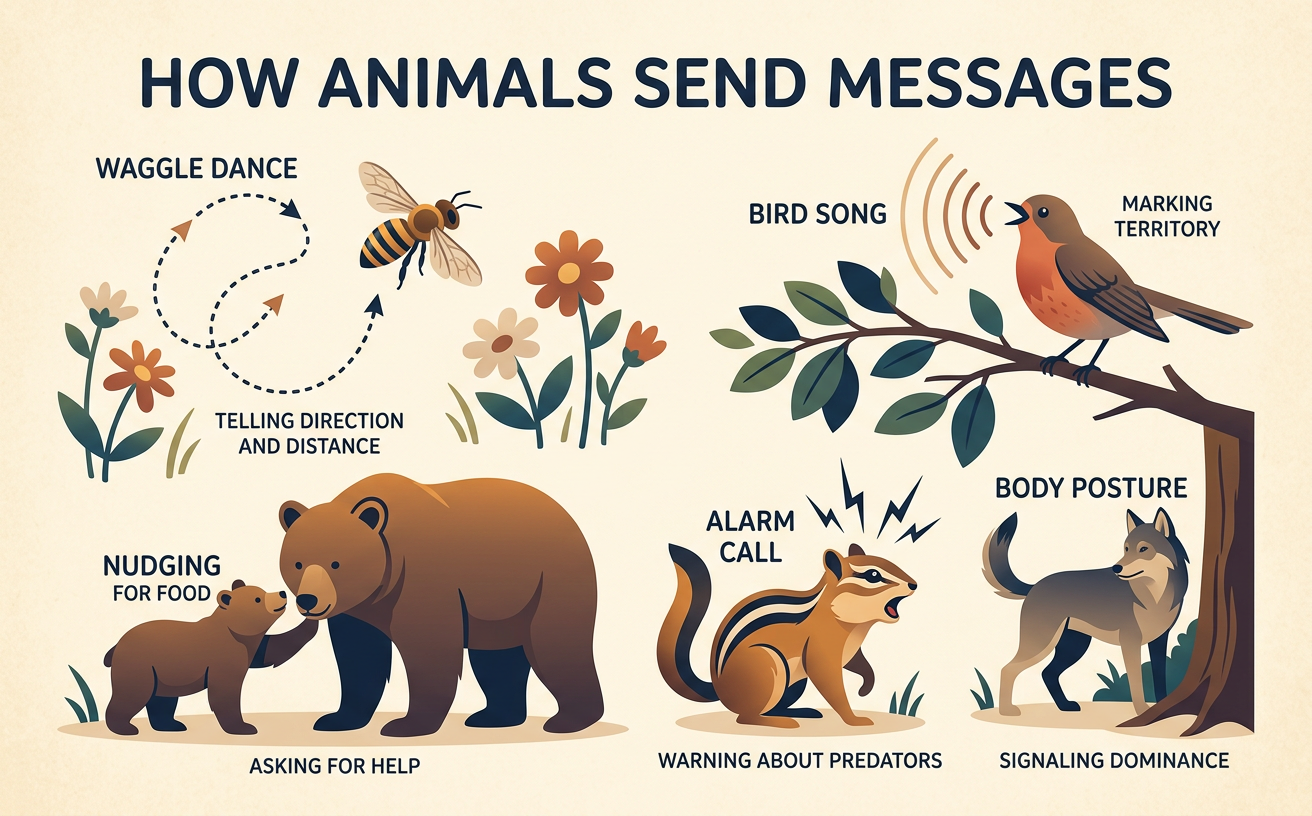
Illustrations are auto-generated and may be placeholders. They can be refreshed to match the narration.
What Is Communication?
Animals communicate when one animal sends a signal and another animal responds. A signal can be a sound, a movement, or a body sign such as raised fur or a bright tail. Signals help animals share messages about danger, food, location, or needs. For example, a prairie dog gives a sharp alarm call when it notices danger. Other prairie dogs may run into their burrows. The call connects two events: one animal spots danger, and the group seeks shelter. Animal communication is not the same as human speech, but it still carries useful information. To understand a signal, notice who sends it, what happens nearby, and how another animal acts afterward.

Listen and Watch for Animal Signals
Listen quietly and watch carefully to find animal signals. A sound may be a bird’s call, a frog’s croak, or a cricket’s chirp. A movement may be a honeybee’s waggle dance. A body signal may be a dog’s stiff legs and bared teeth, which can warn others to stay away. Always observe wild animals from a safe distance or use a recording, photograph, or video. Also notice the place. Frogs often call near ponds, while prairie dogs give alarm calls in open grasslands near their burrows. On a simple habitat map, connect each animal to the place where its signal works. Ask: What did the animal do? What happened next? These clues help reveal the likely message.

Match Each Signal to Its Message
A signal makes sense when you connect it to what happens before and after. Match each signal with the message it most likely carries. When a hungry nestling sees its parent, it may open its beak wide and call. The parent may bring food, so the signal is connected to a need for food. When a white-tailed deer raises its white tail while running from danger, nearby deer can become alert and flee. That signal is connected to warning. A honeybee’s waggle dance inside the hive gives other bees information about the direction and distance of food. Look for evidence instead of guessing: identify the sender, the receiver, the signal, and the response. Then explain the connection in one sentence: “The animal did this, so another animal did that.”

Sort Animal Signals
We can sort animal signals into three categories: sounds, movements, and body displays. Place a bird alarm call in sounds. Place a honeybee waggle dance in movements. Place a peacock holding its colorful feather train open in body displays. Some signals use more than one category. For this activity, choose the main part you notice and use the same rule each time. Make a picture graph with one column for each category. Add one animal picture or square for every example. Then count each column. Tell which category has more, which has fewer, or whether two categories are equal. For example, if the graph shows three sounds, two movements, and one body display, sounds are the largest group. The graph describes the examples your class observed, not every animal signal in nature.

Create and Share an Animal Message
Now use what animals do to solve a human communication problem. Imagine your class needs a quiet way to tell players to stop during a game. A white-tailed deer can lift its bright white tail while fleeing danger, making a visible signal to other deer. Mimic that idea by making a two-sided signal paddle from cardboard, tape, and paper. Keep one side plain and make the warning side bright and easy to see. Agree that the bright side means “stop and look.” Test it from nearby and farther away. Record whether classmates notice and respond correctly. Show the test spots on a simple map. Then improve the size, color, or movement and explain how the design copies an animal signal without copying the animal’s exact message.
