
How Balanced and Unbalanced Forces Change Motion
Students investigate how pushes and pulls of different strengths and directions affect the motion of an object.

Illustrations are auto-generated and may be placeholders. They can be refreshed to match the narration.
Notice Pushes and Pulls
A force is a push or a pull. A force can start an object moving, stop it, speed it up, slow it down, or change its direction. Notice forces as you move classroom objects. Your hand pushes a book across a desk. A string pulls a toy wagon. Both the strength and direction of a force matter. Draw an arrow to show each force. The arrow points in the direction of the push or pull, and a longer arrow can represent a stronger force. People have always used forces to move objects. Long ago, workers pulled heavy loads on sleds or pushed them over logs. Today, people may use wheeled carts or machines. The tools have changed, but moving each load still requires pushes and pulls.

Predict the Object's Motion
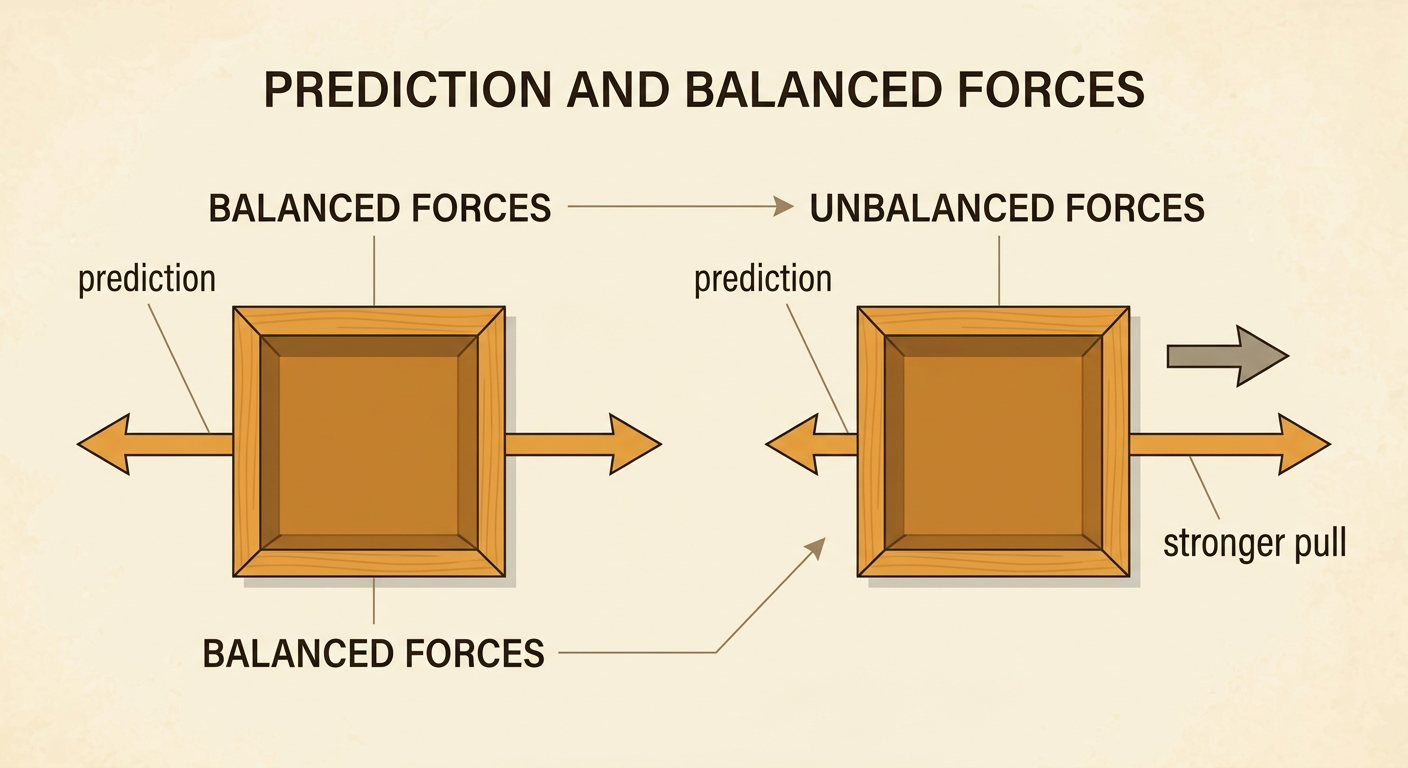
Before testing forces, predict what an object will do. Look at the strength and direction of every push or pull. Imagine two students pulling opposite ends of a rope attached to a box. If they pull with equal strength in opposite directions, the forces are balanced. A box at rest should remain at rest. If one student pulls harder, the forces are unbalanced, so the box should move toward the stronger pull. Use arrows to explain your prediction. Equal-length arrows pointing in opposite directions show balanced forces. Unequal arrows show unbalanced forces. You might write, “I predict the cart will move right because the right pull is stronger.” A prediction is not a guess without a reason. It is an idea based on what you notice about the forces.
Test Balanced Forces
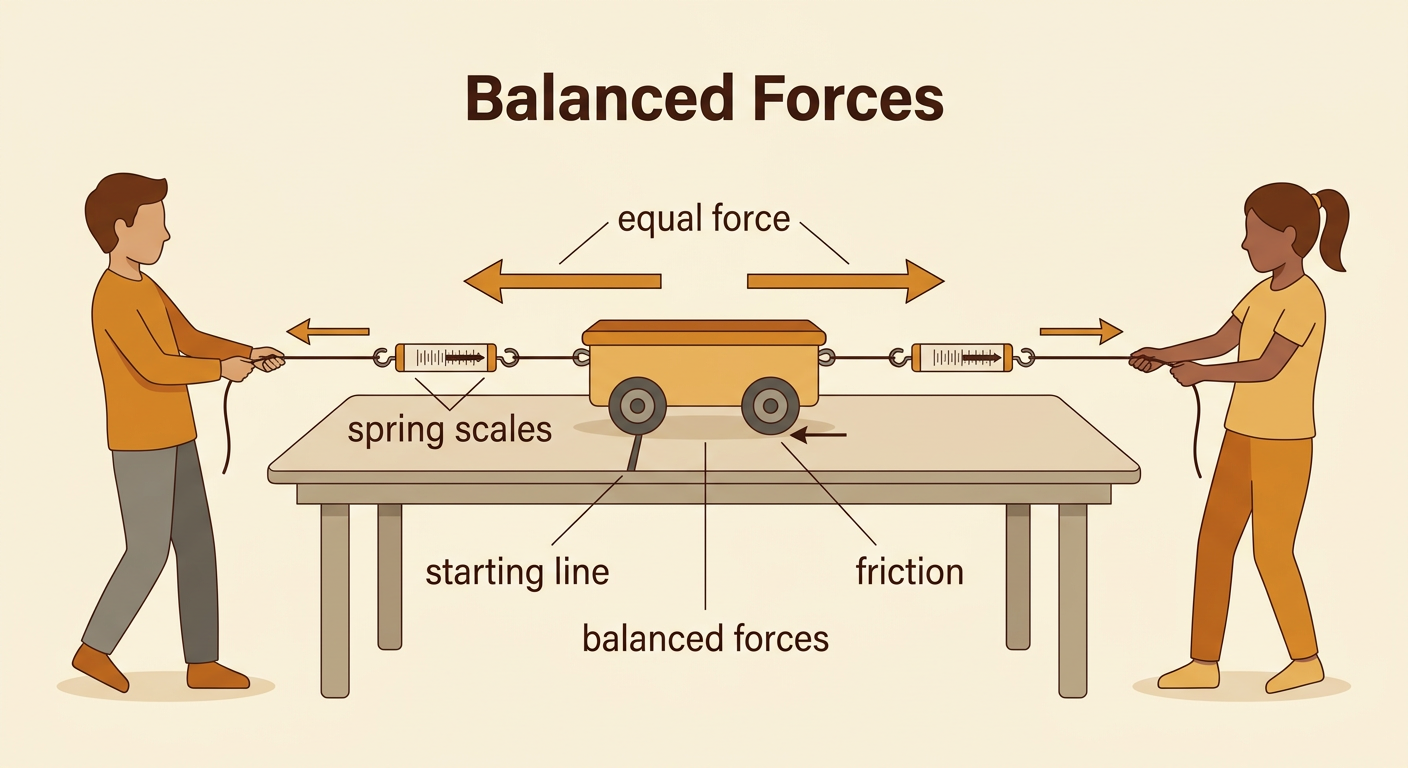
Work with your group to test balanced forces on a toy cart. Place the cart on a smooth, level surface. Attach a string to each end. Two students should pull gently in opposite directions with equal force while another student watches the cart. If available, use spring scales to check that both pulls have the same measurement. Repeat the test three times. The cart should stay in place when it begins at rest because the equal, opposite forces balance. Balanced forces do not cause a change in motion. If an object were already moving steadily, perfectly balanced forces would not make it speed up, slow down, or turn. In a real test, tiny differences in pulls or surface friction may cause slight movement. Discuss those differences instead of changing the results.
Test Unbalanced Forces
Now change only one part of the test. Have one student pull the cart more strongly than the other student, or let one student pull while the other does not. Keep the same cart, surface, and starting line. Observe whether the cart starts moving and which direction it travels. Repeat the test with the stronger pull on the other side. The forces are unbalanced because they do not cancel each other. The cart's motion changes in the direction of the greater force. For example, a 4-unit pull to the right and a 2-unit pull to the left produce a stronger overall effect to the right. Test safely with gentle pulls, and stop the cart before it reaches the table's edge. Take turns pulling, observing, and recording.

Record and Compare Results
Record evidence after every trial instead of relying on memory. Make a table with columns for the left force, right force, whether the forces were balanced, and the cart's motion. You might record equal pulls as 3 units left and 3 units right, with no movement from the starting line. Another trial might show 2 units left and 5 units right, with motion to the right. Compare at least three trials. Look for a pattern: equal, opposite forces cause no change in motion, while unequal forces cause a change toward the stronger force. You can also measure how far the cart travels in the same amount of time. Numbers, words, and arrows help your group explain results clearly. Listen to each group member and ask questions about measurements that differ.

Explain the Evidence
Use your observations to make a claim about forces and motion. State the claim, give evidence from your results, and explain why the evidence supports it. For example: “Unbalanced forces change motion. In two trials, the cart moved right when the right pull was greater than the left pull.” Also consider friction, a force that acts against motion when surfaces rub. A rolling cart eventually slows because friction and other resisting forces act opposite its movement. Connect your findings to history. Long ago, people sometimes dragged heavy stones or used sleds. Later, rollers, wheels, wagons, and machines made loads easier to move by reducing friction or providing stronger pushes and pulls. Compare what stayed the same: forces were still needed. End by sharing your explanation and respectfully discussing whether every group's evidence supports the same pattern.
