
How Bodies Use Fat from Food
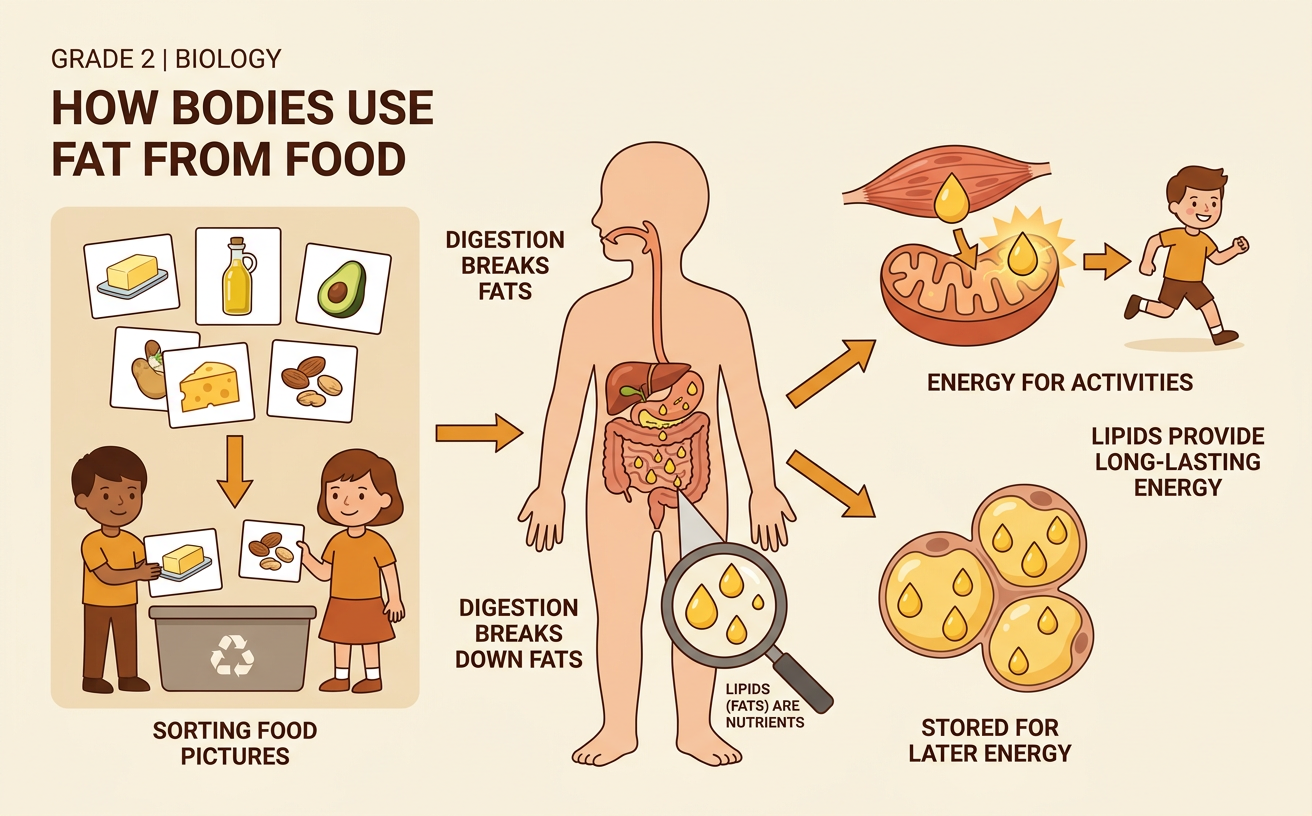
Students use a simple model and food-picture sort to learn that fats, also called lipids, are nutrients that the body can break down and use or store for energy.
Illustrations are auto-generated and may be placeholders. They can be refreshed to match the narration.
Energy Begins with Plants
Most energy in our food begins with sunlight. A plant uses light from the Sun, water, and air to grow and make sugar. The plant can use some sugar to make fats, especially in seeds and fruits. When people eat plant foods, they get some of this stored energy. Animals also eat plants. When people eat foods from animals, the energy can still be traced back to plants. For example, sunlight helps grass grow, a cow eats the grass, and milk from the cow can contain fat. This is an energy pathway: Sun to plant to animal to person. Plants need both sunlight and water to grow well, so these resources help begin the pathway that brings energy to living things.
What Are Fats?
Fats are nutrients found in many foods. Scientists also call fats lipids. The body needs some fat to work well. Fat can provide energy, help build cell coverings, protect organs, and help the body use certain vitamins. Different foods contain different amounts and kinds of fat. Avocado, peanut butter, seeds, olive oil, cheese, and fish are examples of foods that contain fat. A food can have fat and other nutrients at the same time. For example, peanut butter contains fat and protein. Fat is not the same as body fat, although extra food energy can be stored in the body. We can look at food pictures or nutrition labels to compare foods, but one food does not tell the whole story of a person’s eating pattern.
From Food to Usable Energy
After you eat food that contains fat, your body changes it through several steps. First, your teeth chew the food into smaller pieces. Next, the food moves through the stomach and into the small intestine. There, digestive juices help break fat into much smaller parts. These small parts can pass into the body and travel in the blood. Cells can then use them to help release energy for movement, growth, warmth, and other work. For example, after a child eats avocado on toast, digestion breaks down the food. Later, the child’s cells can use nutrients from that meal while the child walks, thinks, and plays. The change does not happen all at once. It is a sequence with steps in a clear order.
Use Now or Store for Later
The body needs energy all day, even during sleep. After digestion, cells can use nutrients from fat to help provide energy now. If the body receives more food energy than it needs at that time, it can store some for later, including as body fat. Later, between meals or during activity, the body can use stored energy. Think of a rechargeable battery: energy can be available for current work or kept until it is needed. The body is more complex than a battery, but the model helps show two possible paths. For example, energy from lunch may support afternoon play, while some extra energy may be stored. Everyone’s energy needs are different and can change with growth and activity. Stored fat also cushions organs and helps keep the body warm.
Sort and Graph Food Sources
We can sort food pictures to compare sources of fat. Make three categories: plant foods with fat, animal foods with fat, and foods with little or no fat. Place each picture in one category using the information provided by your teacher or a nutrition label. For example, avocado and sunflower seeds belong in the plant-food category. Salmon and cheese belong in the animal-food category. An apple has little or no fat. Then make a picture graph. Let one food picture stand for one food. Label the categories and count the pictures in each row. If the graph shows four plant foods, three animal foods, and two foods with little or no fat, the plant-food row has one more picture than the animal-food row. Graphs help us describe and compare the sorted data.
Healthy Variety Review
Fat is one nutrient the body needs, but people need a variety of foods. Fruits, vegetables, grains, protein foods, and dairy or fortified alternatives can provide different nutrients. People make choices about which foods and other goods to buy. Their choices may depend on price, taste, family traditions, allergies, what is available, and what their bodies need. For example, one family might choose peanut butter, while another chooses sunflower seed butter because of an allergy. Both are goods sold in stores, and both choices can fit into varied eating patterns. Remember the main sequence: sunlight helps plants grow, foods store energy, digestion breaks down nutrients such as fat, and the body uses or stores energy. No single food decides whether an eating pattern is healthy. Variety and suitable amounts matter over time.