How Can We Tell When a New Substance Forms?
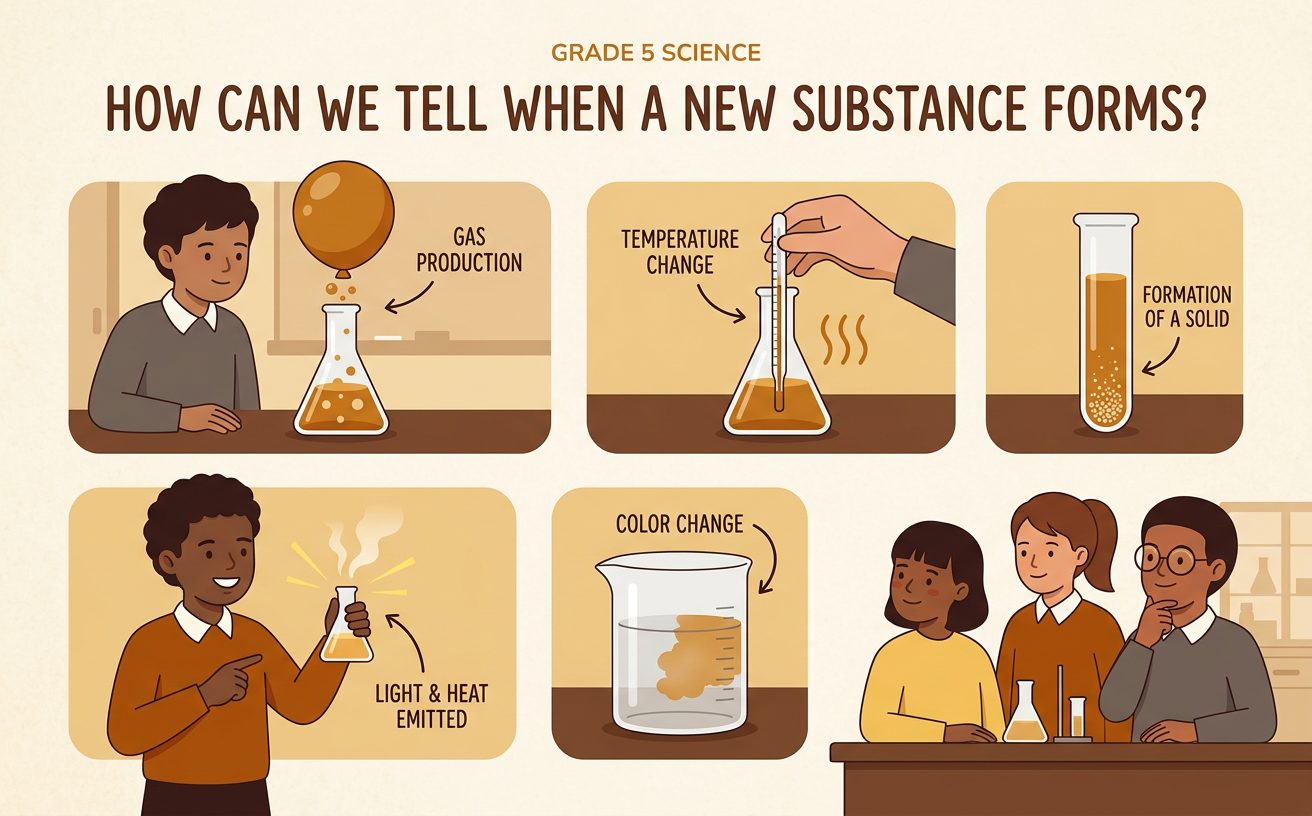
Students examine observations from mixing substances and use evidence such as gas production, temperature change, or formation of a solid to determine whether a new substance formed.
Illustrations are auto-generated and may be placeholders. They can be refreshed to match the narration.
Changes from Mixing Materials
When materials are mixed, they may change without forming a new substance. For example, sugar seems to disappear when stirred into water, but the sugar is still present. The water can evaporate, leaving the sugar behind. This is a physical change. In other mixtures, the original substances react and their particles rearrange to form one or more new substances. For example, mixing baking soda and vinegar produces carbon dioxide gas along with other substances. The new materials have properties that are different from those of the starting materials. Scientists carefully observe a mixture before, during, and after mixing. They compare its properties and look for several pieces of evidence before deciding whether a new substance formed.

Signs of a New Substance
Certain observations can be evidence that a new substance has formed. Gas production may be shown by unexpected bubbles or an inflating balloon. A temperature increase or decrease without outside heating or cooling can also be evidence. Another sign is the formation of a new solid when two liquids are mixed. This solid is called a precipitate. An unexpected color change or a new odor may provide additional evidence, although color or odor alone may have another cause. For example, when two clear liquids are combined and a cloudy solid appears, the solid may be a new substance. Scientists use more than one observation when possible because a single change, such as bubbling caused by boiling, does not always mean a new substance formed.

Observe a Mixing Demonstration
Consider a demonstration using vinegar, baking soda, a clear bottle, and a balloon. First, the teacher pours vinegar into the bottle and places baking soda inside the balloon. The balloon is attached to the bottle without dropping in the powder. Students record the starting temperature and describe both substances. When the balloon is lifted, the baking soda falls into the vinegar. The mixture fizzes, and the balloon expands as gas collects inside it. The container may also feel cooler, which can be checked with a thermometer. These observations provide evidence that a reaction occurred. The collected gas is carbon dioxide, a substance that was not present as a gas before mixing. Students should wear safety goggles, keep the bottle pointed away from faces, and never taste investigation materials.

Record and Compare Evidence
A clear data table helps scientists compare the substances before and after mixing. Record observations such as state of matter, color, temperature, bubbles, and solid formation. Measurements are stronger evidence than descriptions alone. For example, a group might record that vinegar and baking soda began at 72 degrees Fahrenheit. After mixing, the temperature dropped to 66 degrees Fahrenheit, bubbles formed for 40 seconds, and the balloon expanded. The group can compare these results with a cup of vinegar that was not mixed with baking soda. If the unmixed vinegar does not bubble or cool, the comparison supports the idea that mixing caused the changes. Notes, thermometer readings, timed observations, and classmates’ results are multiple sources of evidence that can be checked for agreement.

Make a Claim from Evidence
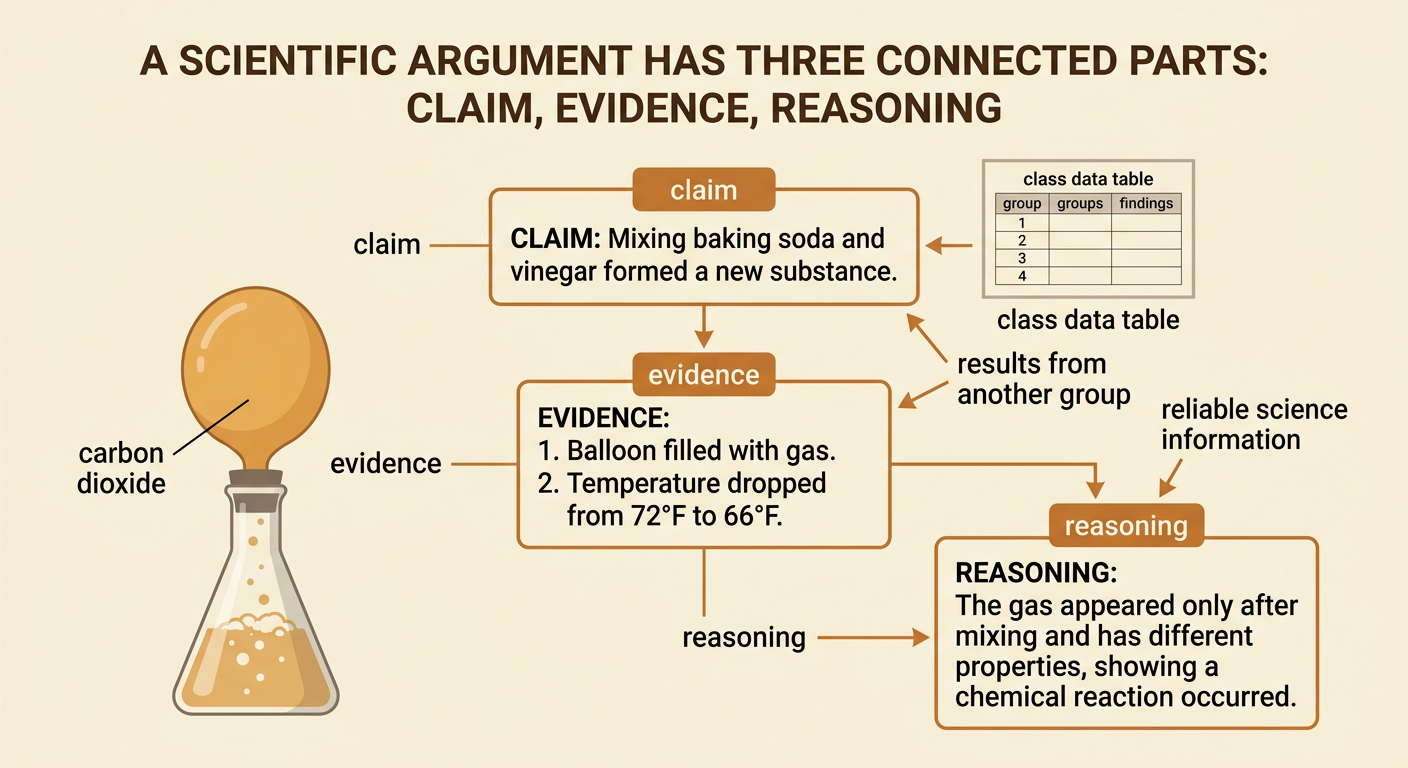
A scientific argument includes a claim, evidence, and reasoning. The claim answers the investigation question. Evidence includes specific observations and measurements, not guesses. Reasoning explains how the evidence supports the claim. For example, a student might claim that mixing baking soda and vinegar formed at least one new substance. The student could cite the gas that inflated the balloon and the temperature drop from 72 to 66 degrees Fahrenheit. The reasoning would explain that the gas was produced only after mixing and had properties different from the starting solids and liquids. A strong argument may also use the class data table, another group’s results, and reliable science information about carbon dioxide. Students should consider other explanations, check whether results were repeated, and arrange their reasons in a logical order before writing a conclusion.