How Can We Tell When a New Substance Forms?
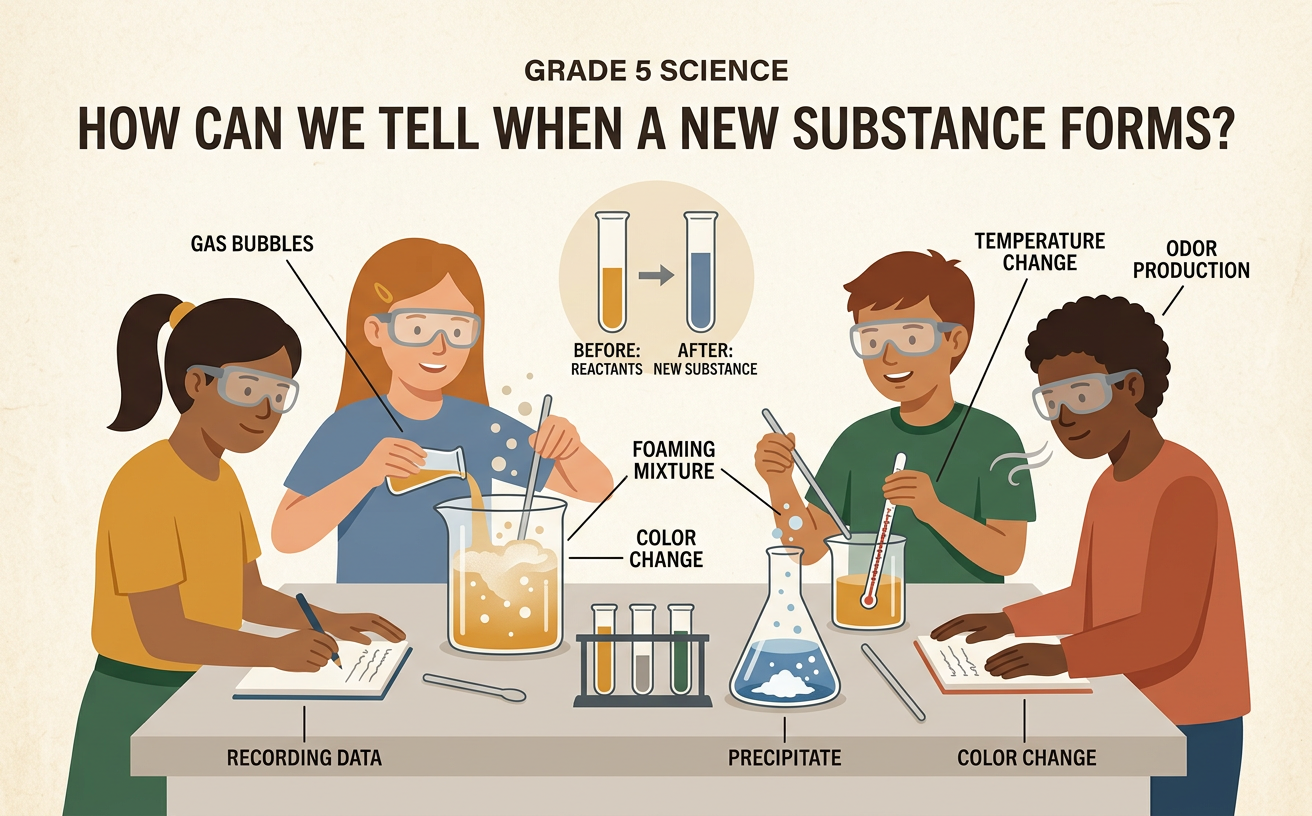
Students mix safe materials, record changes in properties such as temperature, odor, and gas production, and use the evidence to determine whether a new substance formed.
Illustrations are auto-generated and may be placeholders. They can be refreshed to match the narration.
Properties Before Mixing
Before mixing materials, observe and record each substance’s properties. A property is something that can be measured or described, such as color, state of matter, texture, odor, or temperature. Use only teacher-approved ways to observe. Never taste a substance, and do not touch or smell it unless your teacher says it is safe. For example, baking soda is a white, powdery solid. Vinegar is a clear liquid with a noticeable odor. A thermometer might show that both materials begin at 22.5 degrees Celsius. Record these facts in a data table before doing anything else. These starting observations give you a basis for comparison. After mixing, you can look for properties that are different from those of the original materials. Careful notes, measurements, and trusted reference information provide several sources of evidence for the investigation.
Safe Mixing Procedure
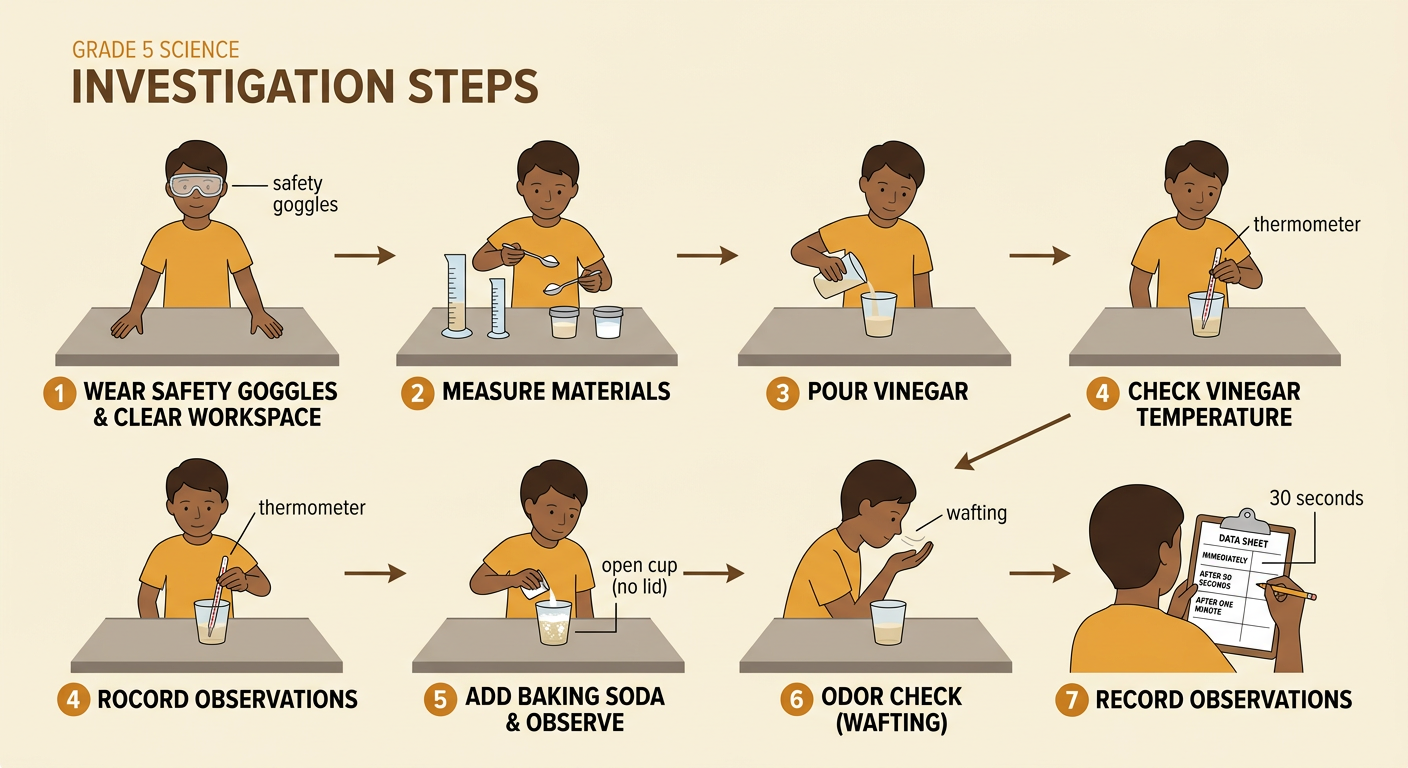
A fair and safe investigation follows the same planned steps each time. Put on safety goggles, clear the workspace, and use only the amounts your teacher provides. Place a measured amount of vinegar in an open cup. Record its temperature without letting the thermometer touch the bottom. Add the measured baking soda, then step back slightly and observe. Keep the cup open because gas may form and needs room to escape. Never seal a reacting mixture, taste the materials, or place your face over the cup. If your teacher allows an odor check, gently waft air toward your nose instead of sniffing directly. Record observations at regular times, such as immediately, after 30 seconds, and after one minute. Using equal amounts and the same timing in each trial makes the results easier to compare.
Signs of a Possible New Substance
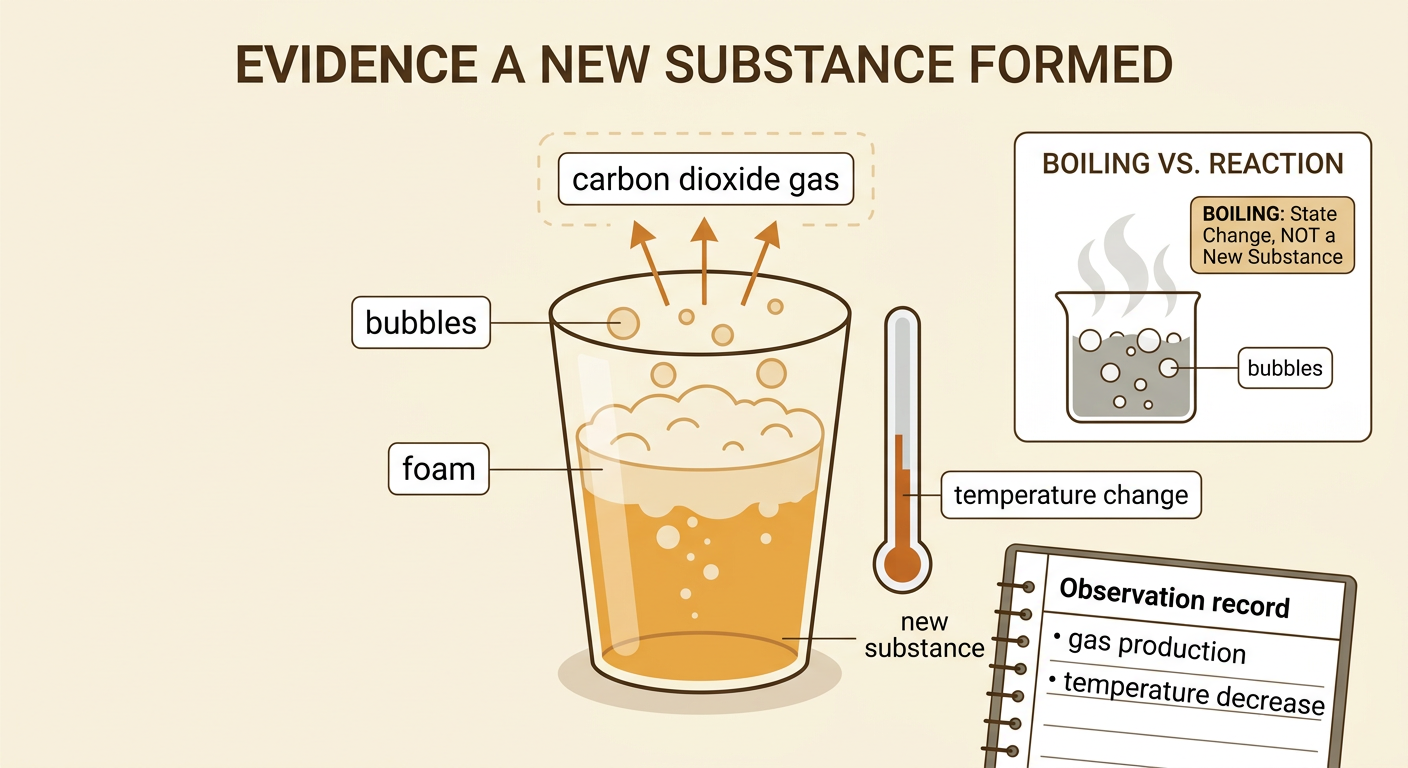
When substances are mixed, certain changes can be evidence that a new substance formed. Possible signs include gas production, an unexpected temperature change, a new odor, a lasting color change, or the formation of a solid from liquids. In the baking soda and vinegar example, many bubbles and foam appear. The bubbles contain carbon dioxide gas, a substance that was not present as free gas before mixing. The mixture may also become cooler. These observations support the claim that new substances formed. However, one sign alone is not always enough. Bubbles can also appear when water boils, and a solid can disappear simply by dissolving. Scientists combine several observations with information from reliable sources. They ask whether the final materials have properties that differ from the starting materials and whether the evidence can be repeated in another trial.
Measuring Temperature Change
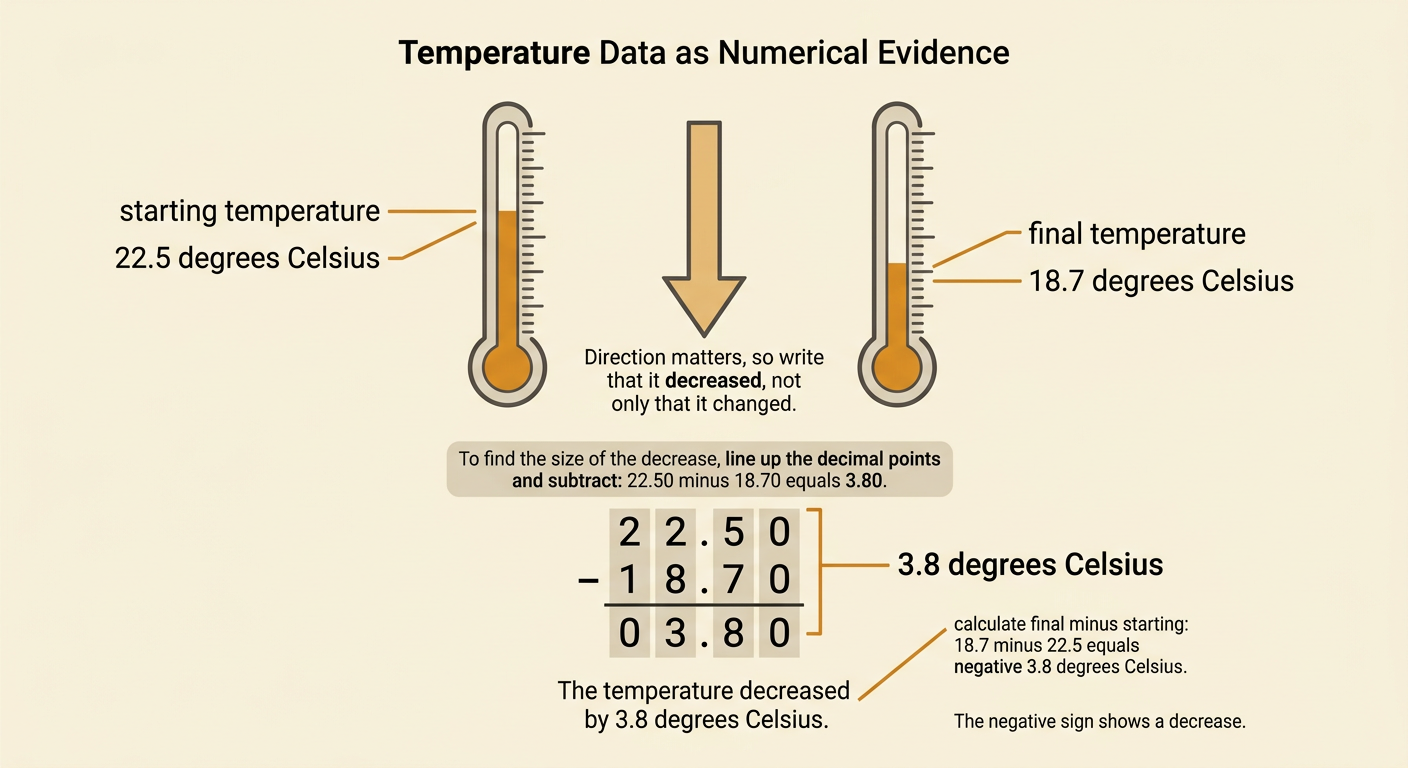
Temperature data provide numerical evidence about what happens during mixing. Measure the temperature just before mixing and again at a chosen time after mixing. Use the same thermometer and read it at eye level. Suppose the starting temperature is 22.5 degrees Celsius and the temperature after mixing is 18.7 degrees Celsius. Subtract the decimals by lining up the decimal points: 22.50 minus 18.70 equals 3.80. The mixture decreased in temperature by 3.8 degrees Celsius. Write both the size and direction of the change. A negative temperature change can also be shown as 18.7 minus 22.5 equals negative 3.8 degrees Celsius. Repeat the trial to see whether a similar change occurs. Temperature change is useful evidence, but it should be considered with observations such as gas production and information from a science text or teacher-provided source.
Evidence-Based Conclusion
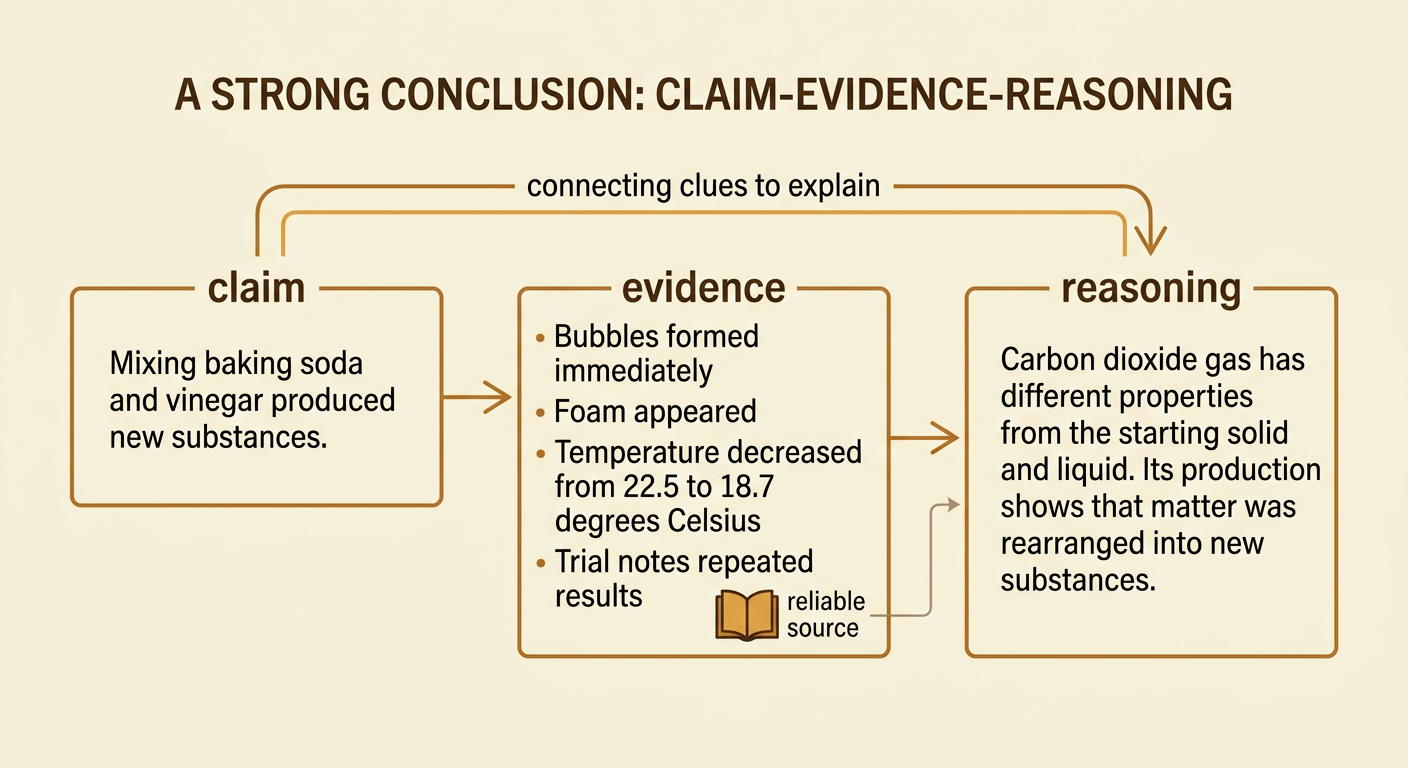
A strong conclusion answers the investigation question and supports the answer with evidence. Begin with a claim, such as, “Mixing baking soda and vinegar produced new substances.” Then cite specific observations and measurements. For example, gas bubbles formed immediately, foam appeared, and the temperature decreased from 22.5 to 18.7 degrees Celsius. Add information from a reliable source stating that this mixture produces carbon dioxide gas, water, and sodium acetate. Finally, explain the reasoning: carbon dioxide has different properties from the starting solid and liquid, so its production shows that matter was rearranged into new substances. Compare your own data, repeated trial results, classmates’ findings, and a trusted science source. If the evidence is inconsistent, say what remains uncertain and suggest another trial. A conclusion is strongest when each claim is connected to relevant, repeatable evidence from multiple sources.