
How Cells Release Energy from Food
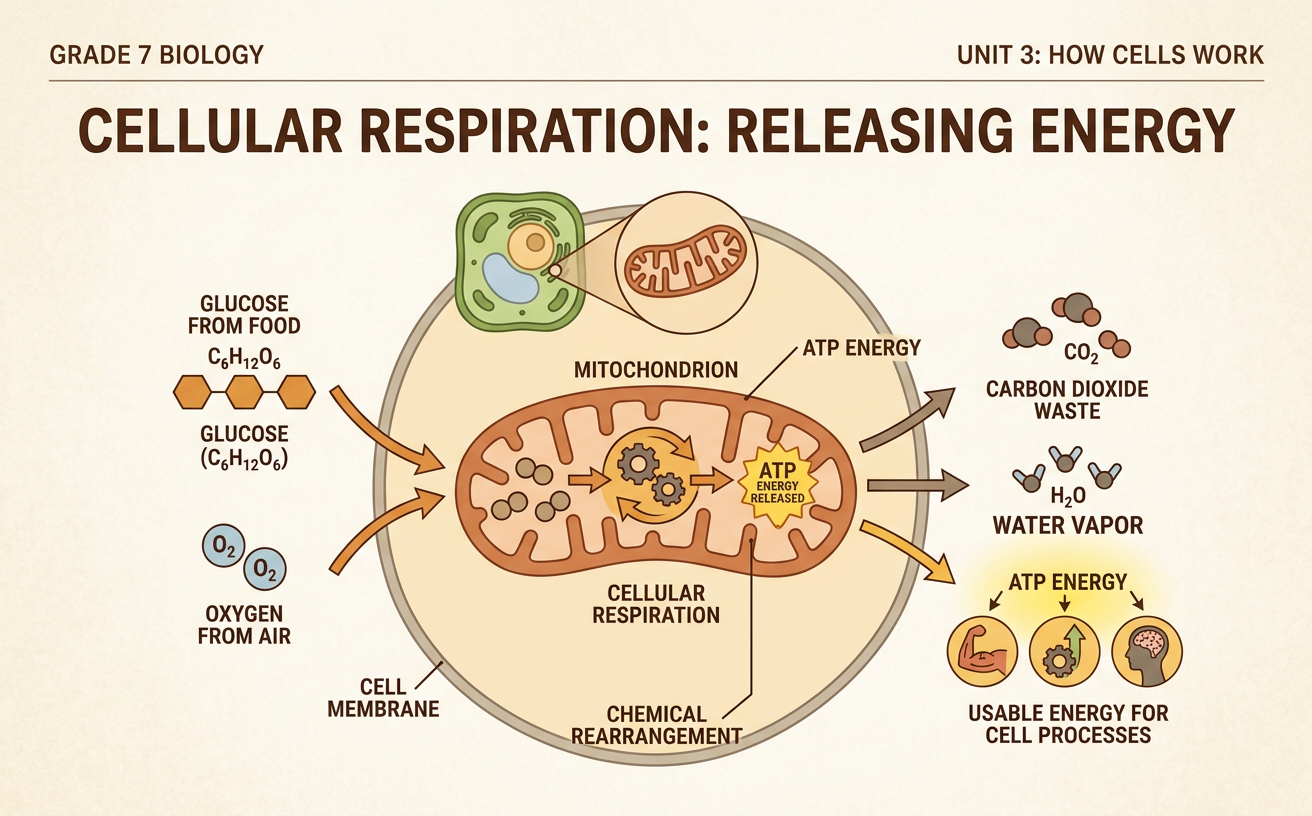
Students develop and interpret a model showing how cells rearrange glucose and oxygen during cellular respiration to release usable energy and produce carbon dioxide and water.
Illustrations are auto-generated and may be placeholders. They can be refreshed to match the narration.
Why Cells Need Energy
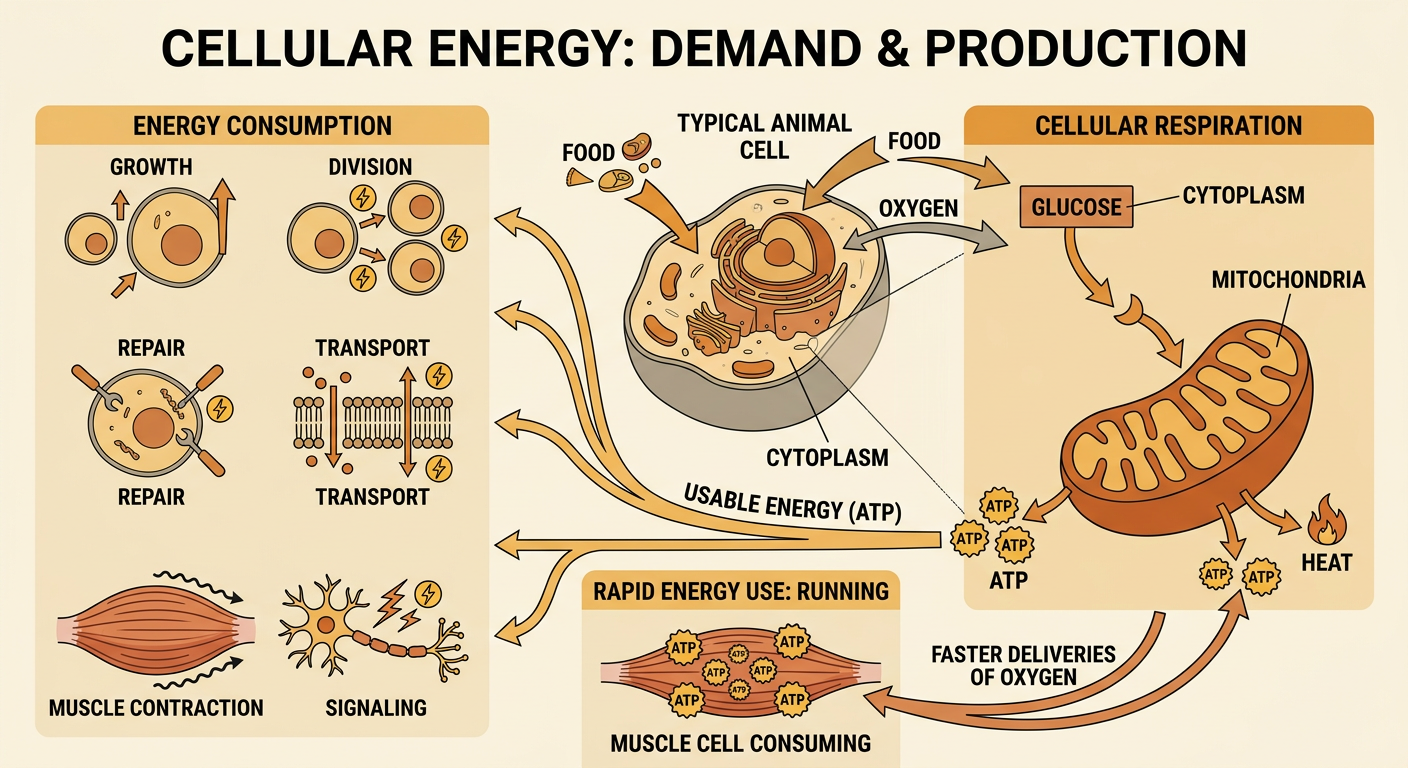
Every cell needs a steady supply of usable energy to carry out life processes. Cells use energy to build and repair structures, move materials across cell membranes, grow, and divide. Muscle cells also need energy to contract, while nerve cells use energy to send signals. Most cells release usable energy from food through cellular respiration. This series of chemical reactions begins in the cytoplasm and continues mainly in the mitochondria. During respiration, energy stored in glucose is transferred to ATP, a molecule that cells can use directly. Some energy is also released as heat. For example, when you run across a playground, your muscle cells use ATP to contract rapidly. Your breathing and heart rate increase because the cells need more oxygen and glucose for cellular respiration.
Reactants: Glucose and Oxygen
The starting substances in a chemical reaction are called reactants. The main reactants of cellular respiration are glucose and oxygen. Glucose is a sugar with the formula C6H12O6. Digestive processes break carbohydrates in food into smaller molecules, including glucose, which the blood carries to cells. Oxygen enters the lungs when you inhale and then moves through the blood to cells. One glucose molecule reacts with six oxygen molecules during the overall process of cellular respiration. This relationship can be written as C6H12O6 + 6 O2. For example, after eating a banana, glucose from the digested food can enter muscle cells. Oxygen from the air you breathe enters those cells too. The atoms in both reactants will be rearranged, not destroyed, as the reactions proceed.
Products: Carbon Dioxide, Water, and Usable Energy
The new substances formed by a chemical reaction are called products. In cellular respiration, the products are carbon dioxide and water. The overall reaction also transfers energy from glucose into ATP, a form of usable chemical energy for cells. The balanced relationship is C6H12O6 + 6 O2 → 6 CO2 + 6 H2O + usable energy. Carbon dioxide moves from cells into the blood, travels to the lungs, and leaves the body when you exhale. Cells can use some of the water, while other water leaves the body in urine, sweat, and exhaled air. Some of the transferred energy becomes heat instead of ATP. For example, active muscle cells produce more carbon dioxide and heat as their rate of cellular respiration rises during exercise.
Modeling Matter Rearrangement
A useful model of cellular respiration must show that atoms are rearranged and conserved. Conserved means that the same number of each kind of atom is present before and after the reaction. In the balanced equation, the reactants contain 6 carbon atoms, 12 hydrogen atoms, and 18 oxygen atoms. The products contain those same totals. Carbon atoms from glucose become part of carbon dioxide. Hydrogen atoms from glucose become part of water. Oxygen atoms from both glucose and oxygen appear in the products. Bonds between atoms change during the reaction, forming new molecules. The overall rearrangement releases energy that cells can capture in ATP, but energy is not an atom or a form of matter. For example, students can use colored counters to build the reactants, then rearrange the same counters into six carbon dioxide and six water molecules.
Reading a Cellular Respiration Diagram
To read a cellular respiration diagram, begin with the title, labels, and arrow direction. Arrows pointing into a cell or mitochondrion identify inputs, while arrows pointing away identify outputs. Next, connect the pictures to the written equation. A coefficient, such as the 6 before O2, tells how many molecules are involved. A subscript, such as the 2 in O2, tells how many atoms of that element are in one molecule. Color keys can help track carbon, hydrogen, and oxygen atoms, but the written labels provide the exact identities. Energy arrows should be interpreted differently from matter arrows because energy is transferred rather than rearranged into atoms. For example, if a diagram shows six O2 molecules entering and six CO2 molecules leaving, students can compare those images with the coefficients in the balanced equation.
Food Energy and Human Well-Being
People need reliable access to nutritious food because cells require molecules from food to grow, repair tissues, and release usable energy. Economic decisions can affect whether individuals and communities can obtain that food. Household income, food prices, transportation, store locations, farming policies, and school meal funding all influence access. A lack of food does not immediately stop every cell, because the body can store some fuels, but long-term shortages can reduce growth, health, concentration, and physical activity. Food quality matters too; cells need more than calories because the body also requires protein, vitamins, minerals, fats, and water. For example, a community that funds a school breakfast program may help students receive regular nutrients and food energy. This can support student well-being and readiness to learn while also reducing some effects of unequal food access.