
How Communities Use and Change Their Environment
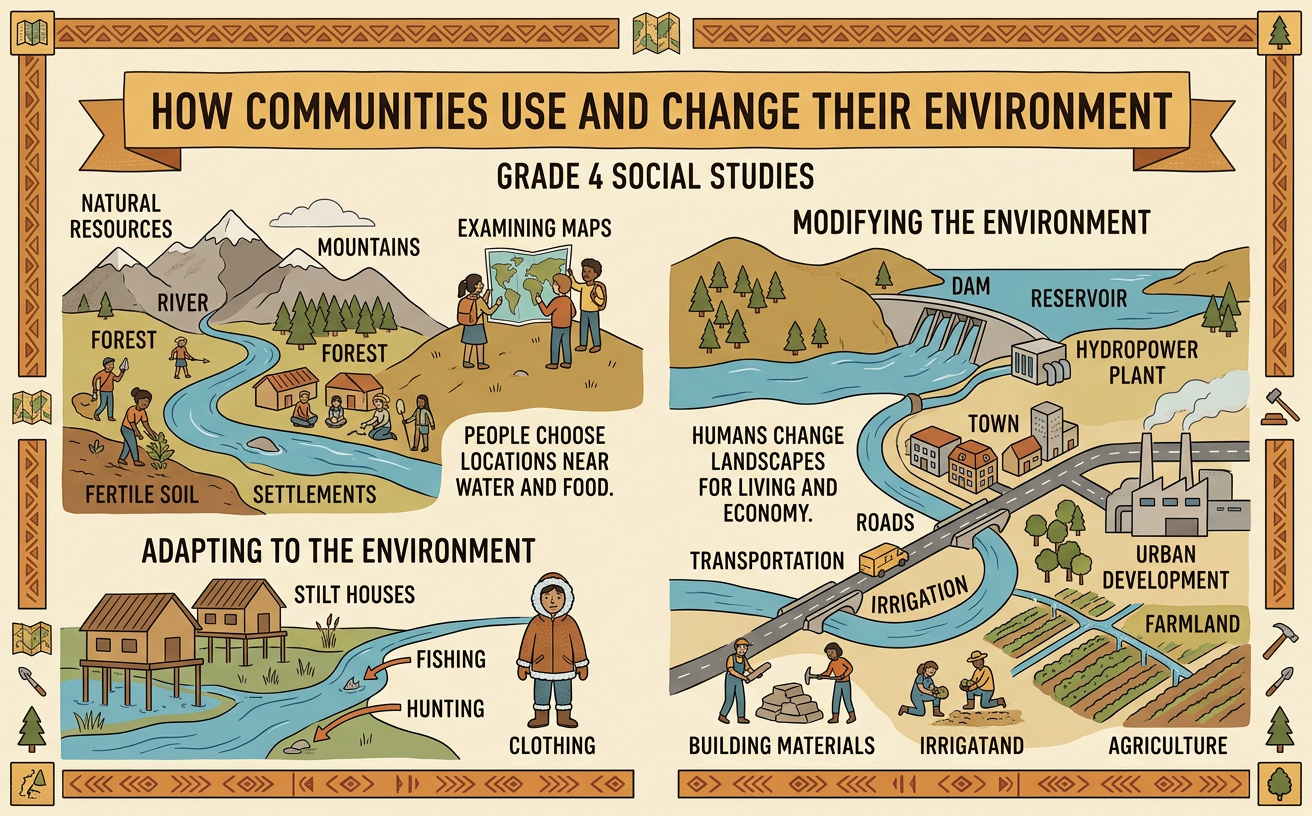
Students examine maps and short texts to explain how natural resources influence where communities develop and how people adapt to or modify their environment.
Illustrations are auto-generated and may be placeholders. They can be refreshed to match the narration.
Natural Resources and Community Locations
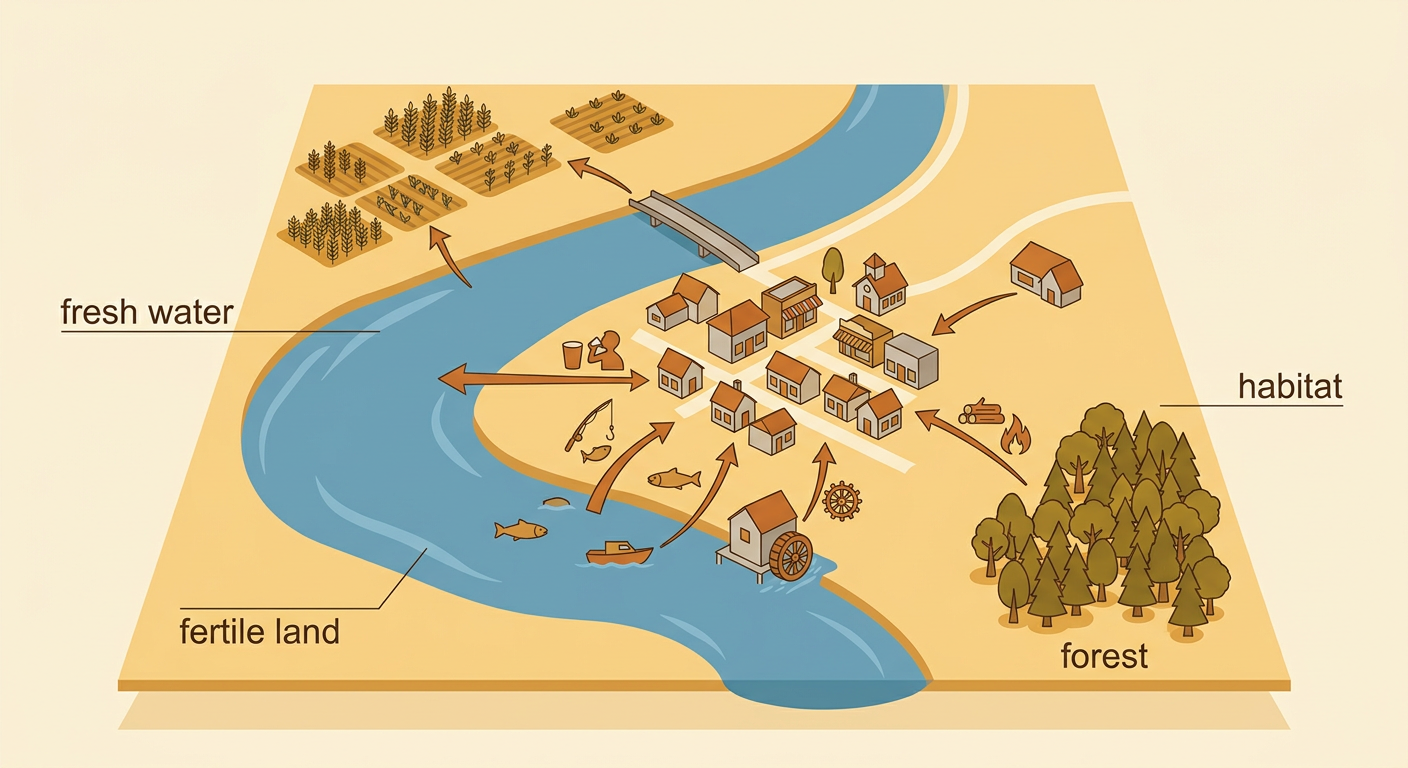
Natural resources are useful materials and features found in nature, such as fresh water, soil, forests, minerals, sunlight, and wind. Communities often develop near resources that support daily life and work. For example, a town might grow beside a river because the river provides drinking water, transportation, fish, and energy. Flat, fertile land nearby can support farms. A forest can supply wood for homes and businesses. However, using resources can affect the environment. Cutting too many trees may destroy wildlife habitats, and burning fuels such as coal or oil can pollute the air. A community’s culture also influences which resources people value and how they use them. By studying a community’s location, resources, and traditions, geographers can explain why people settled there and how the community grew.
Reading Physical and Human Maps
Different maps provide different kinds of evidence. A physical map shows natural features, such as rivers, mountains, plains, and lakes. A human map shows features people have built, such as roads, towns, bridges, farms, and dams. Reading both maps helps explain how people use the land. Suppose a physical map shows a river valley between steep mountains, while a human map shows a town and highway in that valley. The maps suggest that people chose the flatter valley for travel and building. A map scale can be used to find real distance. If one inch represents 5 miles and two towns are 3 inches apart, multiply 3 by 5. The towns are 15 miles apart. Map symbols, legends, directions, and scales turn visual information into useful geographic evidence.

Ways People Adapt to Environments
To adapt means to adjust how people live without greatly changing the environment itself. Climate, landforms, available resources, and culture all influence adaptation. In a hot, dry region, people may wear lightweight clothing, build homes with shaded windows, and complete outdoor work during cooler hours. They may also choose plants that need little water. In a snowy mountain community, people may build steep roofs so snow slides off and use vehicles designed for icy roads. Knowledge and traditions can guide these choices. For example, people who have lived in a desert region for generations may know how to locate water, create shade, and conserve food. Adaptations help communities meet their needs while responding to local conditions. They can also reduce energy use, such as when shade and natural airflow keep buildings cooler.

Ways People Modify Environments
To modify the environment means to change it. Communities build roads, dig irrigation channels, clear land, construct dams, and install energy systems. These changes can solve problems, but they may also create new ones. For example, a community might build a dam across a river. The dam can store water, control some floods, and produce electricity from moving water. It may also block fish migration, flood habitats, and change the amount of water downstream. Solar panels and wind turbines use renewable resources, while gasoline and coal come from nonrenewable resources that can run out. Burning fossil fuels can release air pollution and greenhouse gases. Before making a change, community leaders should compare benefits, costs, cultural priorities, and environmental effects. Careful planning can help people meet their needs while protecting water, land, air, and living things.

Community Impact Evidence Challenge
Use map, text, and number evidence to evaluate a community decision. Imagine that Cedar Valley plans to build a wind energy site on a ridge. A physical map shows strong winds and a bird migration route. A human map shows that the ridge is 4 inches from town. The scale says 1 inch equals 3 miles, so the distance is 4 times 3, or 12 miles. A short text explains that wind is a renewable resource that produces electricity without burning fuel. Another source warns that poorly placed turbines may harm migrating birds and affect a culturally important view. Make a claim about whether and where the site should be built. Support the claim with evidence from the maps, distance calculation, and texts. A strong explanation includes both benefits and possible harms and suggests a solution, such as placing turbines away from the migration route.
