
How Community Members Solve Problems
Students explore how leaders and other community members work together to identify problems, suggest solutions, and improve their community.

Illustrations are auto-generated and may be placeholders. They can be refreshed to match the narration.
What Is a Community Problem?
A community problem is something that affects people in a place where they live, work, learn, or play. It is something people want to change or improve. For example, imagine that litter is scattered across a neighborhood park. The litter makes the park look messy, can harm animals, and may stop families from enjoying the area. Community members first identify the problem. They observe what is happening and ask who or what is affected. They may say, “There is too much litter near the playground and pond.” This statement clearly describes the problem without choosing a solution yet. Other community problems might include an unsafe crosswalk, a damaged library book drop, or a lack of trees for shade. Defining a problem clearly helps people begin working together.

Roles of Leaders and Community Members
Both leaders and other community members help solve problems. A mayor, city council member, principal, or park manager may organize meetings, explain rules, or approve a plan. However, leaders do not do all the work. Children, families, teachers, business owners, and volunteers can notice problems, share ideas, gather information, and help carry out solutions. Suppose a busy street near a school is difficult to cross. Students can describe what they see. Families can ask for a safer crossing. A crossing guard can explain when traffic is busiest. A city engineer can study the street, and local leaders can decide whether to add signs or painted crosswalk lines. Each person brings useful knowledge or skills. When many people listen respectfully and work together, they can make a stronger plan for the whole community.

Read About a Community Solution
Read this example. Maple Street Park had a litter problem. Trash often collected near the picnic tables because the closest trash can was far away. A student named Ava told the park manager what she had noticed. The manager asked families when and where they saw the most litter. Volunteers counted pieces of trash in different parts of the park. Their information showed that the picnic area had the most litter. Community members suggested a cleanup day, more trash cans, and reminder signs. The park manager placed covered trash and recycling cans near the tables. Families held a cleanup day, and students made signs that said, “Keep Our Park Clean.” One month later, volunteers counted much less litter. The solution worked because people used facts, shared jobs, and checked whether the park improved.

Ask Questions and Gather Facts
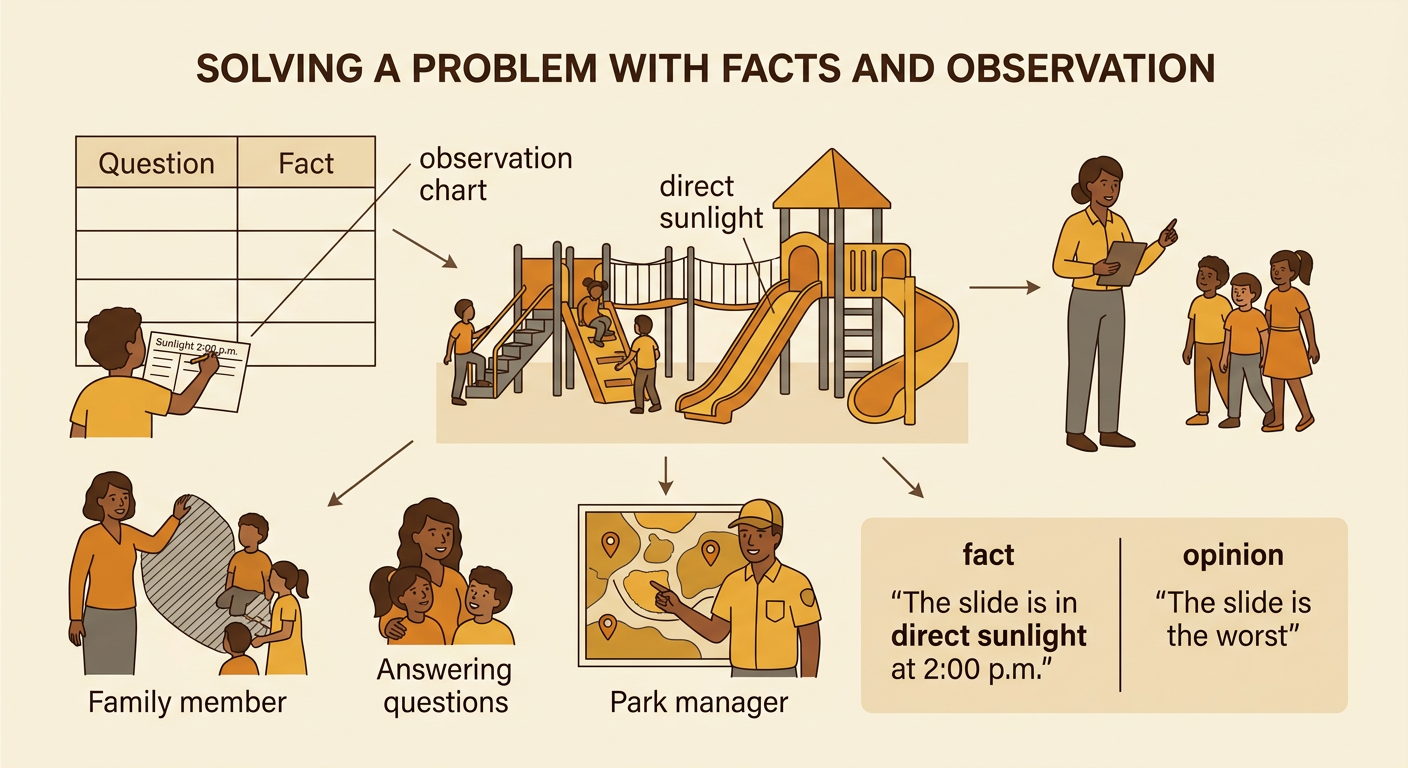
Good solutions begin with questions and facts. Community members can ask, “What is happening?” “Where does it happen?” “When does it happen?” and “Who is affected?” They can gather information by observing, counting, reading notices, looking at maps, or speaking with people who know about the problem. Imagine that a playground has no shade in the afternoon. Students could record which areas are sunny at different times. Teachers could count how many children avoid the hot equipment. Families could share concerns, and the park manager could explain where trees or shade structures may safely be placed. People should separate facts from opinions. “The slide is in direct sunlight at 2:00 p.m.” is a fact that can be checked. “The slide is the worst” is an opinion. Clear facts help everyone understand the problem and compare possible solutions.
Choose and Explain a Solution
After gathering facts, community members compare possible solutions. They ask whether each idea is safe, fair, useful, affordable, and possible. For the hot playground, ideas might include planting trees, adding a shade sail, or changing outdoor playtime. Trees provide natural shade but take years to grow. A shade sail works sooner but costs money and must be installed safely. Changing playtime costs little, but families may still use the sunny playground later. The group might choose a shade sail for quick help and plant trees for future shade. Students should explain the choice with evidence: “We recommend a shade sail because our observations show that the busiest equipment is in direct afternoon sun.” Leaders may approve the work, while families, students, workers, and volunteers help complete it. Afterward, the community checks whether the solution improved the problem.
