
How Dissolving Works: A Particle Model
Students model how a solid can dissolve in water while its particles remain present and consider why communities monitor dissolved substances in drinking water.
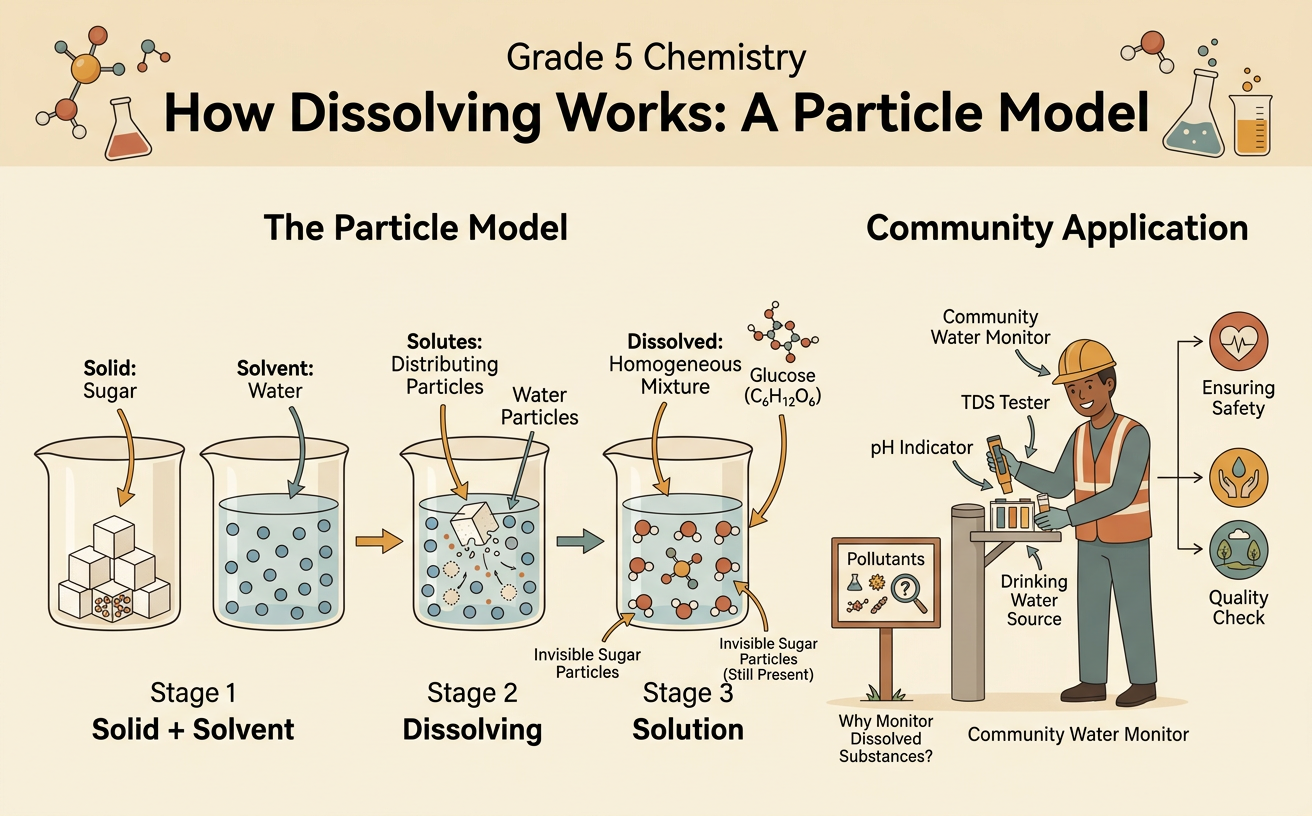
Illustrations are auto-generated and may be placeholders. They can be refreshed to match the narration.
Observe a Solid Dissolving
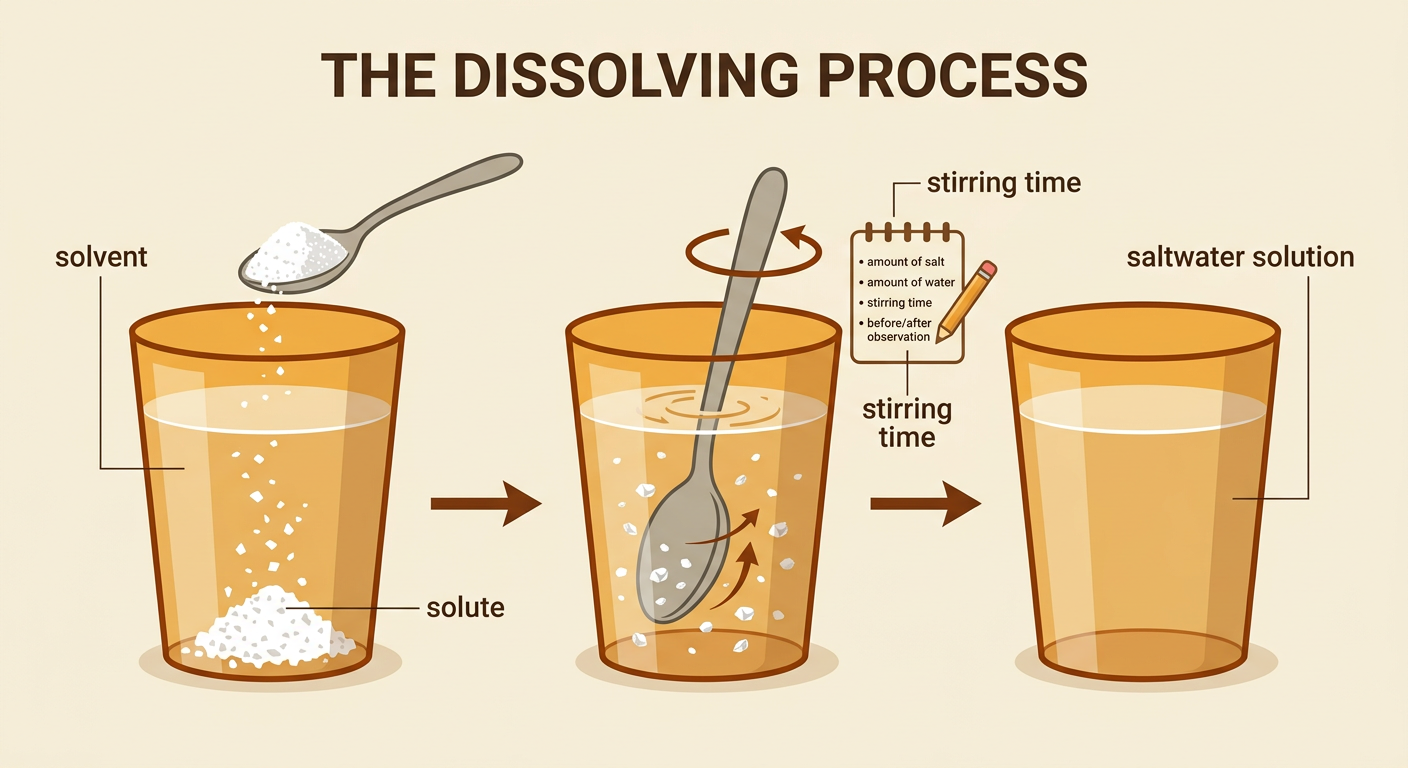
Place a spoonful of table salt in a clear cup of water and stir. At first, you can see white salt crystals fall, collect near the bottom, and move through the water. As you continue stirring, the crystals become smaller and finally seem to disappear. The water remains clear, but it may taste salty. This change is called dissolving. The salt is the solute, the substance being dissolved. Water is the solvent, the substance that does the dissolving. The result is a saltwater solution. Dissolving is not the same as melting because the salt does not become liquid salt. Instead, its particles spread throughout the water. Record the amount of salt and water used, the stirring time, and what you observe before and after stirring.
Where Did the Solid Go?
When salt dissolves, it does not vanish or stop being matter. Its particles are still in the cup, but they are too small to see with our eyes. Evidence can show that the salt remains. For example, compare the mass of a closed container holding water and salt before mixing with its mass after the salt dissolves. The mass should stay the same because no matter entered or left the closed container. You can also place a small sample of saltwater in a dish and allow the water to evaporate. Solid salt crystals will be left behind. The salt did not turn into nothing; it was separated into tiny particles and mixed throughout the water. This evidence supports the idea that matter is made of particles too small to be seen.
Build a Particle Model
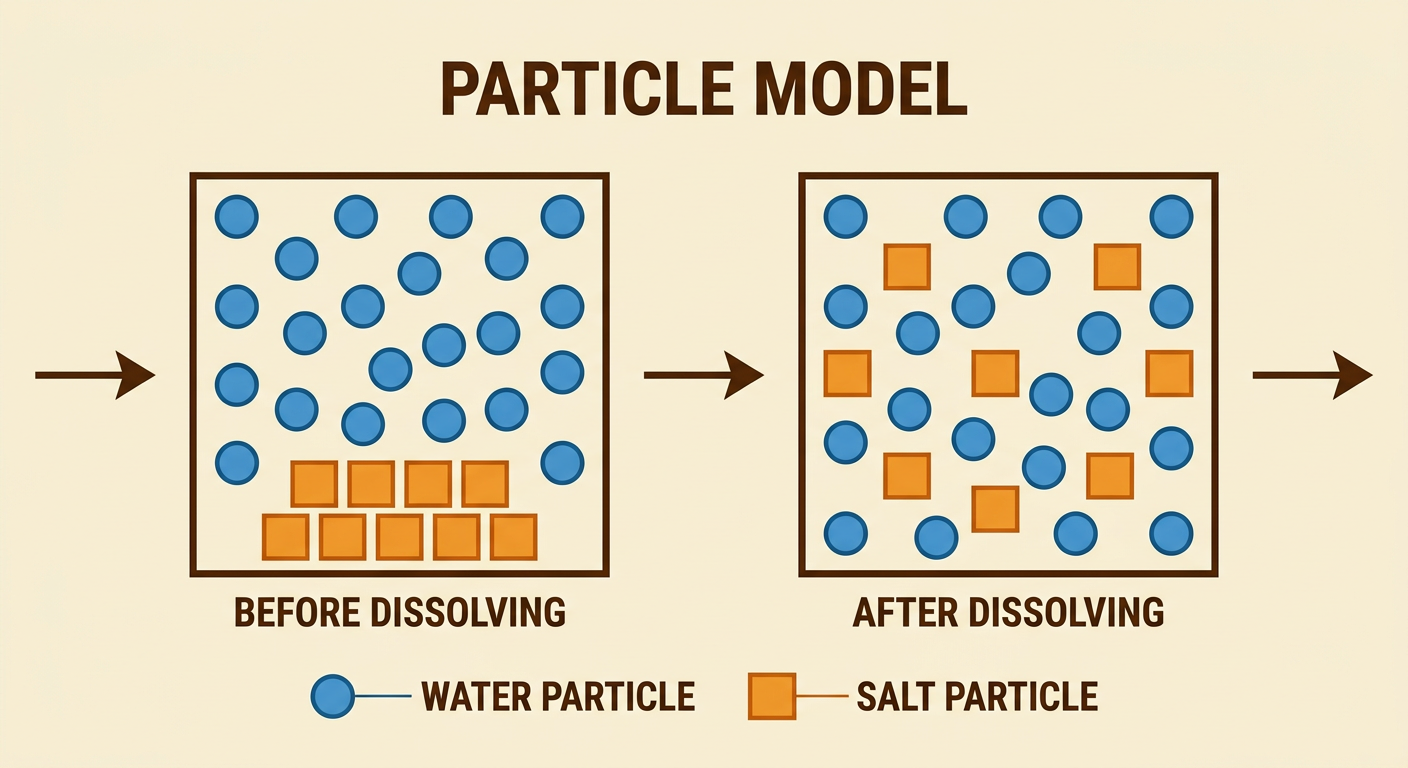
A particle model uses symbols to represent pieces of matter that are too small to see. Draw two boxes of equal size. In the first box, show 20 water particles spread through the box and 8 salt particles grouped in a crystal at the bottom. In the second box, keep the same 20 water particles and the same 8 salt particles, but spread the salt particles among the water particles. Use different colors or shapes for water and salt, and include a key. Counting the symbols makes this a mathematical model: 20 water particles plus 8 salt particles are shown both before and after dissolving. The model should not show salt particles disappearing, growing, or changing into water particles. It should show the same particles arranged differently after the solid dissolves.
Explain What the Model Shows
The particle model explains why salt seems to disappear while remaining in the water. Before dissolving, many salt particles are arranged together in a visible crystal. After dissolving, the salt particles separate and spread among the water particles. Each particle is far too small to see, so the mixed solution may look clear. The model also explains why a sip from one part of a well-mixed cup tastes much like a sip from another part: salt particles are distributed throughout the solution. However, a model is a useful representation, not an exact picture. Real particles are much smaller, more numerous, and constantly moving. The colors and shapes are chosen to make the particles easy to compare. Use the model as a visual display while explaining the evidence that the salt is still present.

Connect to Community Water Quality
Community drinking water can contain dissolved substances that people cannot see, smell, or taste. Some dissolved minerals, such as calcium, are usually not harmful at typical levels, while too much lead, nitrate, or another contaminant can create health risks. Because clear water is not always safe water, trained workers collect samples and test the amount of particular substances. Results may be reported in milligrams per liter, a unit that compares the mass of a substance with the volume of water. Local, state, and federal policies can set safety limits, require regular testing, and tell water systems to treat the water or warn residents when a limit is exceeded. Community members can examine water-quality reports and share concerns at public meetings. Monitoring and clear rules help communities make informed decisions about a shared public resource.
