
How Do We Know a Chemical Reaction Happened?
Students analyze observable changes and temperature data from substances before and after mixing to determine whether evidence supports the occurrence of a chemical reaction.
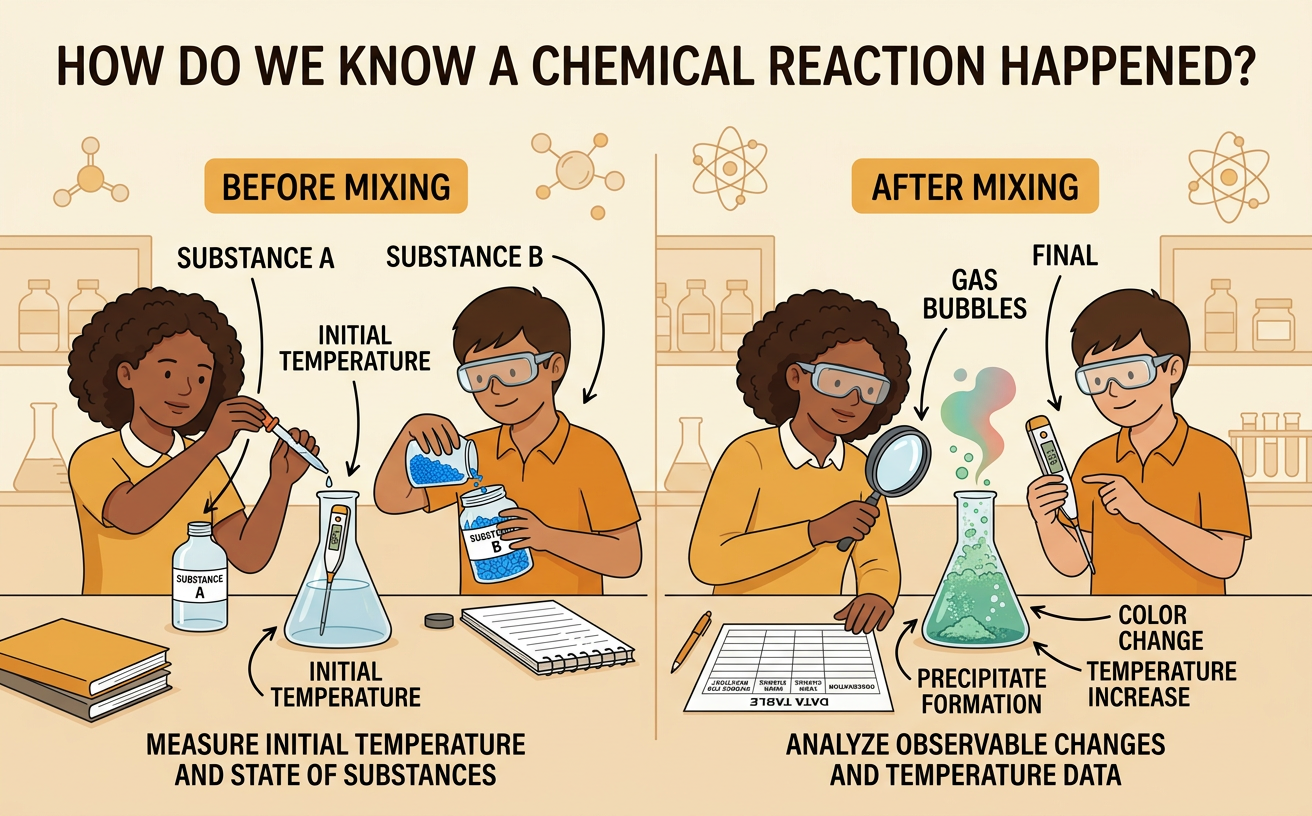
Illustrations are auto-generated and may be placeholders. They can be refreshed to match the narration.
Physical Change or Chemical Reaction?
A physical change changes a substance’s form, size, or state without producing a different substance. For example, when ice melts, solid water becomes liquid water, but it is still water. A chemical reaction occurs when atoms rearrange and new substances form. When baking soda and vinegar mix, bubbling occurs because carbon dioxide gas forms. Other possible signs include an unexpected temperature change, a lasting color change, light, a new odor, or a new solid called a precipitate. One sign alone may not be enough. Bubbles can also appear when water boils, which is a physical change. Scientists compare properties before and after substances interact and use several pieces of evidence to decide whether a chemical reaction probably occurred.

Observe Properties Before Mixing
Before mixing substances, record their starting properties so you have evidence for comparison. Useful properties include state of matter, color, texture, clarity, odor, mass, volume, and temperature. Observe safely: never taste a substance, and smell it only by wafting if your teacher says it is safe. Suppose a class will mix 50.0 milliliters of vinegar with 10.0 grams of baking soda. Students record that the vinegar is a clear, colorless liquid at 22.4°C and that the baking soda is a white, powdery solid. They also note the amounts used and the measuring tools. Specific measurements are stronger evidence than descriptions such as “a little warm” or “some powder.” Careful starting observations create a baseline that can be compared with what happens after mixing.

Record Changes After Mixing
After mixing, watch carefully and record what happens in order. Include measurements, times, and exact descriptions instead of writing only “it reacted.” In the vinegar and baking soda example, bubbles form immediately, foam rises, the white powder disappears, and the cup feels cooler. A thermometer shows that the mixture reaches 17.8°C after 30 seconds. Students should record both changes and nonchanges; for example, the mixture may remain colorless. They should also distinguish an observation from an explanation. “Bubbles rose for 45 seconds” is an observation. “A gas was produced” is an interpretation based on that observation. A table with before-and-after columns makes patterns easy to see. Repeating the test can show whether the same changes happen consistently and can reveal measurements that may be unusual or inaccurate.

Calculate the Temperature Change
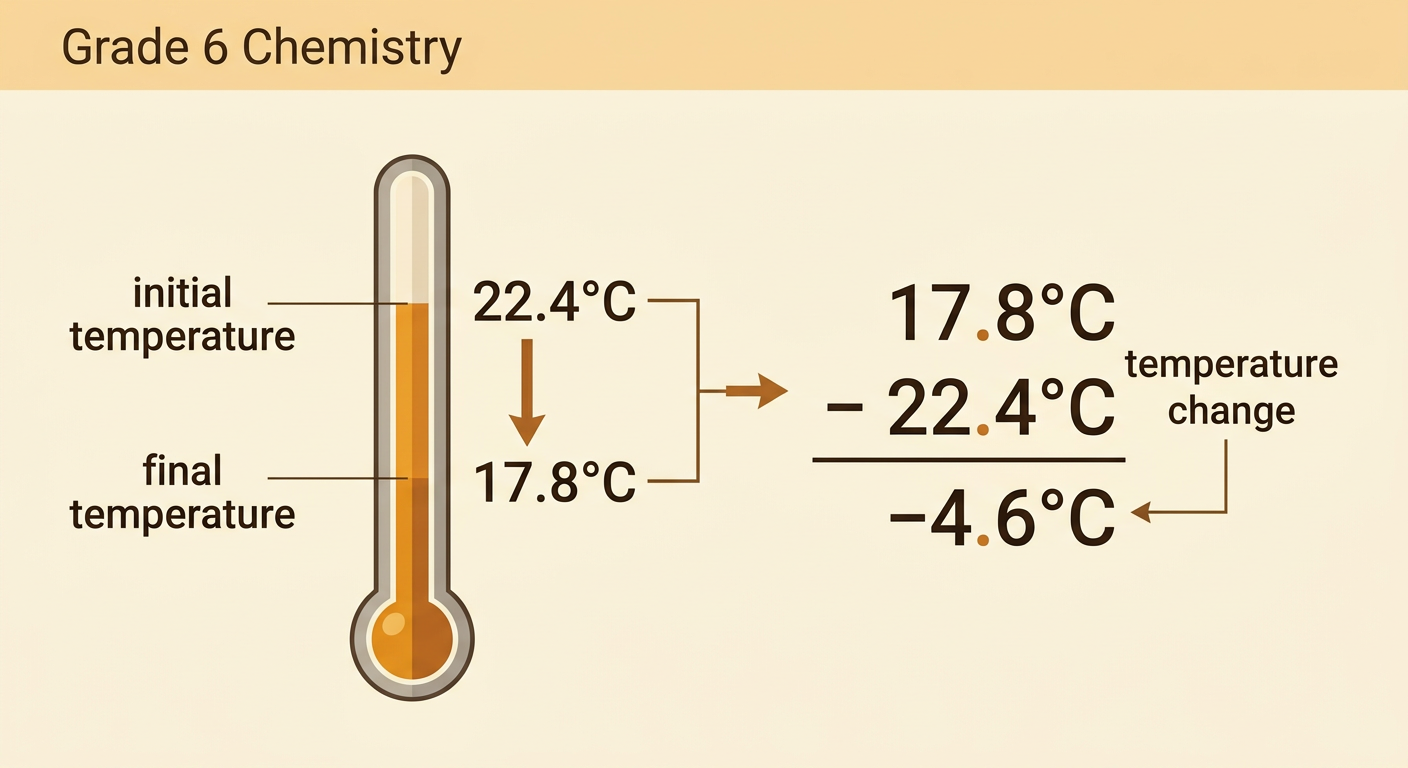
Temperature data can show that energy moved during an interaction. Calculate temperature change by subtracting the initial temperature from the final temperature: temperature change equals final temperature minus initial temperature. For the vinegar and baking soda mixture, the initial temperature was 22.4°C and the final temperature was 17.8°C. Align the decimal points and calculate 17.8 − 22.4 = −4.6°C. The negative sign means the measured mixture became cooler; its temperature decreased by 4.6°C. If the answer were positive, the temperature would have increased. Check that both measurements use the same unit and were taken in the same way. A temperature change can support a reaction claim, but it is not conclusive by itself because physical processes, such as dissolving or exchanging heat with the room, can also change temperature.
Identify Evidence of a Reaction
Evidence for a chemical reaction comes from changes that suggest new substances formed. Strong clues include gas production when no boiling is occurring, formation of a new solid from liquids, an unexpected energy change, or a lasting change in color or odor. In the vinegar and baking soda test, continuous bubbling at room temperature supports gas production, and the 4.6°C temperature decrease shows an energy change. A science reference can confirm that this interaction can produce carbon dioxide gas, water, and sodium acetate. However, each clue has limitations. Bubbles might come from trapped air, and cooling can happen during a physical process. The argument becomes stronger when several observations agree, measurements are repeated, and a comparison test shows that unmixed vinegar does not bubble or cool in the same way.

Make a Claim Using Evidence
A scientific argument includes a claim, evidence, and reasoning. The claim answers the question. Evidence gives specific observations and measurements. Reasoning explains why the evidence supports the claim using scientific ideas. A strong example is: “A chemical reaction occurred when vinegar and baking soda were mixed. Bubbles formed for 45 seconds, and the temperature changed from 22.4°C to 17.8°C, a decrease of 4.6°C. The bubbles support the formation of a gas, and the energy change supports the formation of new substances.” Use multiple sources, such as the class data table, repeated trials, and a reliable science text. Also acknowledge limitations: the thermometer may have measurement error, and bubbles alone could have another cause. The claim is strongest when repeated data and reference information support the same conclusion.
