
How Does the Periodic Table Reveal Patterns?
Students examine periods, groups, atomic numbers, and element properties to explain how the periodic table organizes elements and supports predictions.
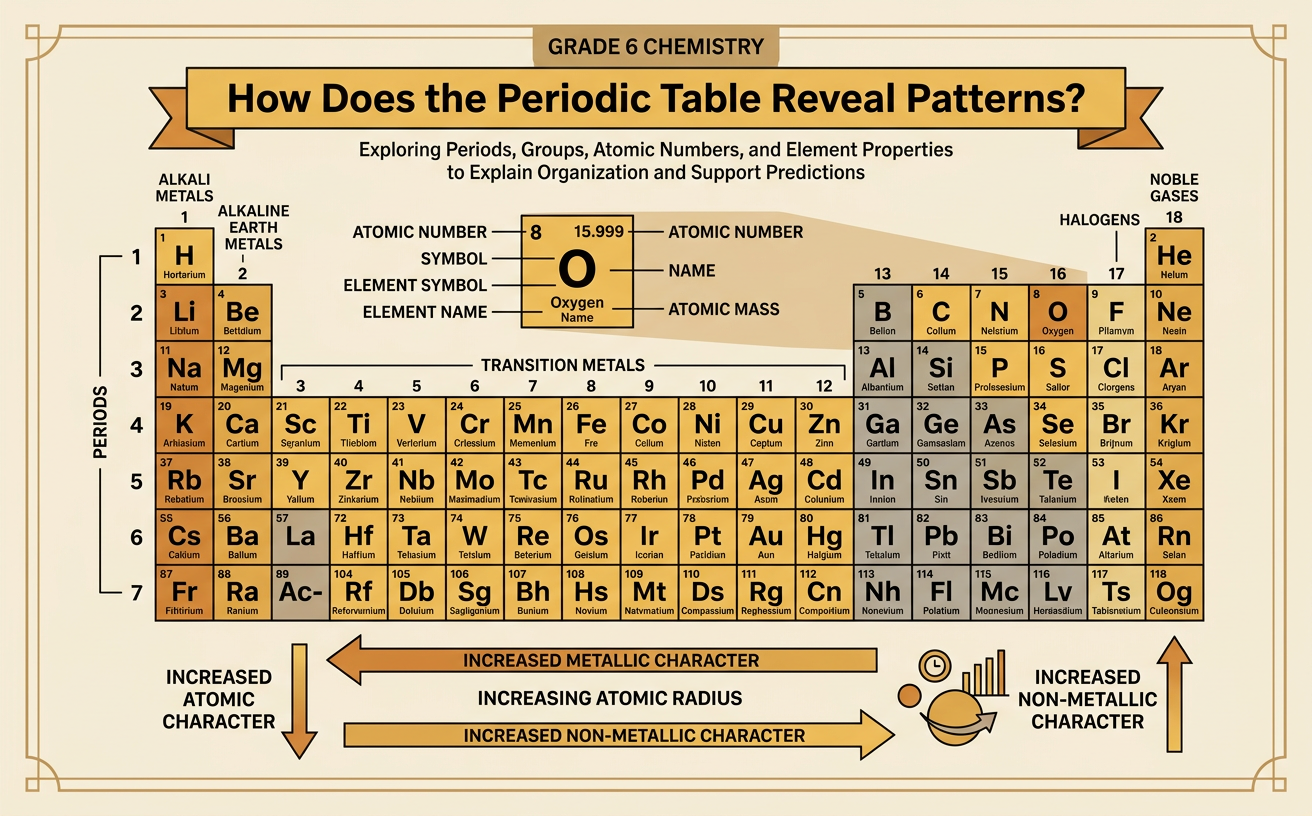
Illustrations are auto-generated and may be placeholders. They can be refreshed to match the narration.
Mendeleev's Organizing Challenge
In the 1860s, scientists knew about many elements, but they needed a useful way to organize them. Dmitri Mendeleev arranged element cards mainly by increasing atomic mass while keeping elements with similar properties in the same columns. He noticed repeating patterns. When no known element fit a position, he left a gap instead of forcing the pattern. For example, Mendeleev predicted the properties of an element he called “eka-silicon.” Germanium was later discovered and closely matched his prediction. Today, elements are ordered by atomic number rather than atomic mass. This is an important historical change. However, the practice of grouping elements by repeating properties has continued. The modern periodic table therefore shows both change and continuity in how scientists organize evidence.

Reading an Element Square
Each square on the periodic table summarizes information about one element. The atomic number is the number of protons in every atom of that element. It identifies the element and determines its position in the table. The chemical symbol is a short form of the name, usually one or two letters. The first letter is always capitalized, and the second letter is lowercase. The atomic mass shown is the average mass of that element’s naturally occurring atoms. For example, carbon has atomic number 6, so every carbon atom has 6 protons. A neutral carbon atom also has 6 electrons. Its symbol is C, and its average atomic mass is about 12.01. Reading these features helps students connect written data to a simple atomic model.

Periods and Groups
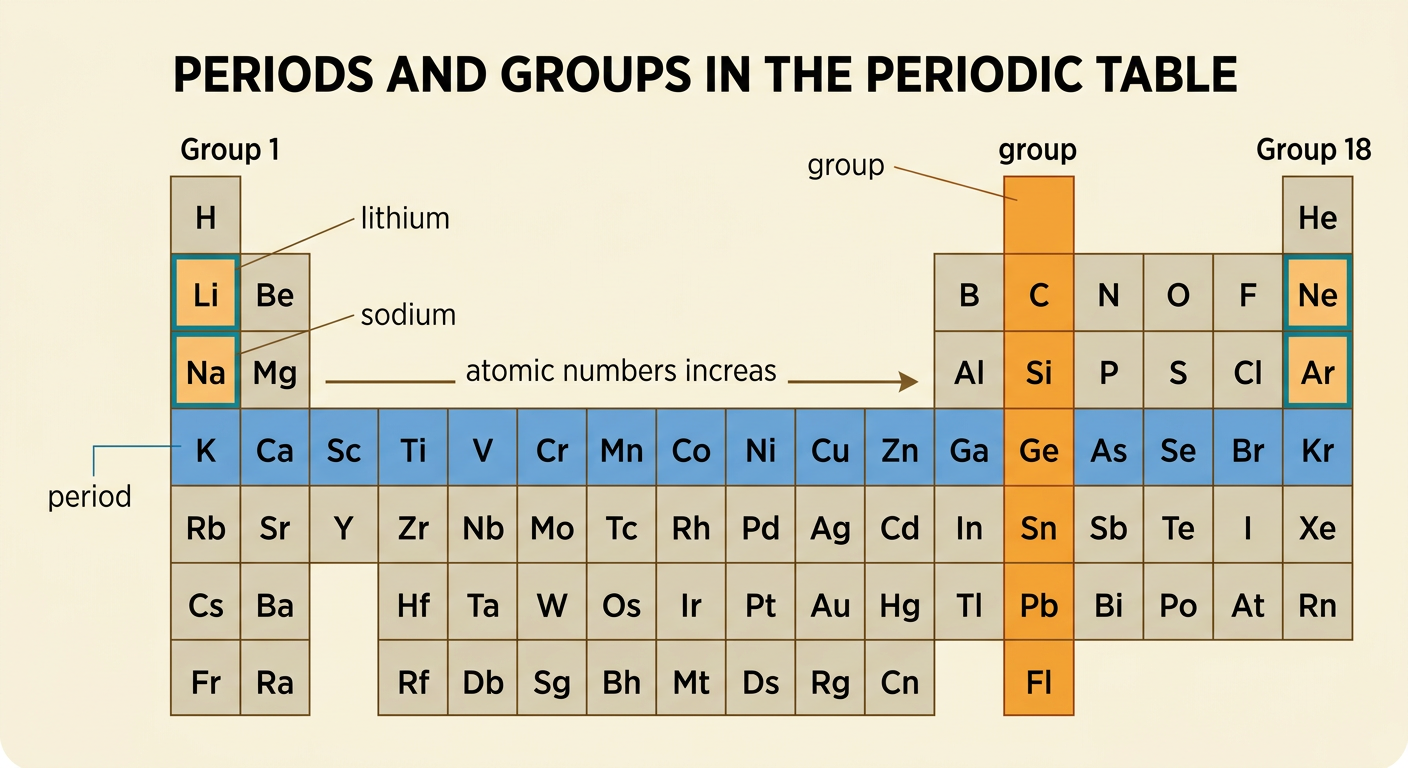
The horizontal rows of the periodic table are called periods, and the vertical columns are called groups. Atomic numbers increase from left to right across each period. As a new period begins, a repeating pattern of properties starts again. Elements in the same group often behave similarly because their atoms have similar outer-electron patterns. For example, lithium and sodium are both in Group 1. They are soft, reactive metals and commonly form particles with a positive one charge. Neon and argon are in Group 18 and are gases that rarely react under ordinary conditions. A period tells where an element lies in a horizontal sequence, while a group helps predict its chemical behavior. Recognizing this row-and-column structure makes the table more useful than a simple list of elements.
Metals, Nonmetals, and Metalloids
The periodic table also reveals broad patterns in element properties. Most elements are metals, located on the left side and center of the table. Metals are usually shiny, can often be shaped without breaking, and conduct heat and electricity well. Nonmetals are mostly on the upper right side. Many are dull or brittle as solids, and most do not conduct electricity well. Oxygen is a nonmetal that is a gas at room temperature. Metalloids lie along a stair-step boundary between metals and nonmetals. They have a mixture of properties. Silicon, for example, is brittle like a nonmetal but can conduct electricity under certain conditions, making it useful in computer chips. Hydrogen is a nonmetal even though its position appears at the upper left of the table.

Using Patterns to Make Predictions
Scientists use periodic-table patterns to predict how unfamiliar elements may behave. An element’s group provides clues about its reactivity and the kinds of particles it may form. For example, chlorine and bromine are both in Group 17. Chlorine is a reactive nonmetal that commonly forms a particle with a negative one charge, so bromine is expected to show similar behavior. Group patterns can also help model substances. Magnesium, in Group 2, commonly loses two electrons, while oxygen, in Group 16, commonly gains two. Their charges balance in a one-to-one ratio, giving the formula MgO. Solid magnesium oxide is an extended structure made of many magnesium and oxide particles arranged in a repeating pattern, not just one separate pair. Predictions based on patterns should still be tested with observations and evidence.
