
How Early American Communities Used and Changed the Environment
Students examine how Indigenous peoples and European settlers used natural resources, adapted to local environments, and changed the land in different ways.
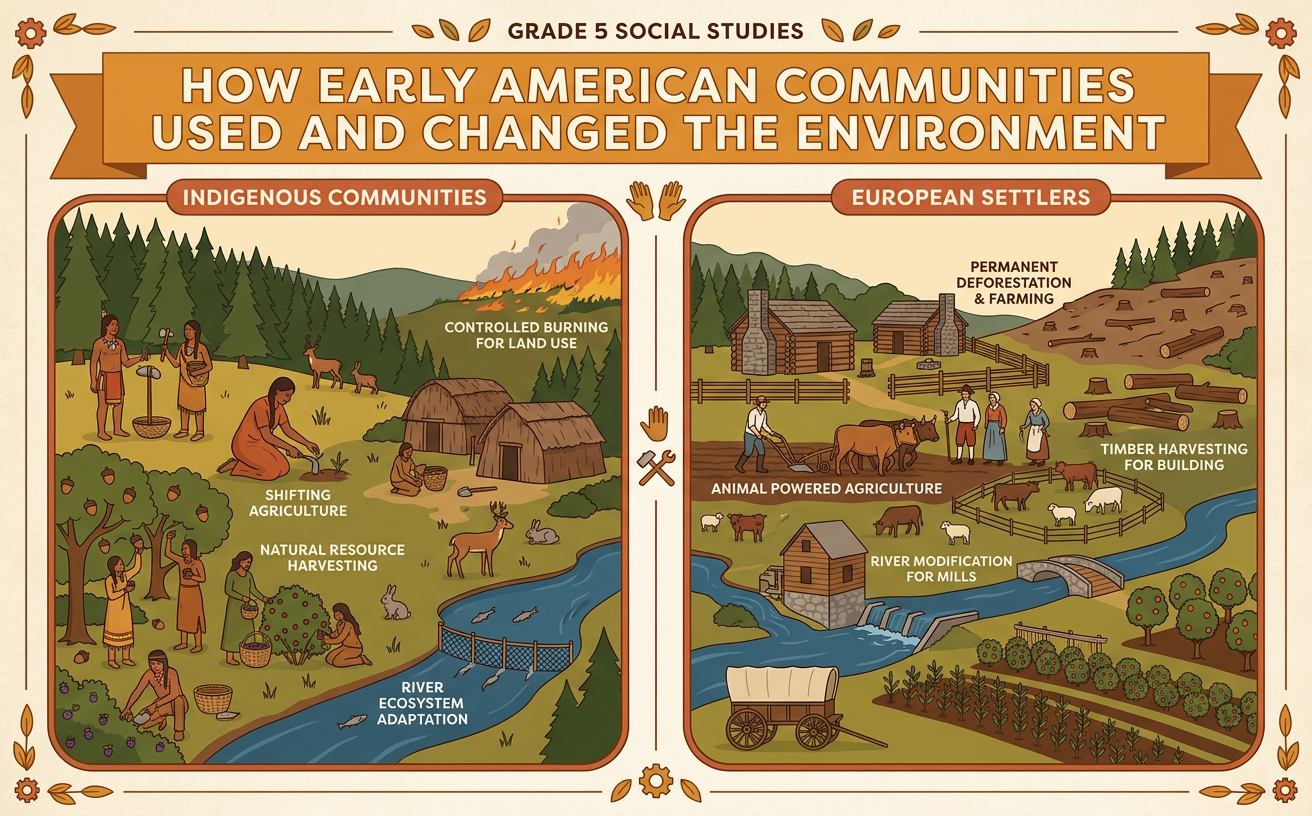
Illustrations are auto-generated and may be placeholders. They can be refreshed to match the narration.
Natural Resources in Early America
Early American communities depended on nearby natural resources for food, shelter, clothing, tools, and transportation. The resources available differed by region. Coastal communities could gather shellfish and catch ocean fish, while communities near forests could hunt animals and use wood. Rivers supplied fresh water, fish, and travel routes. Soil and climate affected which crops people could grow. For example, a community beside the Connecticut River could plant crops in fertile soil, catch fish, and travel by canoe. People also adapted when resources changed with the seasons. They might preserve food, move to another hunting area, or trade with neighboring communities. Examining a region’s land, water, plants, animals, and climate helps explain why communities developed different ways of living.

Indigenous Land-Use Practices
Indigenous nations developed distinct land-use practices based on their cultures and environments. Many communities combined farming, hunting, fishing, gathering, and trade. Some used carefully controlled fires to clear undergrowth, encourage useful plants, and improve habitats for certain animals. These fires were planned and differed from uncontrolled wildfires. The Haudenosaunee, for example, grew corn, beans, and squash together in fields. Corn stalks supported climbing beans, beans added nutrients to the soil, and broad squash leaves helped shade the ground and slow weed growth. Other Indigenous communities used irrigation, seasonal migration, or selective harvesting. These practices changed the environment, but they were often guided by detailed knowledge of seasons, soil, water, plants, and animals developed across many generations.

European Settlement and Farming
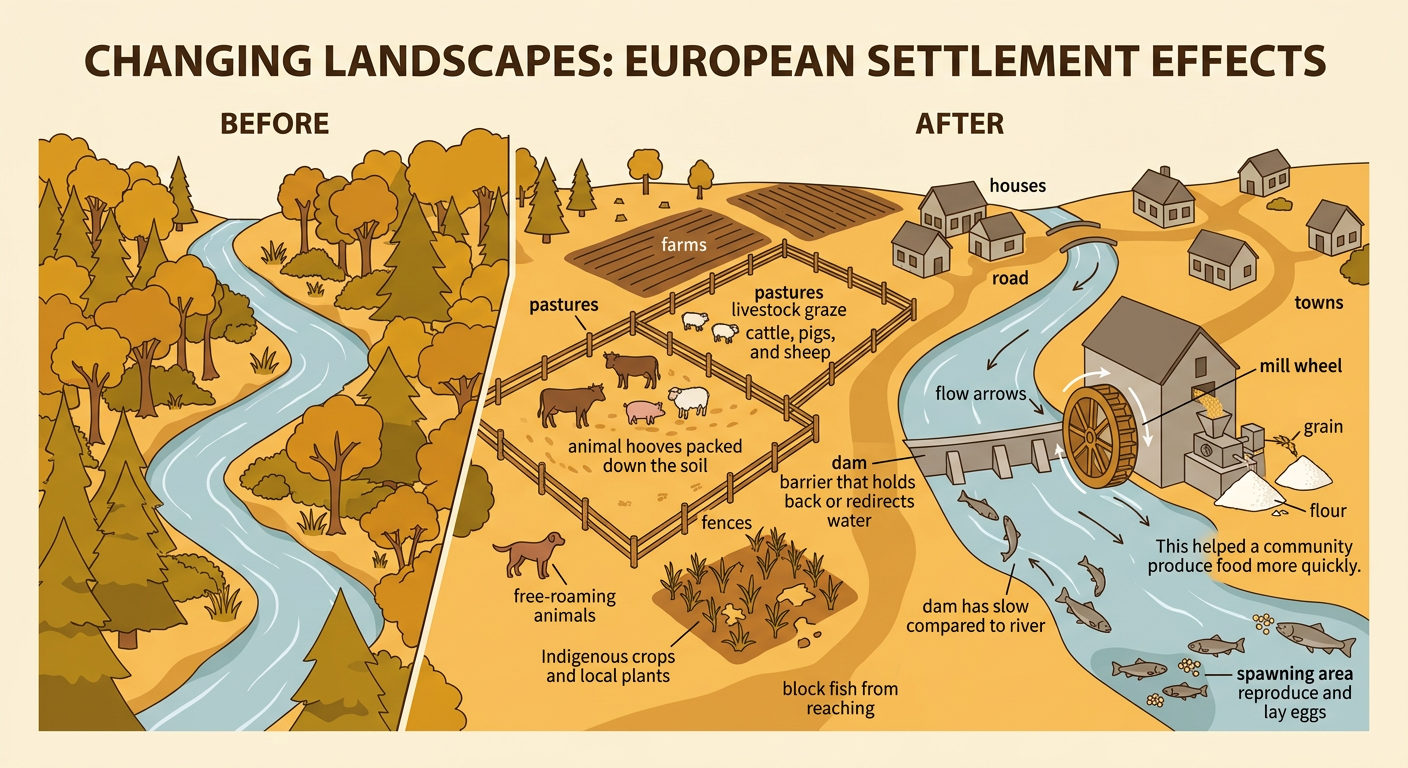
European settlers also adapted to local environments, but their arrival often caused rapid and lasting changes. Settlers cleared forests to create farms, pastures, roads, and towns. They divided land with fences and introduced livestock such as cattle, pigs, and sheep. Hooves packed soil, while free-roaming animals sometimes damaged Indigenous crops and local plants. Settlers also built water-powered mills by placing dams across streams. In a New England settlement, for example, a dam could direct water toward a mill wheel that ground grain into flour. The mill helped the community produce food, but the dam could slow the river and block fish from reaching spawning areas. Population growth, permanent fields, private land claims, and trade encouraged settlers to use larger areas of land more intensively.
Comparing Environmental Changes
Both Indigenous peoples and European settlers used resources, adapted to local conditions, and changed the land. However, their methods, purposes, and effects often differed. Indigenous practices varied greatly among nations, but many relied on seasonal cycles, mixed food sources, selective harvesting, and knowledge passed across generations. European settlers often created permanent farms, fenced property, raised large livestock, and produced goods for growing markets. For example, a planned cultural burn might remove undergrowth while leaving many mature trees standing. Clearing the same area for a farm could remove most trees, expose soil, and create a permanent field. Neither group lived without affecting nature, and no single practice describes every community. Historians compare the scale, speed, duration, and purpose of changes to understand their environmental effects.

Evidence-Based Exit Reflection
An evidence-based reflection includes a clear claim, specific evidence, and reasoning that connects the evidence to the claim. Consider this question: How did culture influence the way an early American community used or changed its environment? One possible claim is that Haudenosaunee agricultural knowledge encouraged farmers to grow several crops together. Evidence includes the use of corn, beans, and squash in the same field. The reasoning explains that these plants supported one another and reflected knowledge shared across generations. You can also connect history to environmental protection today. For example, modern land managers may use carefully planned prescribed fires, informed by science and Indigenous knowledge, to reduce dangerous fuel and support healthy habitats. In your response, name the community, describe one practice, explain its environmental effect, and cite at least two lesson details.
