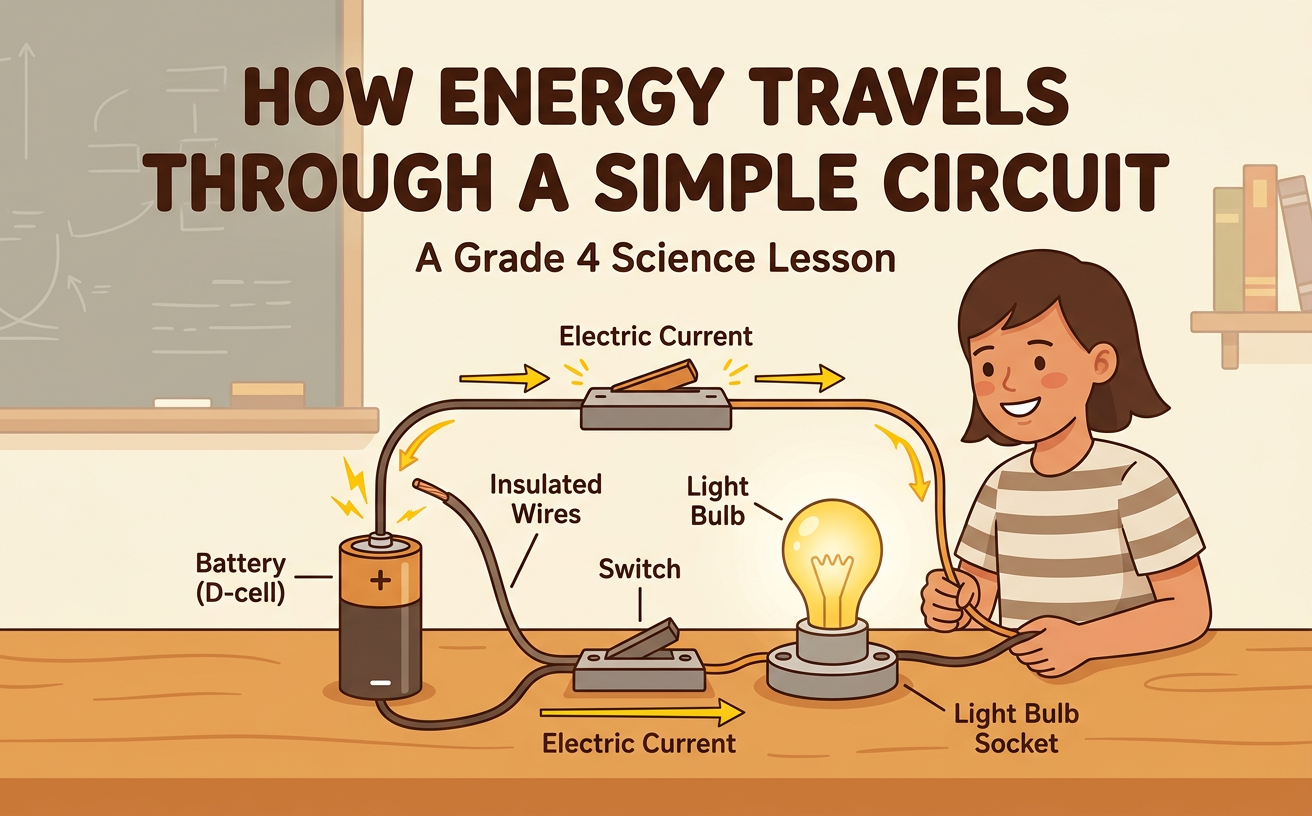
How Energy Travels Through a Simple Circuit
Students observe a simple circuit to explain how electric current transfers energy from a battery to a light bulb.
Illustrations are auto-generated and may be placeholders. They can be refreshed to match the narration.
Energy and Electric Current
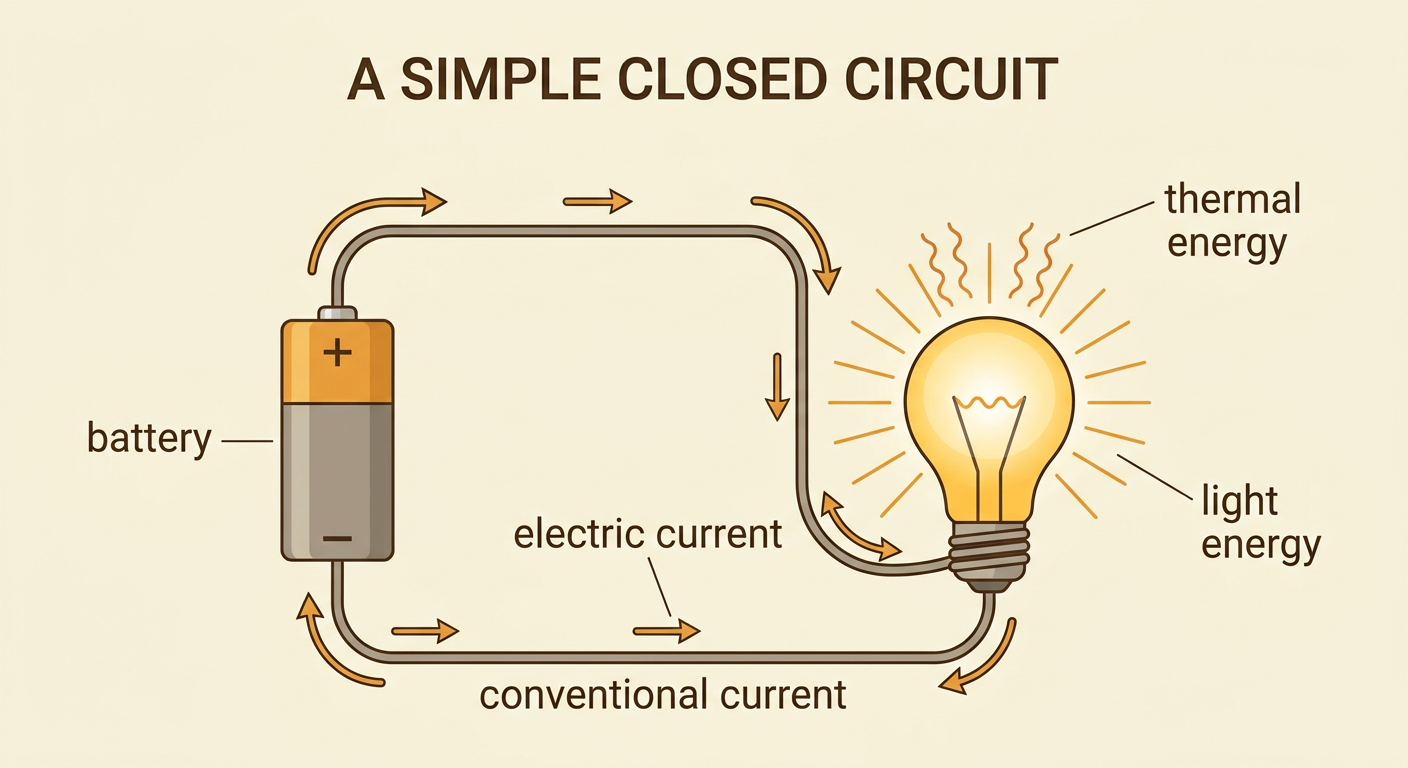
Energy is the ability to cause change. A battery stores chemical energy. When the battery is connected in a complete circuit, it gives energy to moving electric charges. This movement of charge is called electric current. The current transfers energy through the circuit to an electrical device. For example, in a flashlight, current transfers energy from the battery to the light bulb. The bulb changes some of the electrical energy into light energy and thermal energy, which makes the bulb warm. The electric current moves through the entire loop; it does not stop at the bulb. If the path is broken, current cannot flow continuously, so the bulb does not light. Observing light and warmth provides evidence that energy has been transferred.
Parts of a Simple Circuit
A simple circuit needs an energy source, a device that uses the transferred energy, and conductors that form a path. A battery is the energy source. Wires are conductors because their metal centers allow electric charge to move easily. A light bulb is the device that changes electrical energy into light and thermal energy. A switch can open or close the path. The battery has a positive terminal and a negative terminal. For a small bulb to light, one battery terminal must connect to the bulb’s metal side, and the other terminal must connect to the metal tip on the bottom. For example, touching both wires to only the bulb’s metal side will not make a complete path through the bulb, so it will not glow.

Building a Complete Path
To build a circuit, use only a small classroom battery, wires, and a low-voltage bulb. Never connect wires or classroom circuit parts to a wall outlet. First, connect one wire from the battery’s positive terminal to one metal contact on the bulb. Next, connect a second wire from the bulb’s other metal contact to the battery’s negative terminal. Check that metal touches metal at every connection. This creates one unbroken loop. When the final connection is made, the bulb should glow. If it does not, inspect each contact, the bulb, and the battery. For example, a wire resting on the glass part of the bulb will not complete the path because glass does not conduct electric current well. Move the wire to the correct metal contact and observe again.

Observing Energy Transfer
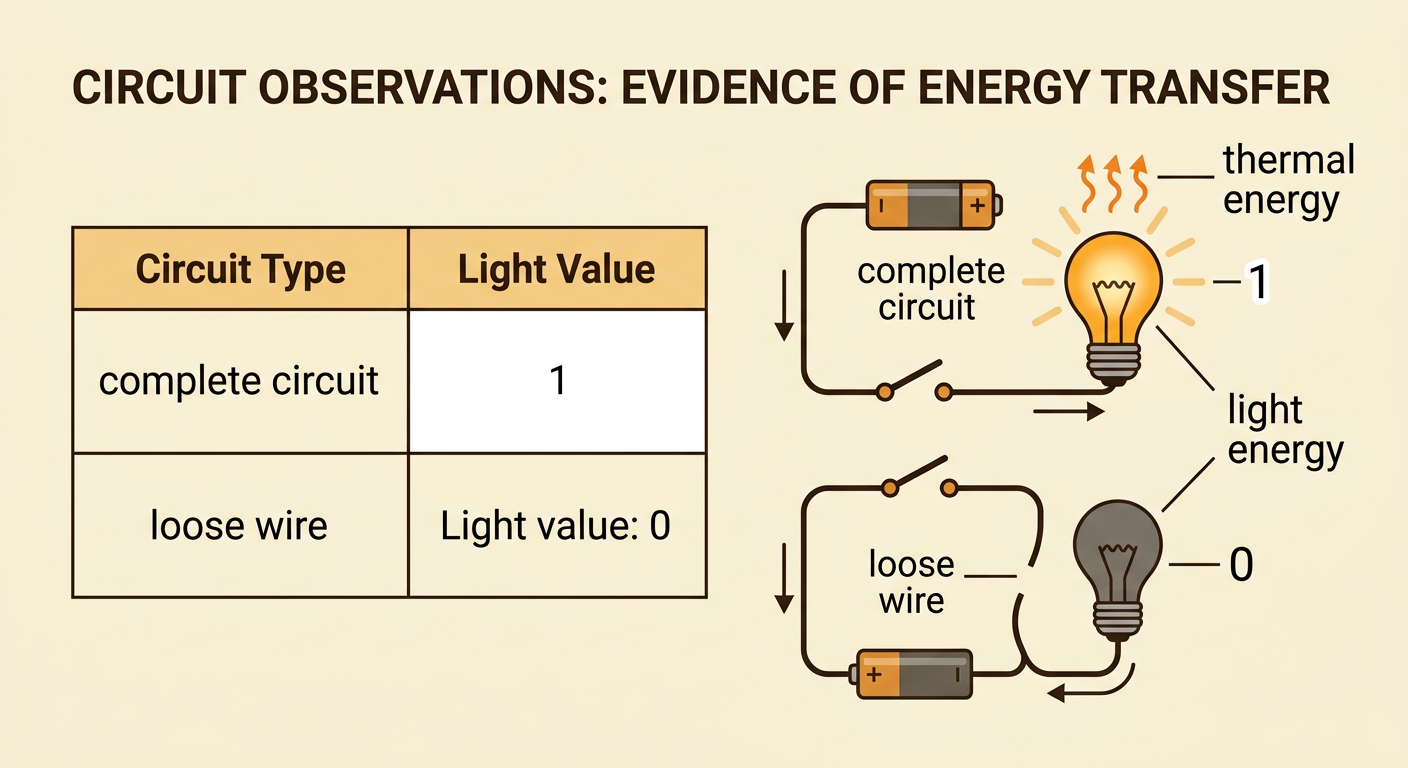
Scientists use observations as evidence. In a working circuit, the bulb gives off visible light. After the bulb has been on briefly, it may also become slightly warm, so follow your teacher’s directions and avoid touching a hot bulb. These changes show that energy reached the bulb. You can record observations in a table. Use 1 for a glowing bulb and 0 for a dark bulb, then compare trials. For example, a complete circuit might have a light value of 1, while a circuit with a loose wire has a value of 0. You can also describe brightness as dim, medium, or bright. The numbers and words represent real observations. The battery’s chemical energy is transferred by electric current, and the bulb changes that energy into light and thermal energy.
Open and Closed Circuits
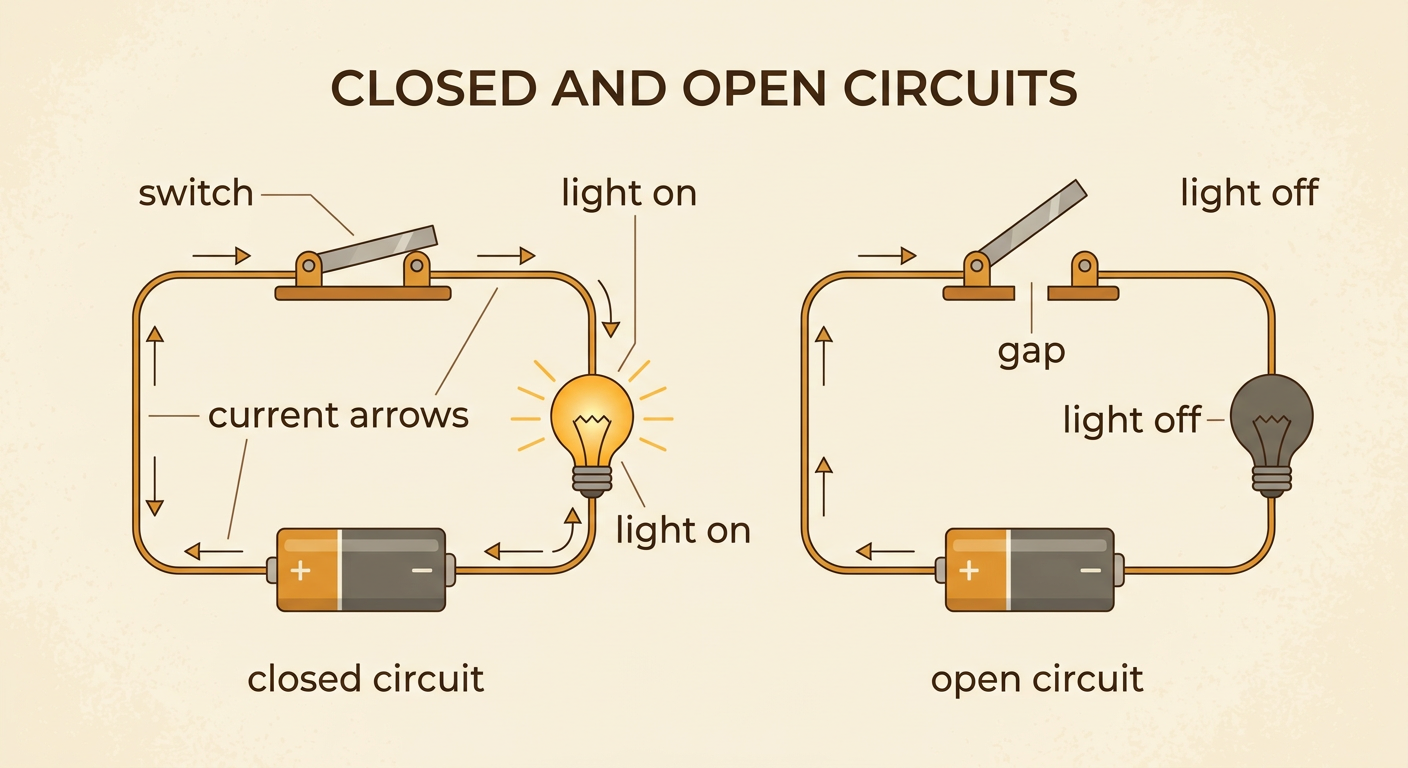
A closed circuit has a complete, unbroken path. Electric current can flow around the loop, so energy can be transferred to the bulb. An open circuit has a gap. The gap stops continuous current, so the bulb remains dark. A switch controls the path without removing a wire. Closing the switch completes the circuit; opening it creates a gap. For example, a desk lamp’s switch lets a person turn the light on when it is needed and off when it is not. Using the lamp provides the benefit of light for reading, but it also uses electrical energy and may cost money. Turning it off when no one needs it reduces energy use and cost. The choice should still consider safety, because needed lights should remain on in dark areas.
Explaining the Evidence
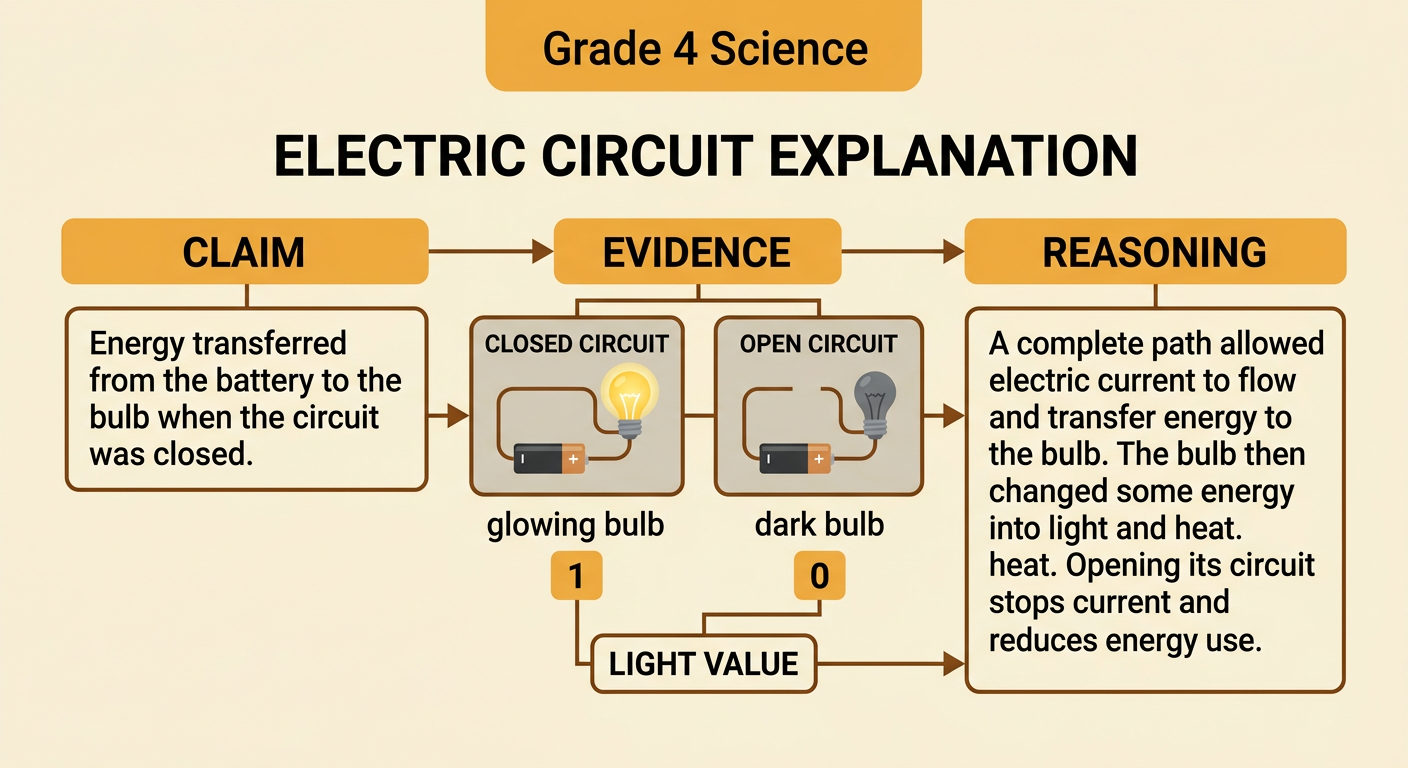
A strong scientific explanation includes a claim, evidence, and reasoning. The claim answers the question. The evidence reports specific observations. The reasoning connects the evidence to a science idea. For example, a student might claim, “Energy was transferred from the battery to the bulb when the circuit was closed.” The evidence is that the bulb glowed in the closed circuit but stayed dark when a wire was disconnected. The reasoning is that a complete path allowed electric current to flow and transfer energy to the bulb, which changed some energy into light and heat. Quantitative evidence can strengthen the explanation: the closed circuit had a light value of 1, while the open circuit had a value of 0. This evidence also supports switching off unneeded devices to reduce energy use while keeping useful lighting available.