
How Force and Mass Change Motion
Students conduct a cart investigation to determine how net force and mass affect acceleration, then apply their findings to transportation safety decisions.
Illustrations are auto-generated and may be placeholders. They can be refreshed to match the narration.
Forces and Motion Phenomenon
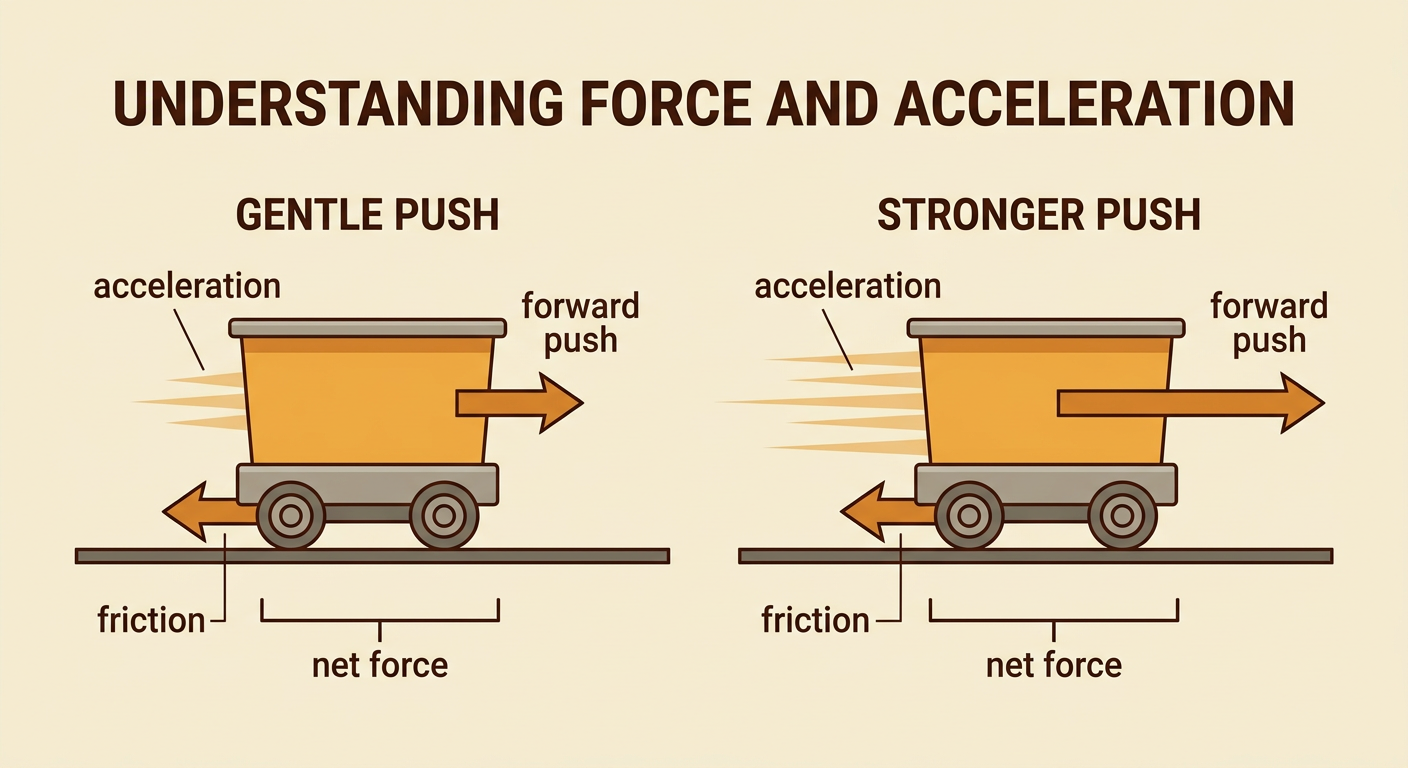
Imagine two identical carts at rest. One cart receives a gentle push, while the other receives a stronger push in the same direction. The cart with the stronger push speeds up more quickly. A force is a push or pull, and acceleration is a change in velocity, including speeding up, slowing down, or changing direction. Motion depends on all the forces acting on an object, not just one force. For example, a student may push a cart forward while friction acts backward. If the forward push is greater than friction, the cart accelerates forward. If the forces are equal and opposite, the net force is zero, so the cart does not accelerate. Its velocity remains constant, which may mean staying at rest or continuing to move steadily.
Net Force and Acceleration
Net force is the combined effect of all forces acting on an object. Forces in the same direction add, while forces in opposite directions subtract. Newton's second law describes the relationship as acceleration equals net force divided by mass, or a = Fnet ÷ m. Suppose a 2-kilogram cart is pulled forward with 6 newtons while friction pushes backward with 2 newtons. The net force is 4 newtons forward, so the cart's acceleration is 4 ÷ 2, or 2 meters per second squared. If the same net force acts on a cart with twice the mass, its acceleration is half as large. Therefore, greater net force produces greater acceleration, but greater mass produces smaller acceleration when net force stays constant.

Cart Investigation
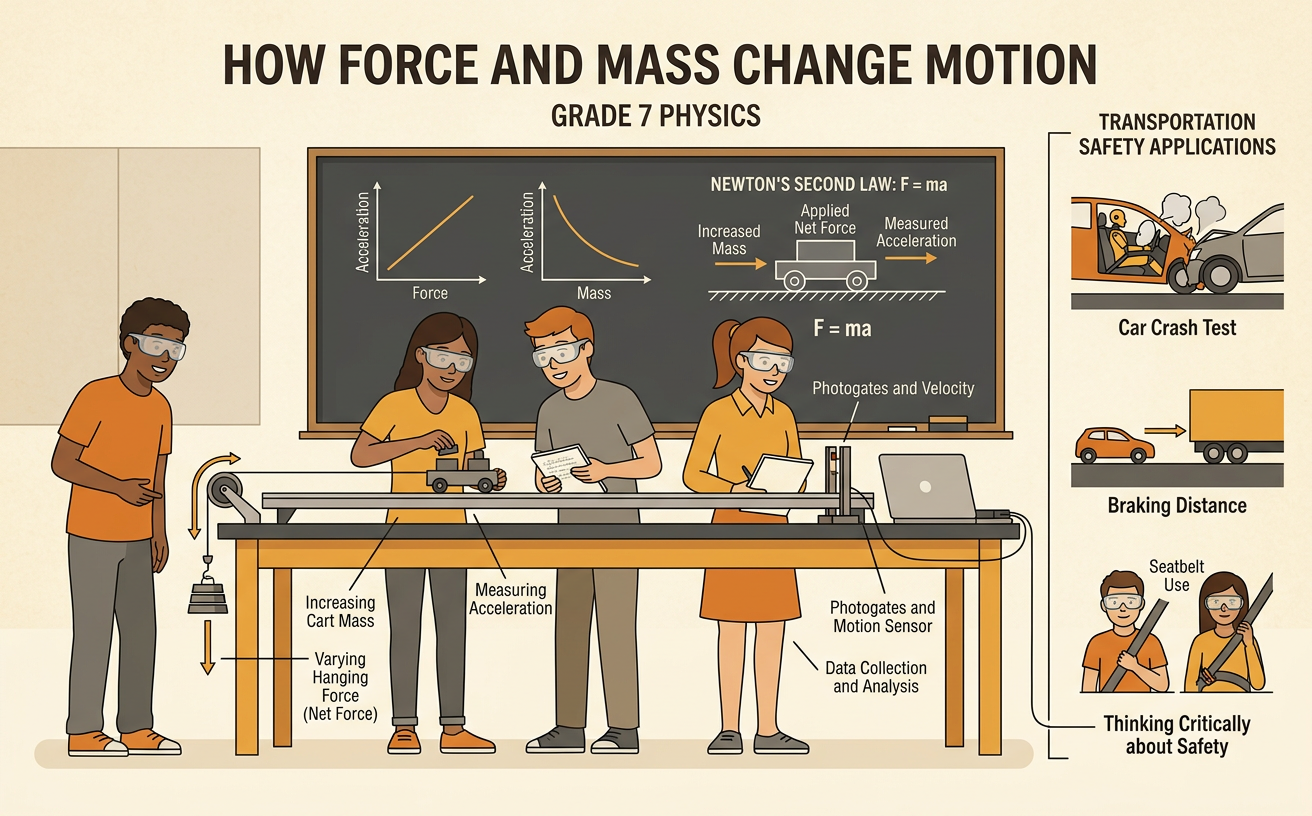
Investigate one variable at a time. Place a cart on a level track and use a spring scale or hanging mass to apply a measured force. First, keep the cart's mass constant and test at least three force values. Release the cart from the same starting line, measure its acceleration with a motion sensor, and repeat each trial three times. Next, keep the net force constant while adding known masses to the cart. Record total mass, net force, and acceleration in a data table. Average the repeated acceleration measurements. Do not push the cart by hand during a trial, and keep the track surface and travel distance unchanged. Use a stop block so the cart cannot leave the track. This fair-test procedure allows changes in acceleration to be connected to force or mass.

Analyze Proportional Patterns
Organize the results in tables and graphs. When mass stays constant, acceleration is directly proportional to net force. For example, a 2-kilogram cart with net forces of 2, 4, and 6 newtons should have accelerations of about 1, 2, and 3 meters per second squared. The ratio of acceleration to net force remains constant at 0.5 for this cart. A graph of acceleration versus net force forms a straight line through the origin. When net force stays constant, increasing mass decreases acceleration. With a constant 6-newton force, masses of 1, 2, and 3 kilograms produce accelerations of 6, 3, and 2 meters per second squared. This second pattern is inverse, not directly proportional: doubling the mass halves the acceleration.

Transportation Safety Application
Force and mass relationships help communities make transportation safety decisions. A loaded truck has more mass than a small car, so it needs a greater net force to achieve the same acceleration or deceleration. This helps explain policies requiring effective brakes, vehicle inspections, lower truck speed limits in some areas, and safe following distances. Seat belt laws serve a different safety purpose: belts apply a controlled restraining force so passengers slow with the vehicle instead of continuing forward during a crash. Policymakers must consider both purposes and consequences. Safety rules can reduce injuries and protect other road users, but inspections, equipment, and enforcement also cost money and time. Students can evaluate a proposed rule by using force and motion evidence, crash data, costs, fairness, and effects on drivers, passengers, pedestrians, and businesses.
