
How Geography Shaped Medieval Japan
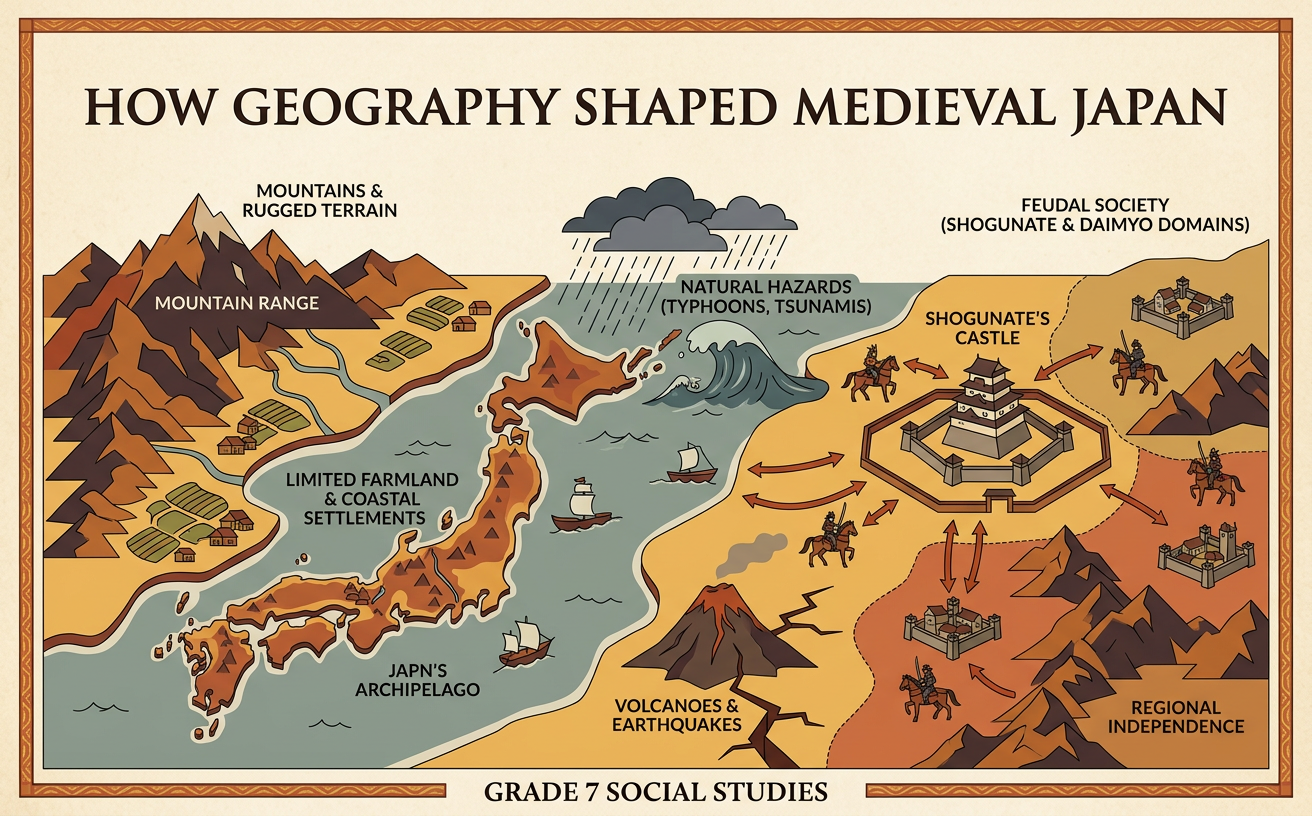
Students examine how Japan’s mountains, islands, natural hazards, and limited farmland influenced settlement, resource use, political organization, and the development of feudal society.
Illustrations are auto-generated and may be placeholders. They can be refreshed to match the narration.
Japan’s Physical Geography
Japan is an archipelago, or chain of islands, off the eastern coast of Asia. Its four largest islands are Hokkaido, Honshu, Shikoku, and Kyushu. Most medieval people lived on Honshu, Shikoku, and Kyushu. Mountains cover much of the land, while plains and river valleys make up a smaller share. Japan’s mountains formed largely because moving tectonic plates pushed, folded, and uplifted Earth’s crust. This plate activity also produced volcanoes and earthquakes. Steep slopes separated many communities and made travel by land difficult. In contrast, low coastal plains offered flatter ground for towns and farming. For example, the broad Kanto Plain supported agriculture and settlements and later helped the city of Kamakura become an important political center. Japan’s physical geography created both opportunities and limits for medieval society.

Settlement and Limited Farmland
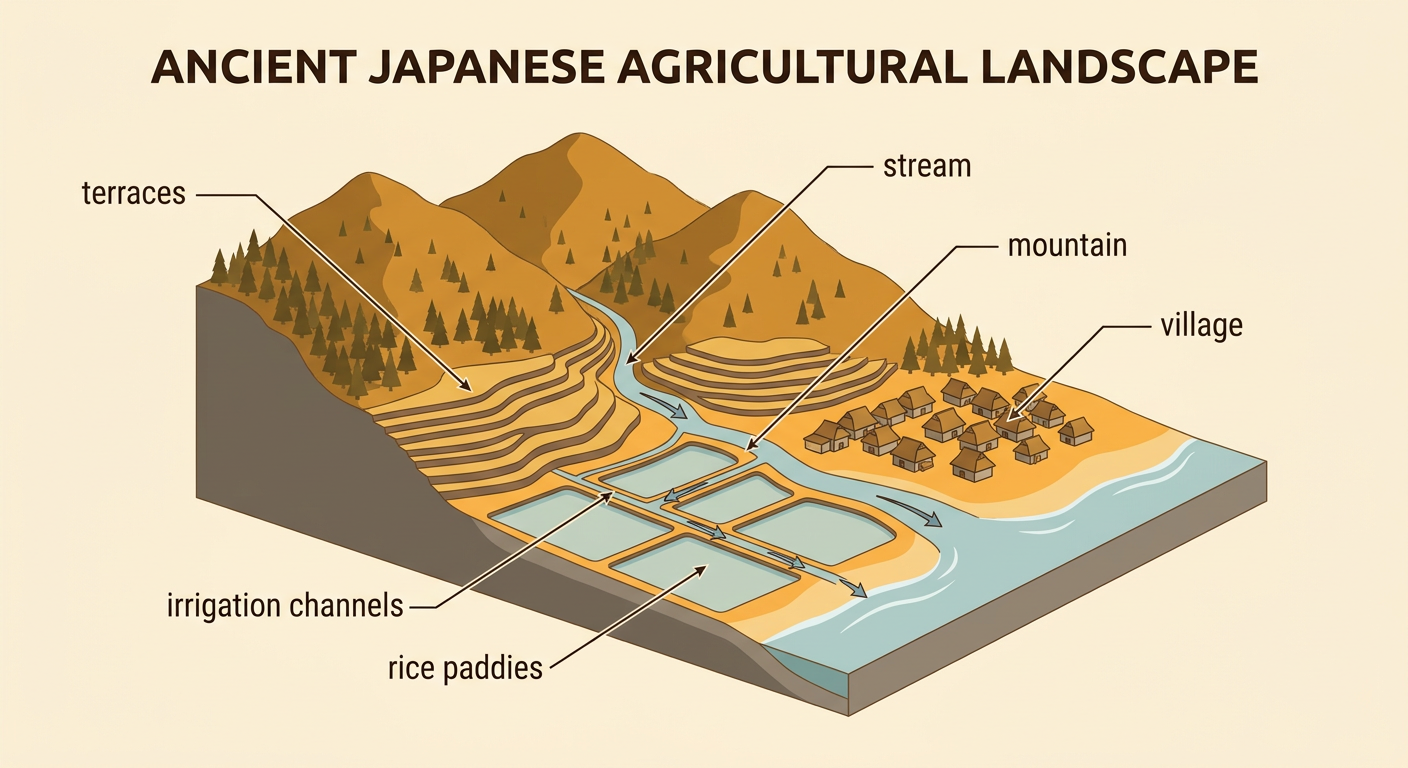
Because mountains cover much of Japan, suitable farmland was limited. People concentrated in coastal plains, river valleys, and small mountain basins where soils were deeper and water was available. Villages often developed near rice paddies because wet-rice farming required level fields, irrigation channels, and shared labor. Farmers reshaped some hillsides into terraces, creating flat steps that slowed runoff and held soil and water. For example, a village might divert water from a stream into several connected paddies, with families cooperating to maintain the channels. Productive farmland became extremely valuable. Landowners, temples, and warriors competed to control fields and collect part of the rice harvest as rent or tax. As a result, the location and quality of farmland influenced settlement patterns, wealth, and political power in medieval Japan.
The Sea as Resource and Barrier
The seas surrounding Japan provided food, transportation, and contact with other societies. Coastal communities harvested fish, shellfish, seaweed, and salt. Boats could move people and goods more easily than travelers could cross steep mountains, so ports and protected waterways became important trade centers. The Seto Inland Sea, between Honshu, Shikoku, and Kyushu, offered routes linking western and central Japan. Across wider waters, contact with Korea and China brought goods, writing, religious ideas, and technologies to Japan. However, the sea was also a barrier. Long voyages were dangerous, and distance helped Japan develop political and cultural traditions distinct from those of mainland Asia. Storms could interrupt trade or destroy ships. Thus, the sea did not completely isolate medieval Japan; instead, it connected some places while limiting and controlling the movement of people and ideas.

Natural Hazards and Adaptation
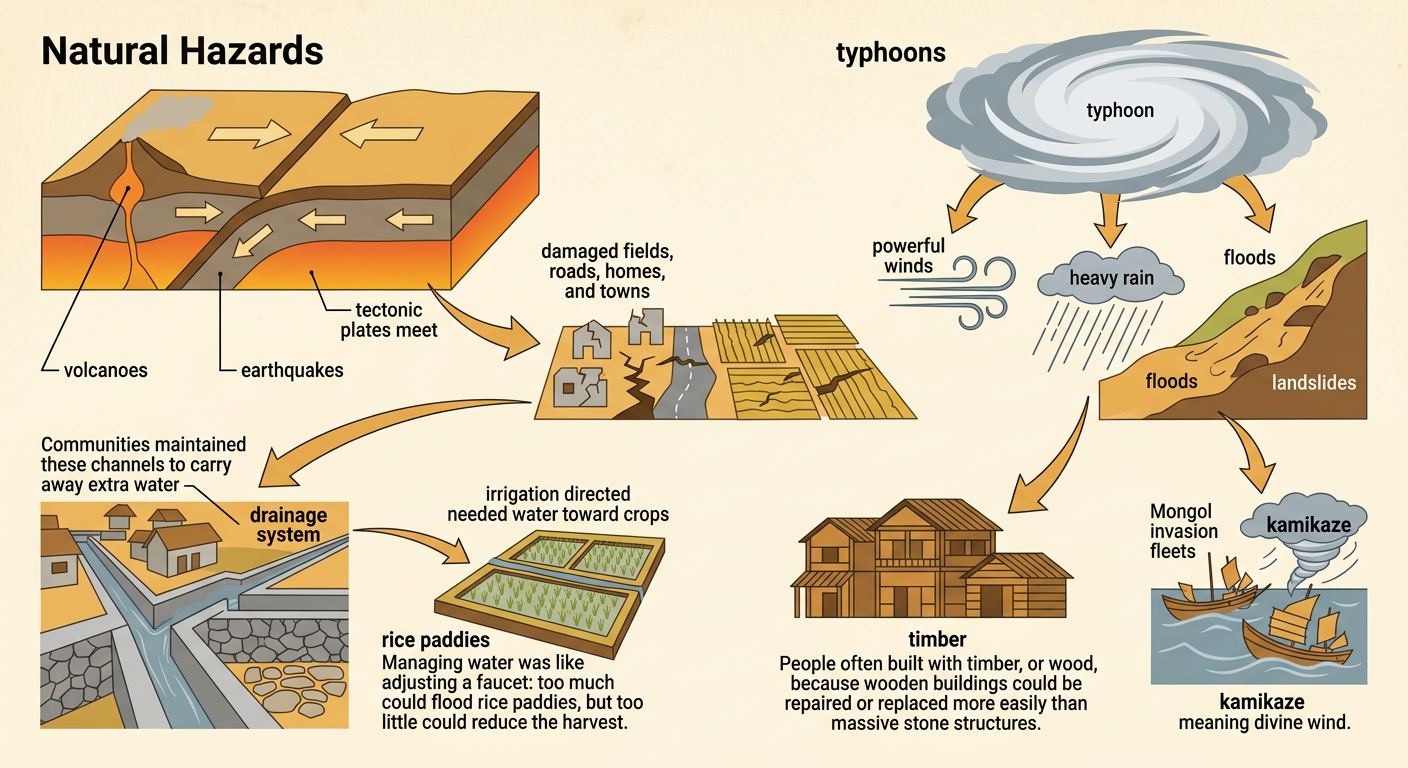
Japan’s location near several tectonic plate boundaries causes frequent earthquakes and volcanic activity. Seasonal typhoons can bring strong winds, heavy rain, flooding, and landslides. These hazards repeatedly damaged fields, roads, homes, and towns. Medieval communities adapted by rebuilding, maintaining drainage and irrigation systems, and using local materials such as timber. Wooden buildings could be repaired or replaced more readily than massive stone structures, although they remained vulnerable to fire and storms. Farmers managed water carefully because too much rain could flood paddies while too little could reduce harvests. A famous example occurred in 1274 and 1281, when powerful storms damaged Mongol invasion fleets near Japan. The Japanese later called these storms kamikaze, meaning “divine wind.” Hazards did not affect every place equally, but they influenced construction, farming, emergency cooperation, and beliefs about nature.
Geography and Feudal Power
Japan’s rugged terrain helped divide the country into regions that could be difficult for one ruler to control directly. Mountains slowed armies and messengers, while valleys, plains, ports, and mountain passes became strategically important. Powerful landowners and warriors protected estates, supervised farming, and collected rents or taxes. Over time, military leaders known as shoguns relied on samurai and regional warrior families to govern and defend territory. Geography did not cause feudalism by itself, but it strengthened local power by making transportation and communication harder. Kamakura provides a clear example. The first lasting shogunate established its headquarters there in 1192. Hills surrounded Kamakura on three sides, and the sea bordered the fourth, making the city easier to defend. Control of productive land and key routes gave warrior leaders the resources needed to reward followers and maintain military authority.
