How Have Models of the Atom Changed Over Time?
Students compare historical and modern atomic models and use a particle model to distinguish atoms, elements, molecules, and compounds.
Illustrations are auto-generated and may be placeholders. They can be refreshed to match the narration.
What Is a Scientific Model?
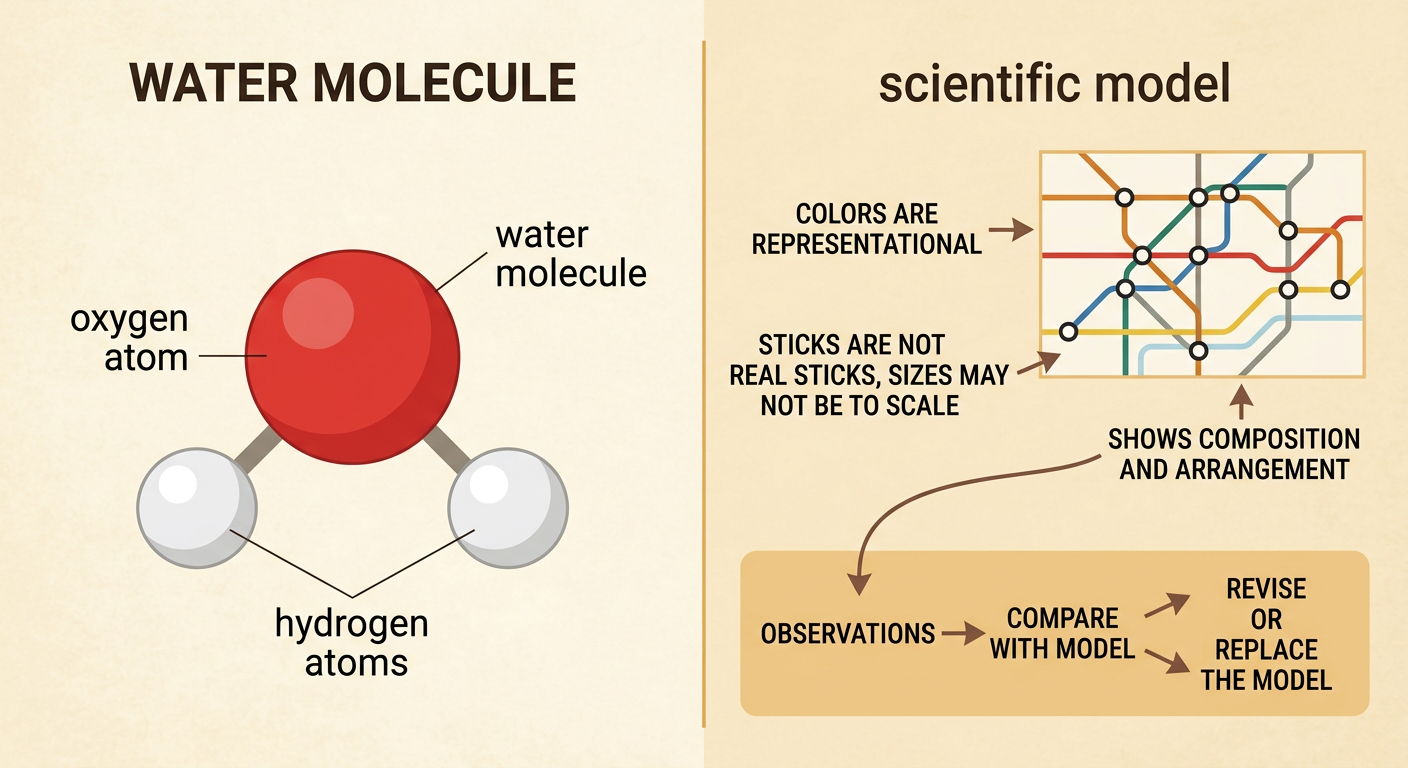
A scientific model is a simplified representation used to explain or predict something that may be difficult to observe directly. Models can be drawings, physical objects, computer simulations, or sets of ideas. An atomic model does not show exactly what an atom looks like. Instead, it represents important features supported by evidence. For example, a ball-and-stick model of water shows one oxygen atom bonded to two hydrogen atoms. The model helps us see the number and arrangement of atoms, but its sticks are not real sticks, and the atom sizes may not be to scale. Scientists test models against observations. When new evidence does not fit a model, they revise or replace it. Therefore, changing a model is a normal part of scientific progress.
Early Ideas About Atoms
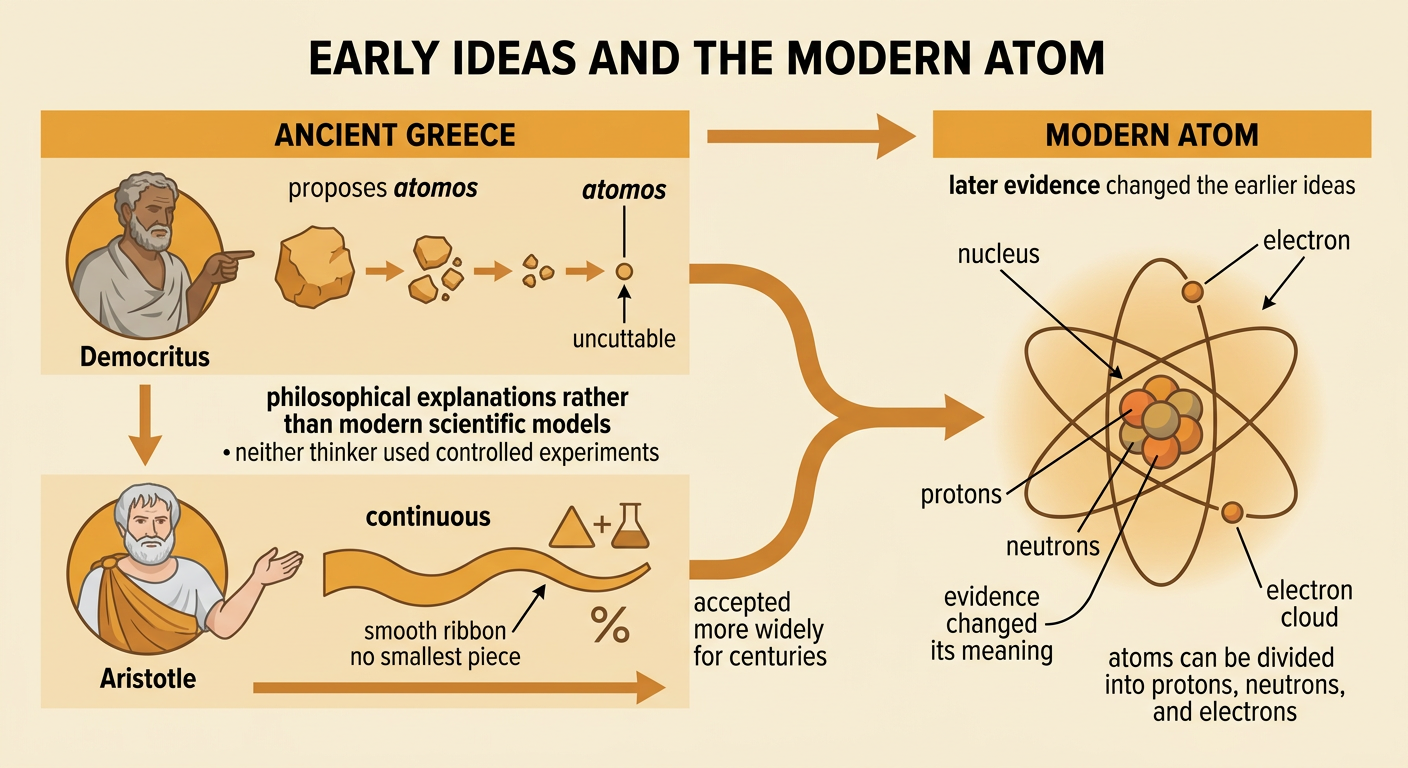
More than 2,000 years ago, Greek thinkers debated what matter was made of. Democritus proposed that matter could be divided into smaller pieces only until an indivisible particle was reached. He called this particle atomos, meaning uncuttable. Aristotle disagreed and argued that matter was continuous and made from combinations of basic substances. Neither thinker tested these ideas with controlled experiments, so their explanations were philosophical rather than modern scientific models. For many centuries, Aristotle’s view was more widely accepted. The idea that matter contains tiny particles continued, but the evidence and details changed greatly. Today, scientists know that atoms can be divided into smaller particles, including protons, neutrons, and electrons. This history shows continuity in the particle idea and change in how that idea is supported and explained.
From Dalton to the Modern Model
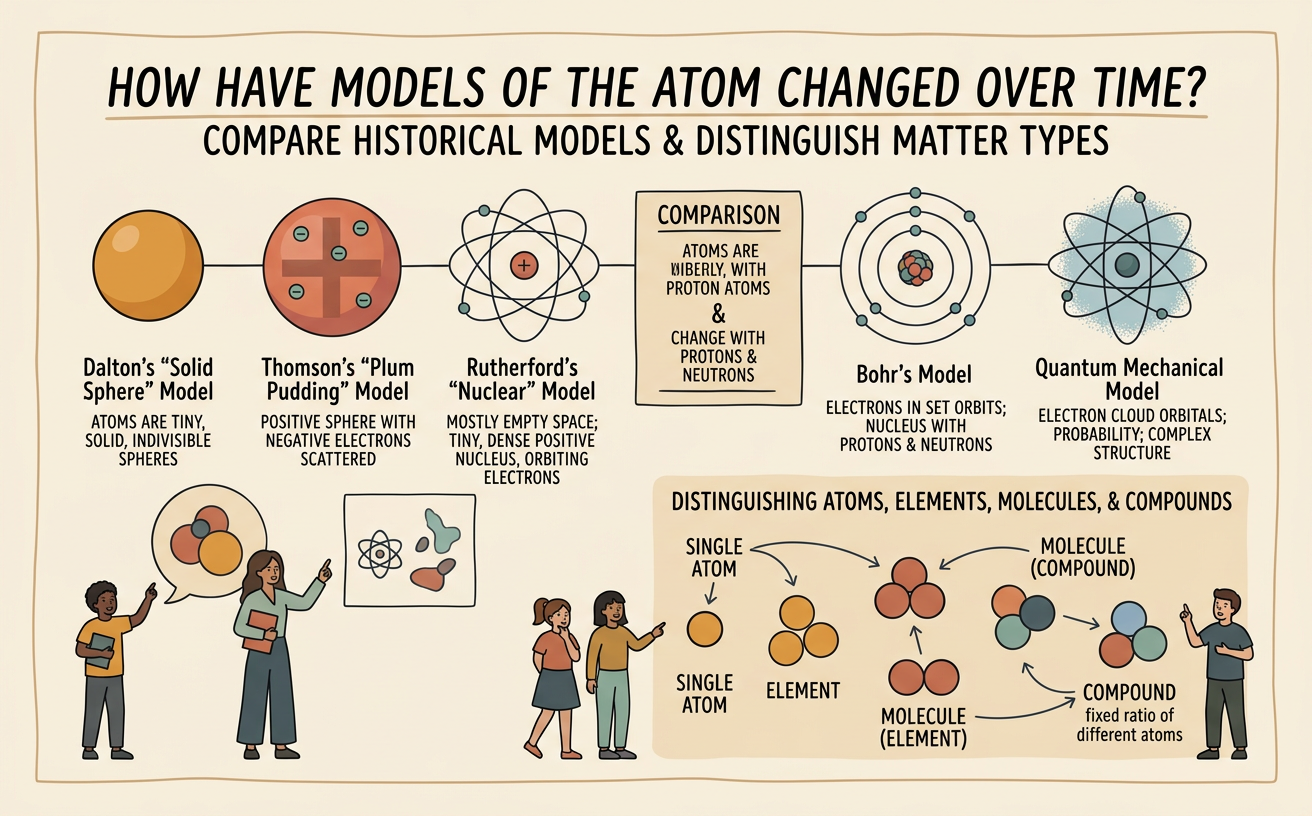
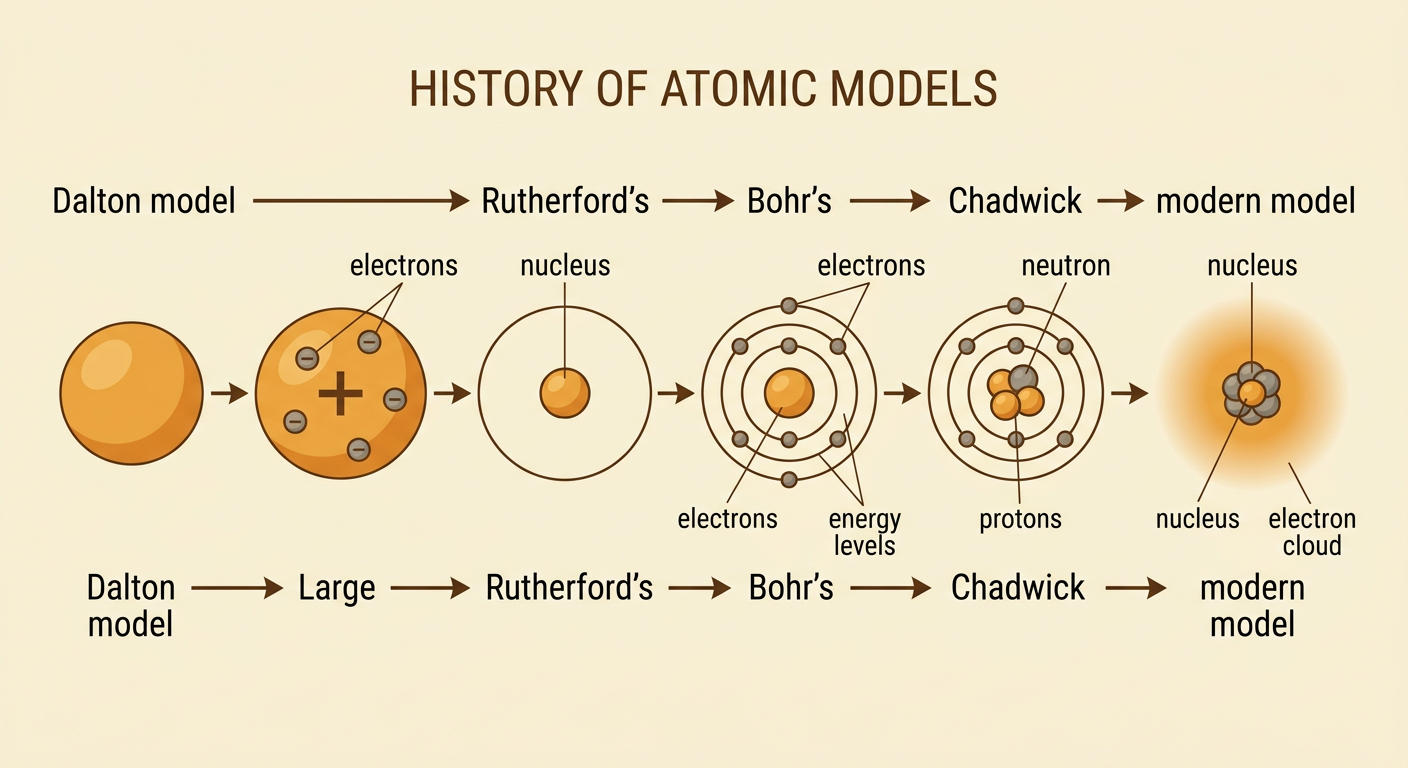
In the early 1800s, John Dalton used chemical evidence to describe atoms as solid, indivisible spheres, with each element having its own kind of atom. Later, J. J. Thomson discovered electrons and proposed a positively charged sphere with electrons inside it. Ernest Rutherford’s gold foil experiment showed that most of an atom is empty space surrounding a tiny, positively charged nucleus. Niels Bohr then modeled electrons in specific energy levels around the nucleus. James Chadwick’s discovery of the neutron improved the model of the nucleus. The modern model describes protons and neutrons in the nucleus and electrons in regions called electron clouds. An electron cloud shows where an electron is likely to be found, not a fixed path. Across these models, the idea that matter is made of atoms continued, while the proposed structure of atoms changed as new evidence appeared.
Atoms, Elements, and Molecules
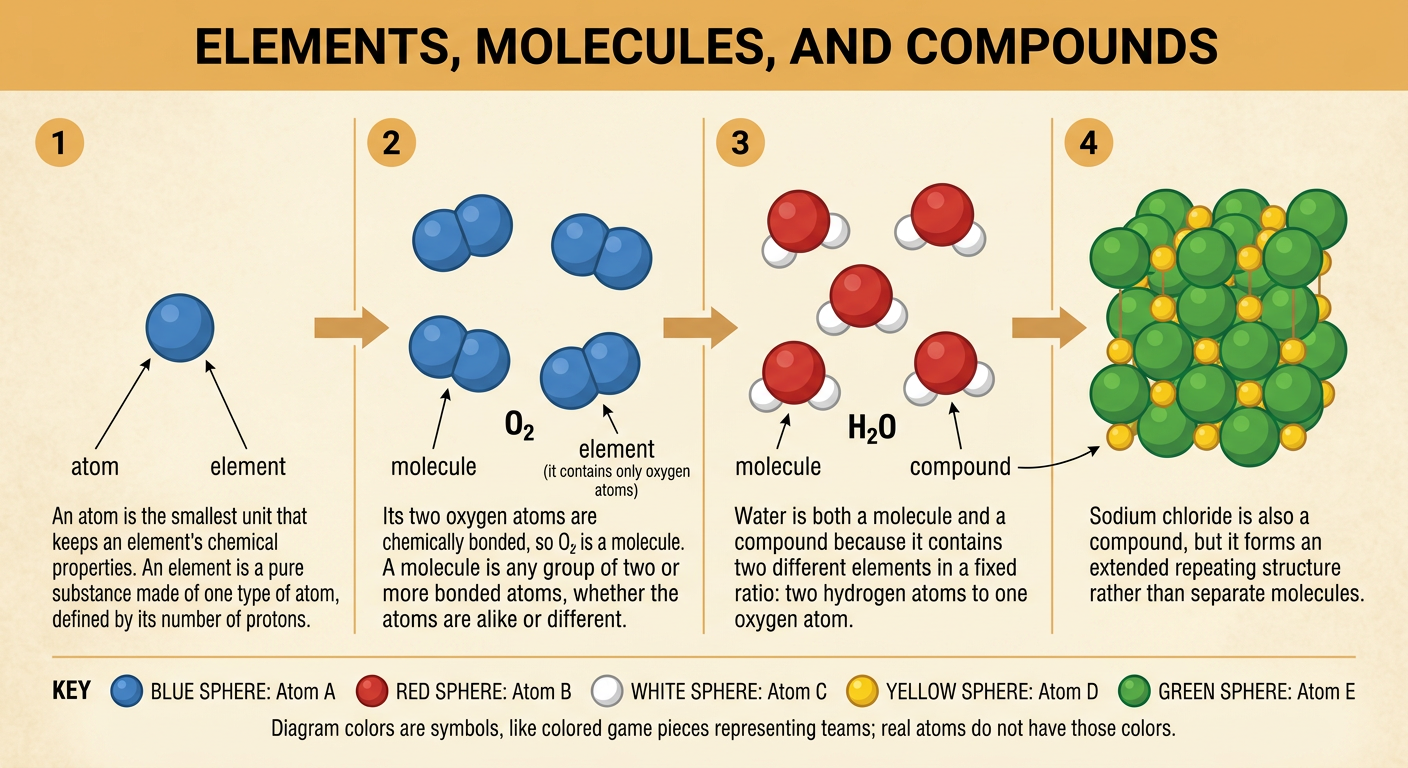
An atom is the smallest unit of an element that keeps that element’s chemical properties. An element is a pure substance made of only one type of atom, defined by its number of protons. A molecule forms when two or more atoms are chemically bonded. The atoms may be the same or different. For example, O2 is a molecule and an element because it contains only oxygen atoms. A compound contains atoms of two or more different elements chemically combined in a fixed ratio. Water, H2O, is both a molecule and a compound because each particle has two hydrogen atoms bonded to one oxygen atom. Not every compound exists as separate molecules. Sodium chloride forms an extended repeating structure of sodium and chloride ions. In particle diagrams, colors are useful symbols, but atoms do not actually have those colors.
Build a Particle Model
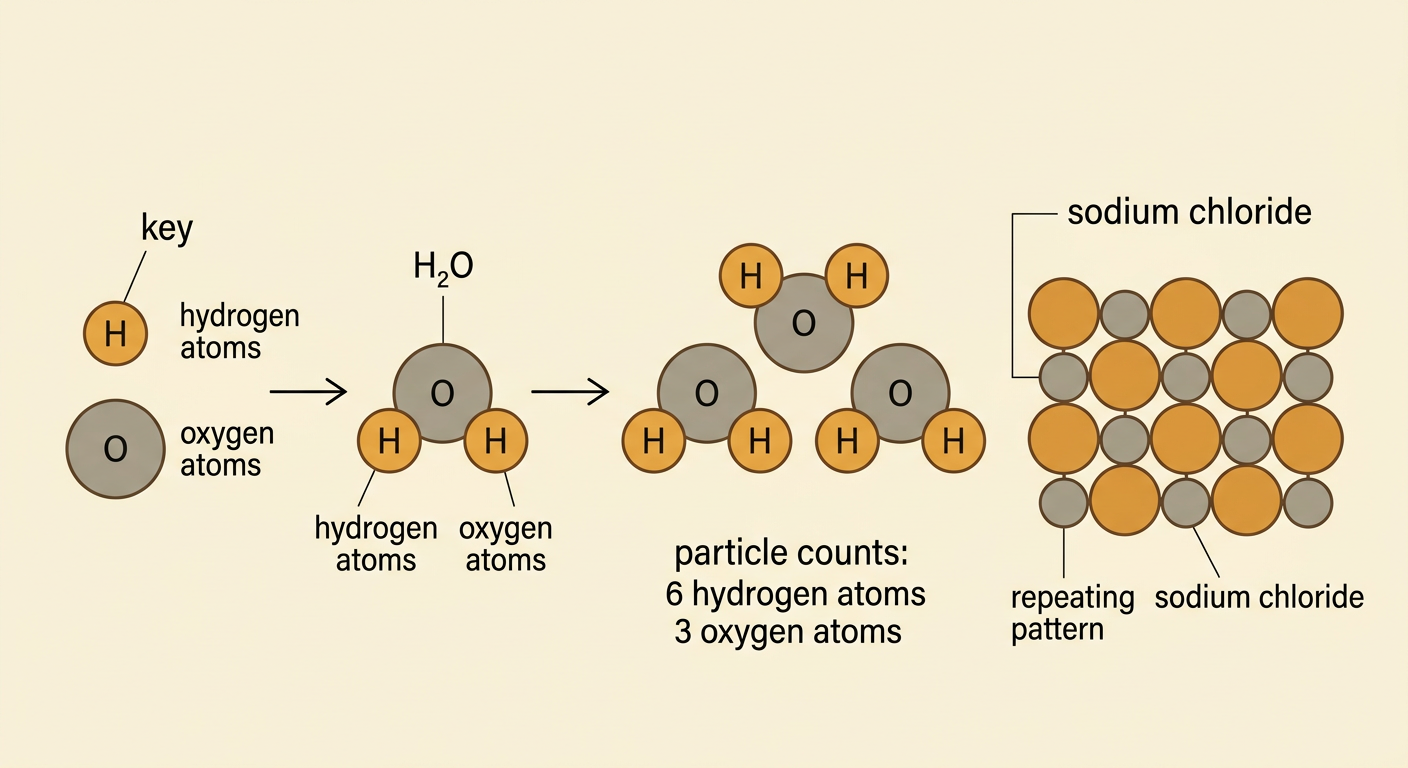
To build a particle model, first create a key that assigns a color and chemical symbol to each element. Use one circle for each atom and connect circles that are bonded. For a water molecule, place one oxygen circle in the center and attach two hydrogen circles, creating H2O. The model must show a ratio of two hydrogen atoms to one oxygen atom in every water molecule. If you model three water molecules, your drawing should contain six hydrogen atoms and three oxygen atoms. For an extended structure, repeat a basic pattern instead of drawing separate molecules. A sodium chloride model, for example, should show alternating sodium and chloride particles in a repeating arrangement. Check that the model’s particle counts, element types, bonds, and pattern agree with the chemical formula or written description.
Compare and Revise Models
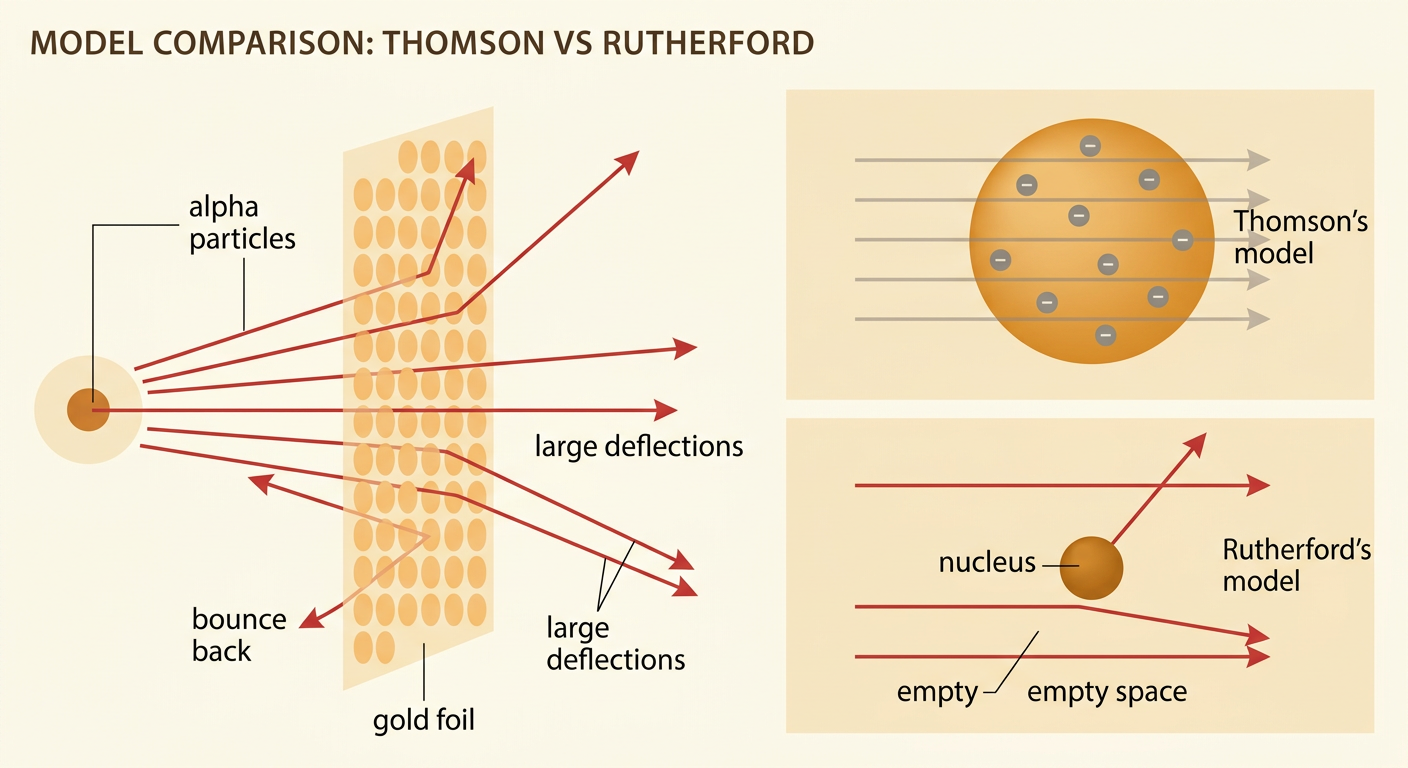
Scientists compare models by asking what each model explains, what evidence supports it, and what it cannot explain. For example, Thomson’s model predicted that positive charge was spread throughout the atom. In Rutherford’s gold foil experiment, most positively charged alpha particles passed straight through thin gold foil, but a few turned sharply. The results showed that atoms are mostly empty space and that positive charge and most mass are concentrated in a tiny nucleus. Because Thomson’s model could not explain the large deflections, scientists revised the atomic model. Students can follow the same process. Compare a model with data, identify a mismatch, and change only the features needed to fit the evidence. A revised model should explain more observations, but it may still change when scientists collect new evidence.