
How Heat Energy Moves
Students compare how quickly warm water cools in containers wrapped with different materials to gather evidence that heat energy moves from warmer objects to cooler surroundings.

Illustrations are auto-generated and may be placeholders. They can be refreshed to match the narration.
Warm and Cool Objects
Objects can have different temperatures. Temperature tells how warm or cool something is, and a thermometer measures it in degrees. When a warm object touches or is near cooler surroundings, heat energy moves from the warmer place to the cooler place. For example, a cup of warm water left on a classroom table slowly cools. At the same time, the cup, nearby air, and table gain some heat energy. The energy has not disappeared; it has moved from place to place. This movement continues until the water and its surroundings are close to the same temperature. We can observe evidence of heat transfer by measuring the water’s temperature at different times. For safety, students should use warm water provided by an adult, not boiling water, and avoid tasting or spilling it.

Predicting Heat Movement
A prediction is a statement about what you think will happen, based on what you know. Suppose three identical cups contain the same amount of warm water at the same starting temperature. One cup is uncovered, one is wrapped in cloth, and one is wrapped in aluminum foil. Heat energy will move from the warm water to the cooler surroundings in every cup, but the wrapping materials may change how quickly it moves. Before testing, predict which cup will have the smallest temperature decrease after 20 minutes. You might predict that thick cloth will slow heat transfer because it traps pockets of air. Record both your prediction and your reason. During a group discussion, listen to other ideas, ask questions, and explain your thinking respectfully. Different predictions are acceptable because the investigation will provide evidence.

Testing Insulating Materials
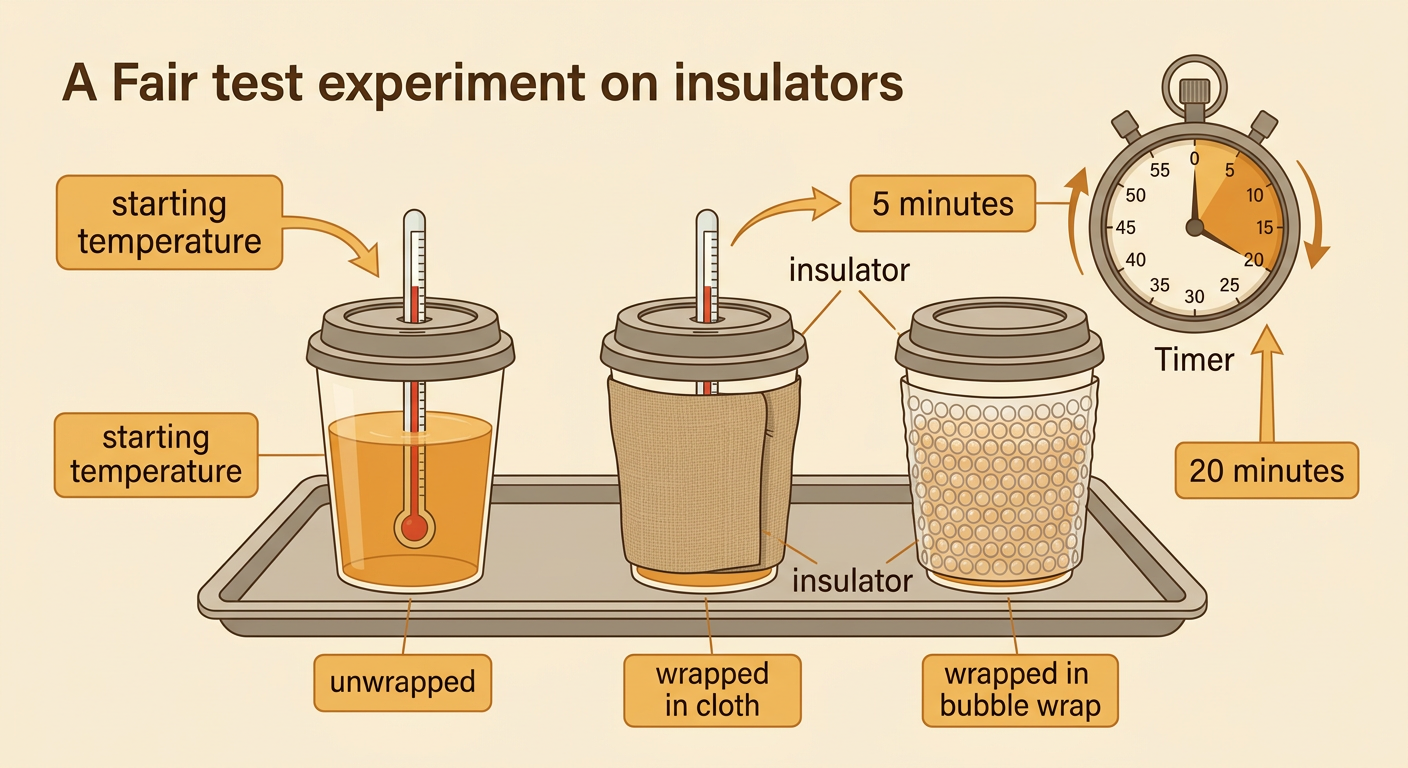
An insulator is a material that slows the movement of heat energy. To test insulating materials, place equal amounts of warm water in identical cups. Leave one cup unwrapped, wrap one with cloth, and wrap another with bubble wrap or foil. Use the same thickness of each material when possible. Measure and record the starting temperature of each cup. Then measure again every five minutes for 20 minutes. Keep the cups in the same location, and do not move or stir only one cup. These controls make the comparison fair. An adult should handle and pour the warm water. Materials have benefits and costs: bubble wrap may insulate well but creates plastic waste, while reusable cloth may be easier to use again. The best choice can depend on insulation, price, safety, and environmental effects.
Comparing Temperature Changes
A single temperature reading does not show how much a cup cooled. Find each temperature change by subtracting the final temperature from the starting temperature. For example, if the cloth-wrapped cup starts at 40 degrees Celsius and ends at 34 degrees Celsius, its temperature decreases by 6 degrees Celsius. If the unwrapped cup ends at 29 degrees Celsius, it decreases by 11 degrees Celsius. The cloth-wrapped cup has the smaller decrease, so its water cooled more slowly. You can also compare equal time intervals. If a cup drops 3 degrees during the first five minutes and 2 degrees during the next five minutes, it drops 5 degrees over ten minutes. A table or line graph makes patterns easier to see. Always include units for temperature and time when recording measurements.

Explaining the Evidence
A scientific explanation includes a claim, evidence, and reasoning. A claim might be, “Cloth slowed the transfer of heat energy better than no wrapping.” Evidence should include measurements, such as, “After 20 minutes, the cloth-wrapped water decreased by 6 degrees Celsius, while the unwrapped water decreased by 11 degrees Celsius.” The reasoning connects the evidence to the science idea: heat energy moved from the warmer water to the cooler surroundings, but the cloth slowed that movement. The water still cooled, so the cloth did not stop heat transfer completely. Compare your group’s results with other groups and discuss possible measurement differences. Then consider practical choices. A reusable insulated bottle may cost more than a disposable cup, but it can keep a drink warm longer and create less waste. Evidence helps people compare these benefits and costs before choosing.
