
How Light Helps Us See Objects
Students observe and model how light reflects from an object and then enters the eye, allowing the object to be seen.

Illustrations are auto-generated and may be placeholders. They can be refreshed to match the narration.
Seeing in Light and Darkness
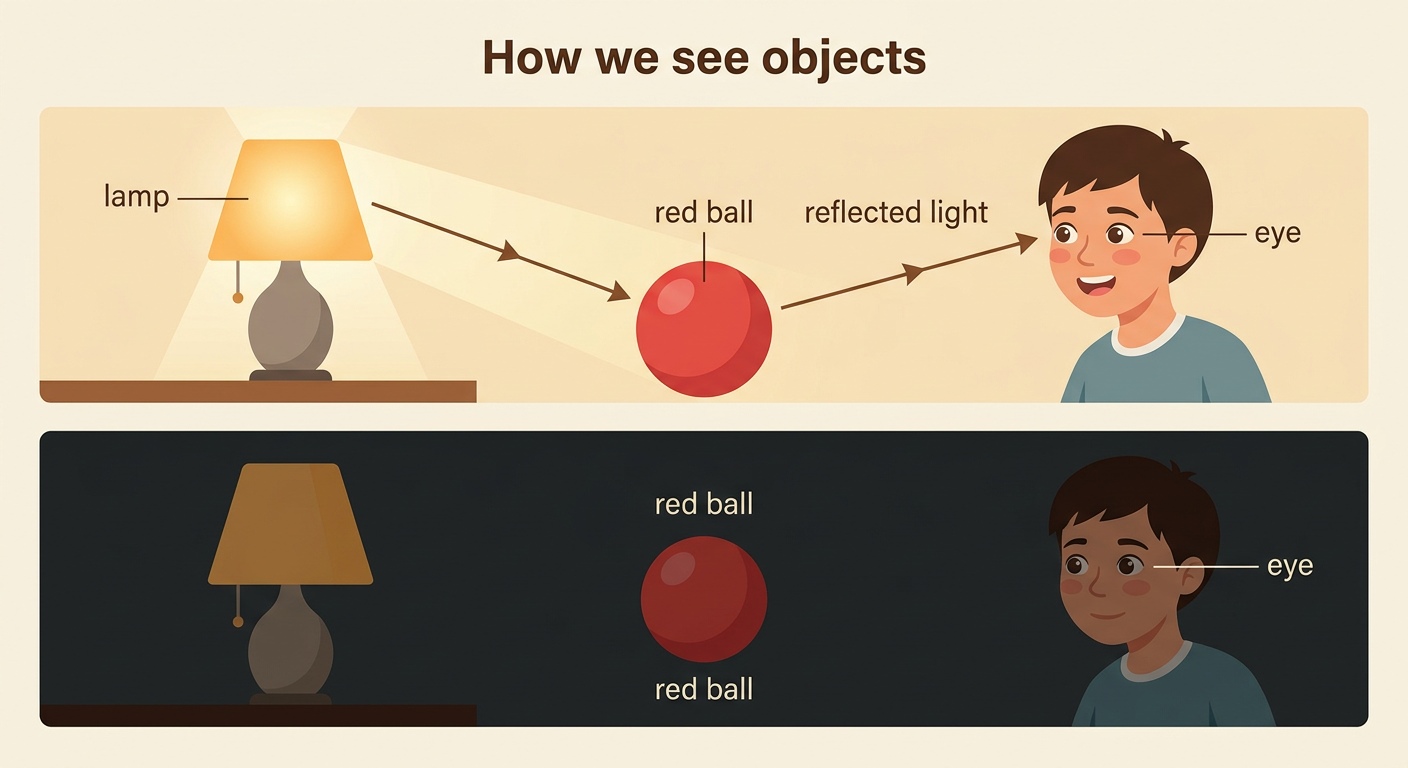
We see an object only when light from that object enters our eyes. Some objects, such as the Sun, a lamp, or a flashlight, produce light. Most objects do not produce light. Instead, light from a source strikes them and reflects, or bounces, in many directions. Some of that reflected light may enter our eyes. Imagine a red ball in a bright room. Light from the lamp reflects from the ball into your eyes, so you see the ball. If the room becomes completely dark, no light reaches the ball and reflects into your eyes. The ball is still there, but you cannot see it. Never test this idea by looking directly at the Sun or another very bright light because intense light can harm your eyes.
Observe Reflected Light
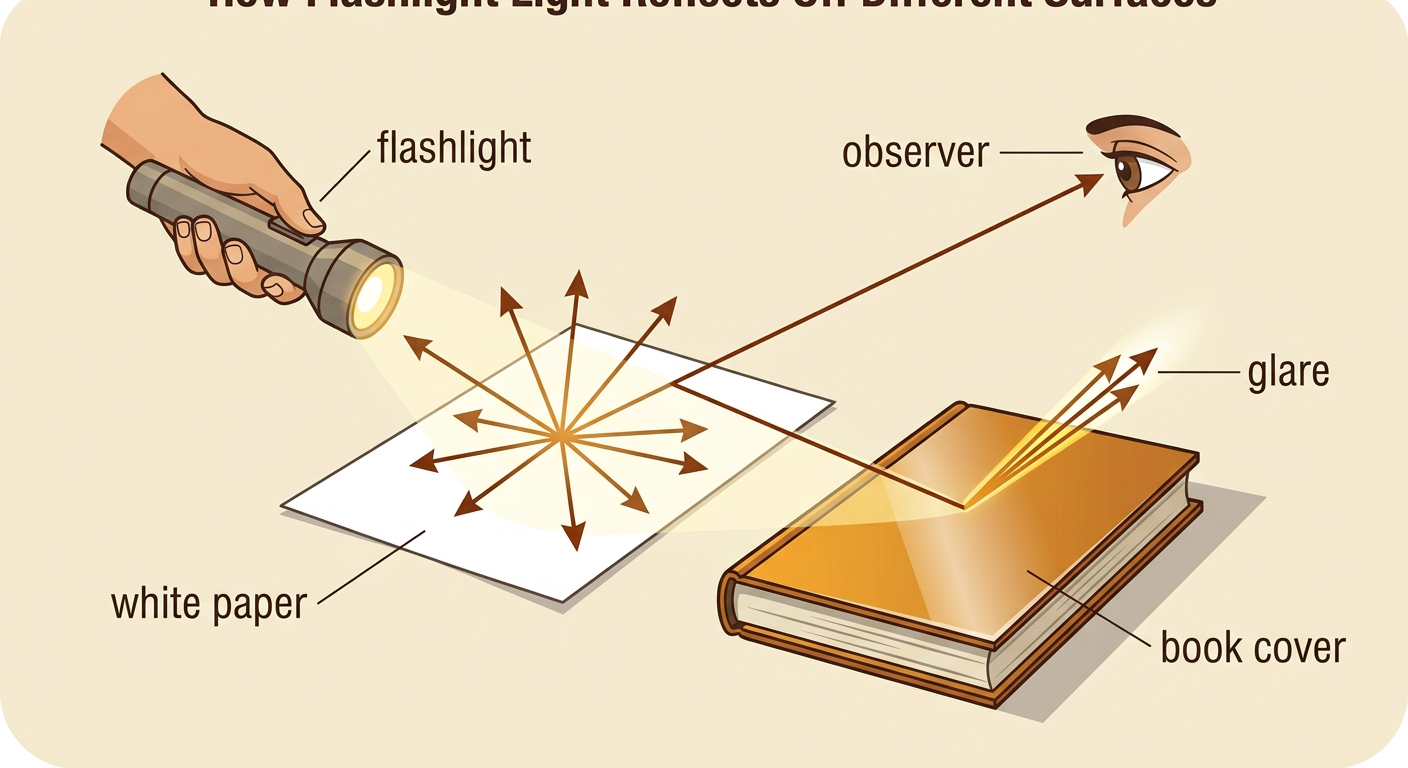
You can observe reflection with a flashlight, a sheet of white paper, and a book in a dim room. Have an adult or partner aim the flashlight at the paper while you look from the side. You can see the bright paper because it reflects flashlight light toward your eyes. Try the book cover in the same way. A shiny cover may produce a bright glare in one direction, while a dull cover spreads reflected light in many directions. Both surfaces reflect light, but they do not reflect it in exactly the same way. Record what you observe, and compare your evidence with a partner's observations or a diagram from a reliable science source. Do not shine the flashlight into anyone's eyes. The evidence supports the idea that objects become visible when reflected light reaches an observer.
Trace the Path of Light
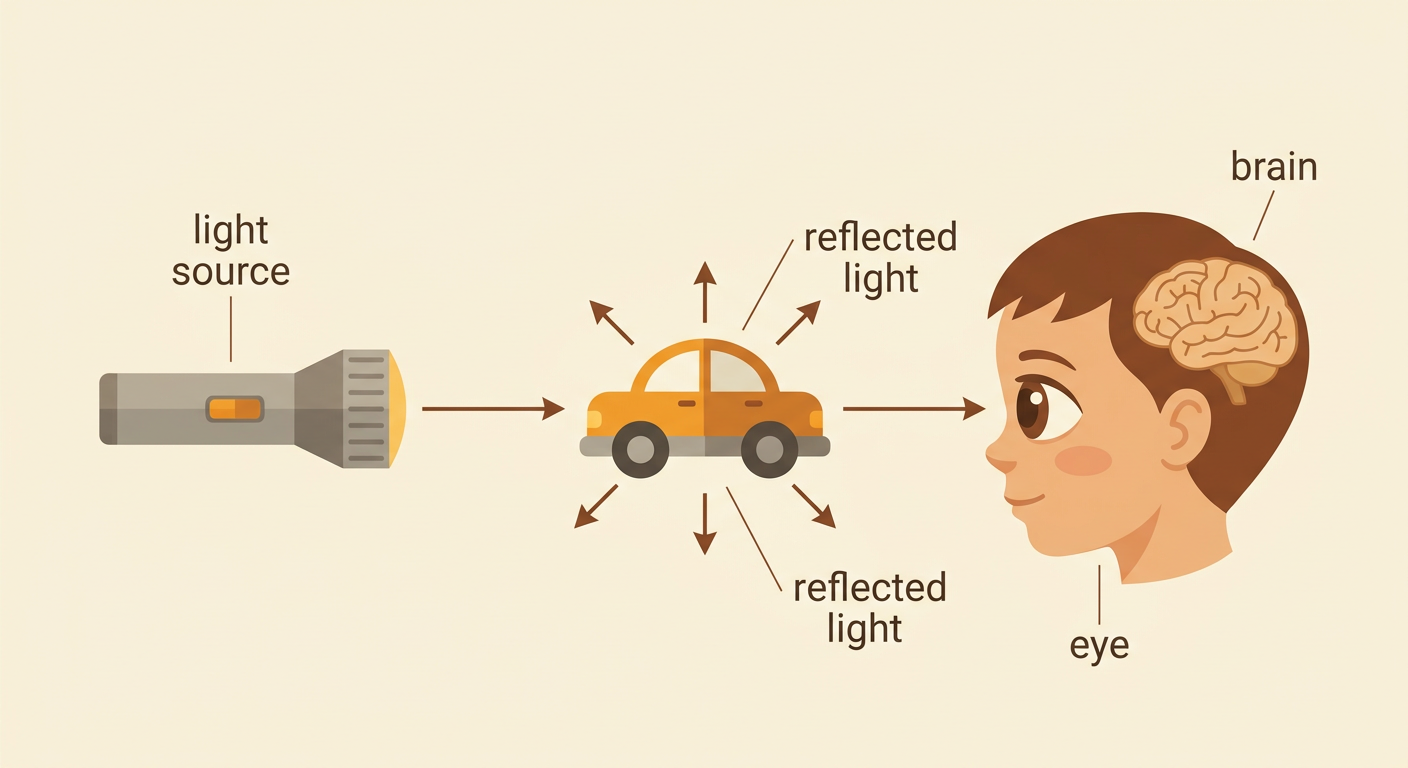
To explain how you see, trace light in the correct order: light source, object, eye. Picture a flashlight shining on a toy car. Light first travels from the flashlight to the car. When the light strikes the car, some of it is absorbed and some is reflected. A portion of the reflected light travels from the car into your eye. Your eye detects that light, and your brain uses the information to recognize the toy car. Draw arrows to show the direction light travels. The arrow from the flashlight must point toward the car, and the arrow from the car must point toward the eye. An arrow pointing from the eye to the car would be incorrect because eyes receive light; they do not send out light for vision.
Build a Light-Ray Model
A model can use points, line segments, and rays to represent the path of light. Mark a point for the flashlight, a point on the object, and a point for the eye. Draw a straight line segment from the flashlight point to the object point. Add an arrowhead to show that the light travels toward the object; this creates a ray model. Then draw another straight ray from the object toward the eye. Label it reflected light. A ray has one endpoint and continues in one direction, while a line segment has two endpoints. Real light can spread in many directions, so your drawing shows only selected paths. Check the model with a partner: Does each arrow show the correct direction? Does reflected light enter the eye? Revise the model if the geometry or science idea is unclear.

Explain How We See
A strong scientific explanation makes a claim, gives evidence, and connects the evidence to the claim with reasoning. Your claim might be, “We see a book when light reflected from the book enters our eyes.” Evidence can come from the light-and-dark comparison, the flashlight investigation, your light-ray model, and a reliable science text or diagram. For example, the book was visible when the flashlight illuminated it but not when no light reached it. Your reasoning should explain that the flashlight supplied light, the book reflected some of that light, and the eye received it. Discuss your explanation with classmates. Listen carefully, ask useful questions, and refer to observations or sources when you agree or disagree. If new evidence reveals a missing step or an incorrect arrow, revise your argument and model to make them more accurate.
