
How Light Reflects and Reaches Our Eyes
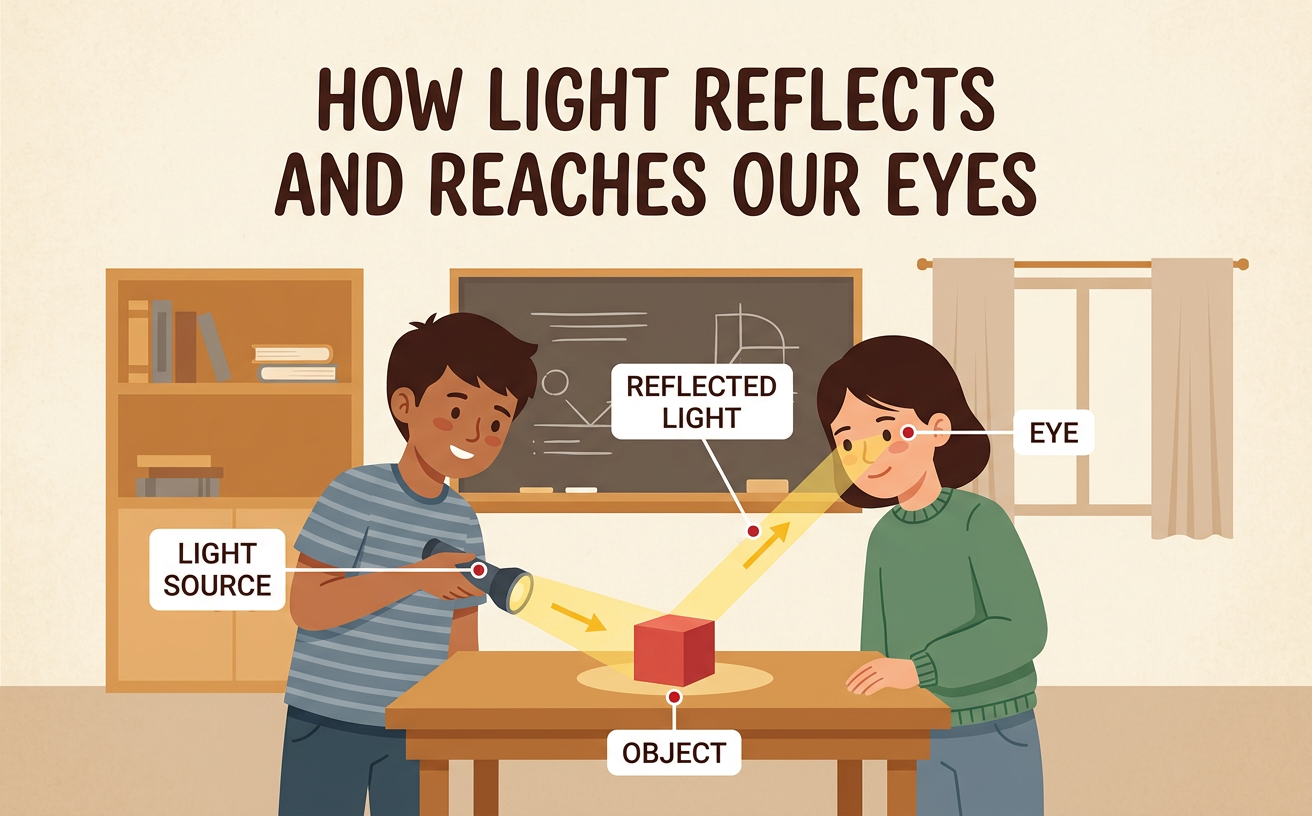
Students use a simple model to explain that objects are visible when light reflects from them and enters the eye.
Illustrations are auto-generated and may be placeholders. They can be refreshed to match the narration.
What Makes an Object Visible?
We see an object only when light from that object enters our eyes. Some objects, such as the Sun, a glowing lightbulb, and a flashlight, produce or give off light. Most objects do not make their own light. Instead, light from a source strikes them and reflects, or bounces, in many directions. If some of that reflected light enters your eyes, you can see the object. For example, light from a lamp may strike a red apple on a table. The apple reflects some of the light toward your eyes, so you see the apple. In a completely dark room, no light reaches the apple to reflect from it. Even though the apple is still there, you cannot see it.

Tracing the Path of Light
A light path describes the order in which light travels. Light usually moves in straight lines through air. To trace how you see a book, begin with the light source, not the eye. First, light travels from a lamp to the book. Next, the book reflects some of that light. Finally, some reflected light travels from the book into your eye. We can show this sequence with arrows: lamp to book to eye. The arrowheads point in the direction that the light moves. The eye receives light; it does not send out rays to find objects. If the book is moved behind a solid wall, the wall blocks the light path, so the book cannot be seen from the other side.

Observing Reflection With a Mirror
A mirror has a very smooth surface, so it reflects light in an organized way. Place a mirror upright on a table and shine a flashlight toward it at a slant. Never shine the flashlight into anyone's eyes. You may see a bright spot on a nearby wall where the reflected beam lands. If you change the direction of the flashlight, the reflected beam also changes direction. Light leaves the mirror at the same angle at which it arrives, measured from an imaginary line perpendicular to the mirror. This predictable reflection lets a mirror form a clear image. A rough wall also reflects light, but its uneven surface scatters light in many directions, so it does not form a clear mirror image.

Drawing a Light-Path Model
A model is a simplified way to explain how something works. To draw a light-path model, include a light source, an object, and an eye. Draw a straight line with an arrow from the source to the object. This represents incoming light. Then draw another line with an arrow from the object to the eye. This represents reflected light. Make every arrowhead point in the direction light travels. For example, a model of seeing a soccer ball outdoors could show sunlight traveling to the ball and reflected light traveling from the ball to a player's eye. The model does not need to show every light ray. It shows the important cause-and-effect relationship that allows the ball to be seen.

Explaining How We See Objects
A strong scientific explanation uses the correct sequence, evidence, and reasoning. Begin by naming the light source. Next, explain that light travels to the object and reflects from it. Finally, state that the reflected light enters the eye, allowing the object to be seen. For example: A student can see a blue backpack because light from the classroom ceiling lamp reaches the backpack, reflects from it, and enters the student's eyes. This explanation connects each event to the next. Evidence can also support the explanation. When the lamp is turned off in a room with no other light, the backpack is no longer visible because no light reaches it to reflect into the eyes. Turning the lamp on restores the complete light path.
