
How Net Force Changes Motion
Students investigate how changing the net force or mass of a toy cart affects its motion and use recorded evidence to explain the results.

Illustrations are auto-generated and may be placeholders. They can be refreshed to match the narration.
Review Force, Mass, and Motion
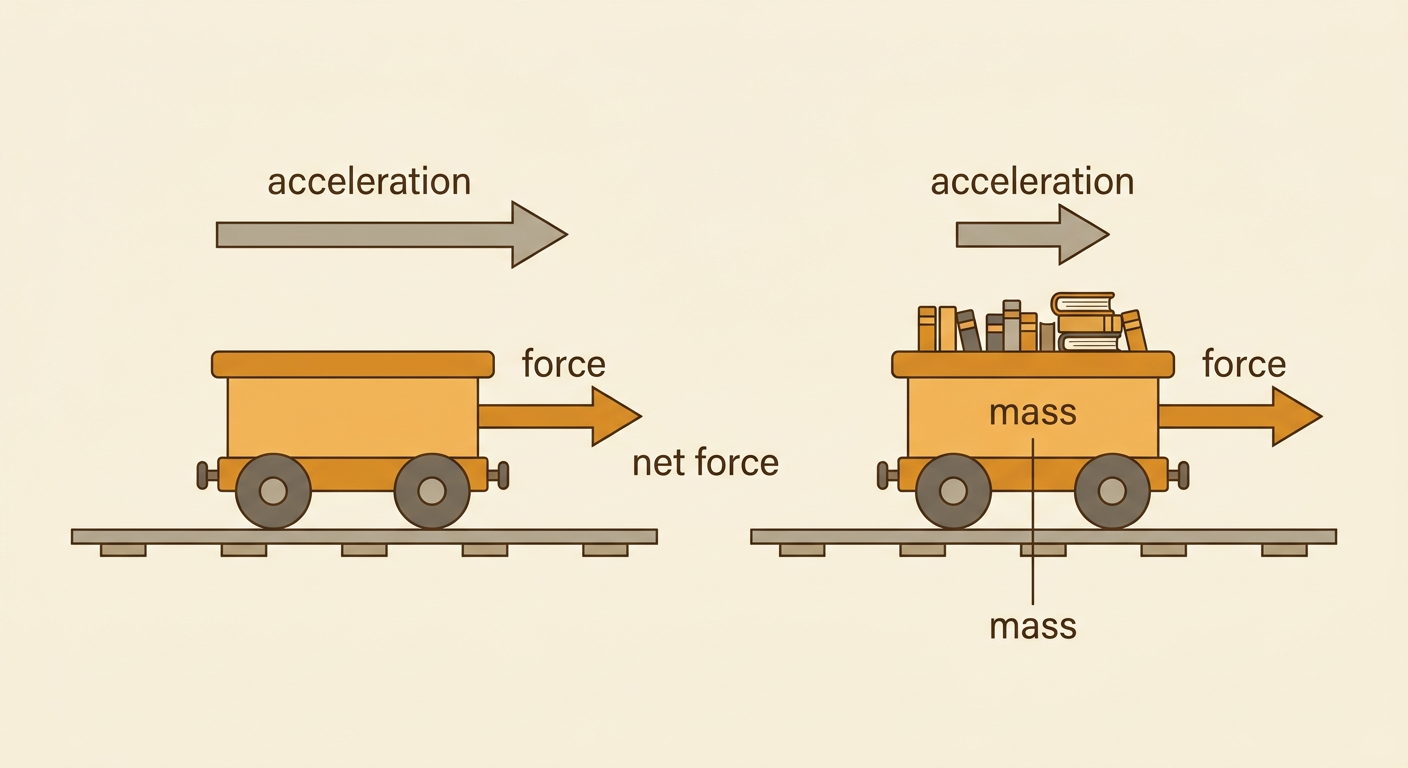
A force is a push or pull measured in newtons (N). Mass is the amount of matter in an object and is measured in grams or kilograms. Motion can be described by an object’s speed and direction. A force can change speed, direction, or both. Net force is the sum of all forces acting on an object, including their directions. An object accelerates when its velocity changes. For the same mass, a greater net force produces a greater acceleration. For the same net force, a greater mass produces a smaller acceleration. For example, an empty toy cart speeds up more easily than the same cart loaded with books when both carts are pushed with equal force. The loaded cart has greater mass, so its change in motion is smaller.
Identify Balanced and Unbalanced Forces
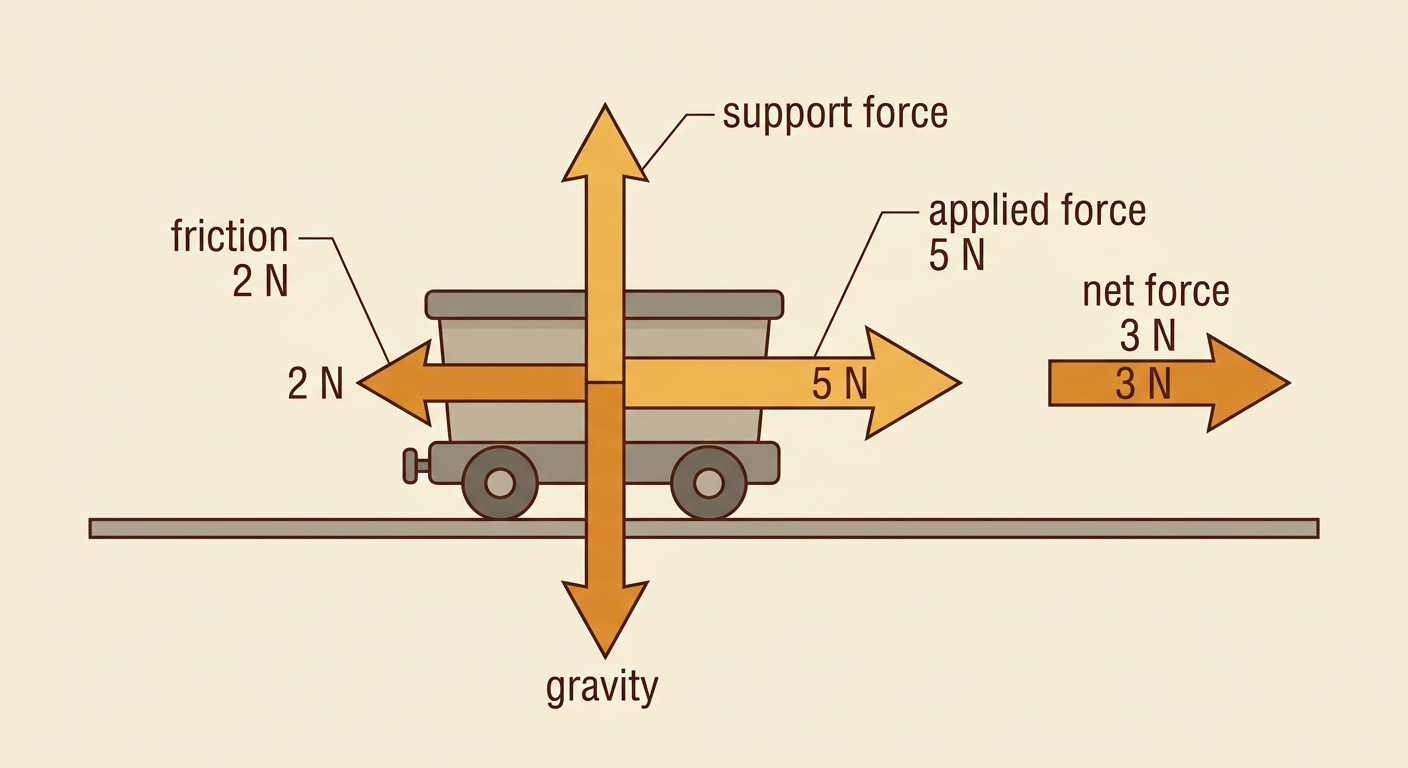
Forces have both size and direction. Balanced forces are equal in size and opposite in direction, so their net force is zero. An object with balanced forces stays at rest or continues moving at a constant velocity. Unbalanced forces do not cancel, so the net force is not zero and the object accelerates in the direction of the net force. Imagine pushing a cart to the right with 5 N while friction acts to the left with 2 N. The horizontal net force is 3 N to the right, so the cart speeds up to the right. Gravity pulls downward on the cart while the track pushes upward. If those vertical forces are equal, they balance. Always examine all force arrows, but combine forces separately for each direction.
Conduct a Toy-Cart Investigation
Use a toy cart, a level track, a fan or another calibrated force source, masses, a meterstick, and a timer or motion sensor. First, mark a starting line and check that the track is level. Second, place the unloaded cart at the line and apply the low force setting. Release the cart without pushing it, then measure its motion for the same amount of time in every trial. Third, repeat the trial at least three times. Fourth, test a higher force while keeping the cart’s mass unchanged. Finally, return to the low force and add a measured mass to the cart. Keep the track, starting position, measuring method, and trial time constant. For example, compare a 0.5 kg cart under low and high force, then compare 0.5 kg and 1.0 kg carts under the same force.

Record and Compare Motion Data
Create a table for each trial with time as the independent variable and speed as the dependent variable. Record force, cart mass, time, distance, and speed with units. Then graph time on the horizontal axis and speed on the vertical axis. A steeper line shows a faster increase in speed and therefore greater acceleration. Acceleration can be calculated as change in speed divided by change in time. For example, suppose a 0.5 kg cart under low force increases from 0 to 1.0 m/s in one second. Under higher force, it increases from 0 to 1.8 m/s in one second. With added mass and the low force, it reaches only 0.6 m/s. Repeated trials and averages make comparisons more reliable and help reveal unusual measurements.

Make an Evidence-Based Claim
An evidence-based explanation includes a claim, evidence, and reasoning. A useful claim is: Increasing the net force increases a cart’s acceleration, while increasing its mass decreases its acceleration when other conditions stay the same. Support the claim with measurements from repeated trials, calculated averages, observations, and patterns in the graph. For example, the cart reached 1.8 m/s with the higher force but only 1.0 m/s with the lower force after the same time. It reached 0.6 m/s when added mass was used with the lower force. Explain that a larger unbalanced force produces a larger change in motion, while more mass resists that change. Also identify limitations. Friction, an uneven track, timer reaction time, or an inconsistent fan could affect results. Evidence from repeated trials is stronger than evidence from one trial.
