How Plants Build Their Bodies
Students analyze evidence and develop a model showing that plants obtain the materials needed for growth chiefly from air and water rather than soil.
Illustrations are auto-generated and may be placeholders. They can be refreshed to match the narration.
What Makes Up New Plant Growth?
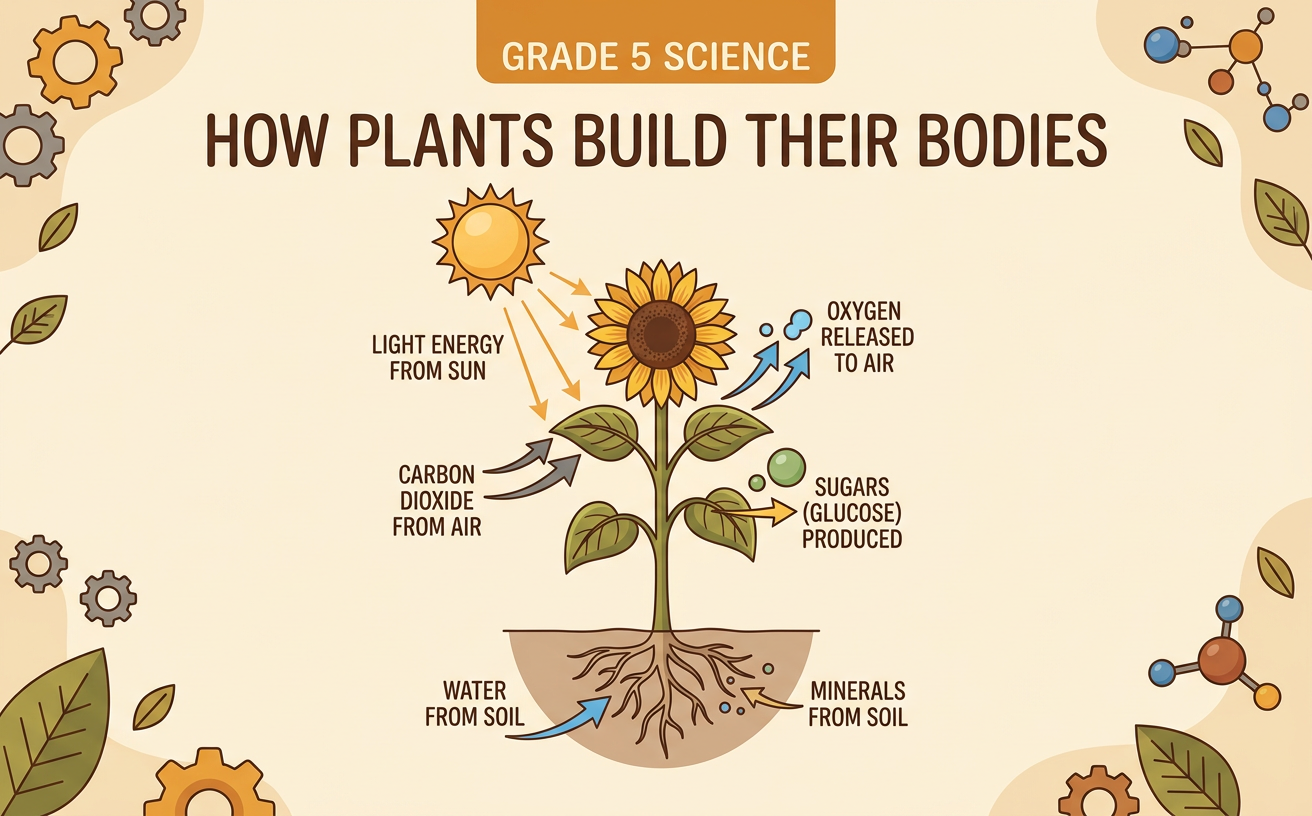
A growing plant makes new roots, stems, leaves, flowers, and fruits. Most of this new material does not come from soil. Leaves take in carbon dioxide, a gas in the air. Roots absorb water. Using energy from sunlight, the plant rearranges matter from carbon dioxide and water to make sugars. It uses these sugars to build substances such as cellulose, which forms much of its body. Sunlight supplies energy, but it is not matter. Soil provides small amounts of essential minerals. For example, a young tree may gain many pounds while the amount of soil around its roots changes very little. This evidence suggests that most of the tree’s added matter came from air and water.

Evidence from a Seedling Investigation
Scientists can measure plant and soil mass to investigate where growth materials come from. Imagine several similar seedlings growing in a measured amount of dry soil. The plants receive only water and light and remain exposed to air. Scientists estimate starting plant dry mass using a matched group of seedlings. After several weeks, they dry and measure the experimental plants and soil again. Suppose plant dry mass increases by 18 grams while soil dry mass decreases by only 0.4 gram. Dry mass is measured so stored water does not hide the change. The large plant gain cannot be explained chiefly by the small soil loss. Because the plants also received water and carbon dioxide from air, the results support the claim that most growth material comes from air and water.

The Roles of Air, Water, and Soil
Air, water, and soil have different roles in plant growth. Carbon dioxide from air supplies much of the carbon used to make sugars and other body materials. Water becomes part of plant matter, helps transport substances, and keeps cells firm. Soil supports roots and usually provides water and minerals such as nitrogen, phosphorus, and potassium. These minerals are essential, even though they make up only a small part of a plant’s total mass. For example, a tomato plant with too little nitrogen may have pale leaves and poor growth. Adding the correct fertilizer can help, but fertilizer alone cannot build the whole plant. The plant still needs carbon dioxide, water, and light. This is why plants can grow without soil in hydroponic systems when their roots receive water containing dissolved minerals.

Modeling How Plants Gain Matter
A scientific model can show how matter moves into and through a plant. Draw material arrows from carbon dioxide in the air to the leaves and from water and dissolved minerals to the roots. Inside the leaves, show carbon dioxide and water being rearranged to form sugars. The plant moves these sugars to growing parts, where their atoms become part of roots, stems, leaves, and fruits. Also draw oxygen leaving the leaves. Use a different arrow for sunlight because sunlight transfers energy rather than matter. For example, carbon atoms from carbon dioxide can later become part of the cellulose in a bean plant’s stem. A good model does not show soil turning directly into the whole plant. It shows that atoms are conserved and rearranged as the plant builds its body.

Defending a Claim with Evidence
A strong scientific argument includes a claim, relevant evidence, and reasoning that connects them. A useful claim is: Plants get the materials needed for growth chiefly from air and water. Quote investigation evidence accurately. For example, write, “The plants gained 18 grams of dry mass, while the soil lost only 0.4 gram.” Then explain the inference: the small soil loss could not account for most of the added plant mass. The plants had access to water and carbon dioxide in the air, so those sources better explain the gain. Address a possible counterclaim too. Soil matters because it supplies minerals and support, but the data do not show that soil supplied most of the new matter. Accurate evidence and clear reasoning make the argument stronger than simply stating an opinion.

Helping Plants Grow in Different Environments
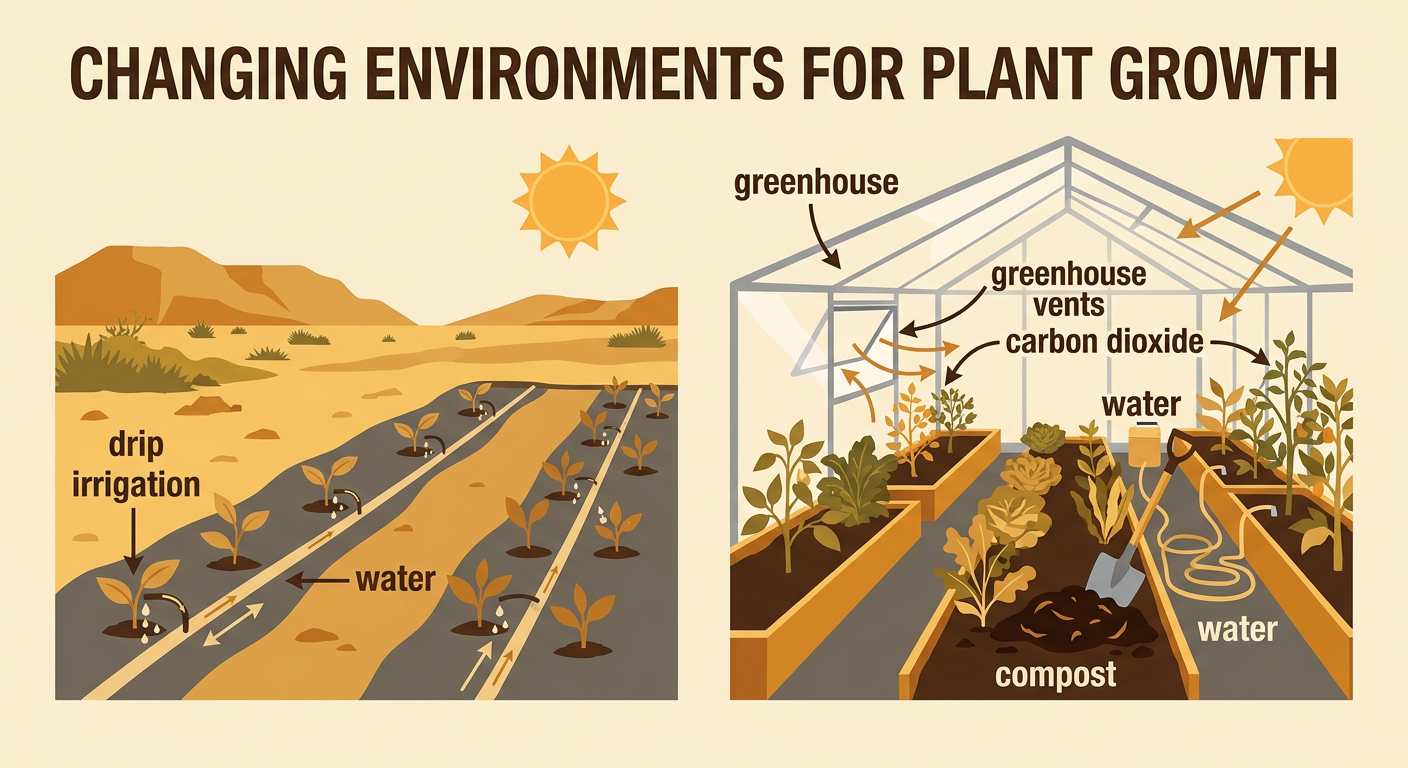
People modify environments so plants can obtain water, air, light, and suitable temperatures. Their choices are influenced by climate, local knowledge, technology, available resources, and cultural practices. In a dry region, farmers may use canals or drip irrigation to deliver water while limiting evaporation. In a cold region, growers may use greenhouses to trap warmth and extend the growing season. Greenhouse vents or fans allow fresh air to reach leaves because plants need carbon dioxide. Gardeners may also use compost to replace minerals removed during harvest. For example, a desert community might combine traditional knowledge about planting times with modern drip tubing. These methods change growing conditions, but they do not change the basic science: plants still build most of their new matter from carbon dioxide in air and from water.