How Plants Store Sunlight: Modeling Photosynthesis
Students use molecular models, data, and a global vegetation map to explain how photosynthesis converts light energy into stored chemical energy.
Illustrations are auto-generated and may be placeholders. They can be refreshed to match the narration.
Where Does Plant Mass Come From?
A growing plant gains dry mass mostly by taking carbon dioxide from the air, not by absorbing soil as food. Through photosynthesis, carbon atoms from carbon dioxide become part of sugars and other carbon-based molecules. Plants use these molecules to build cellulose, starch, oils, and proteins. Water supplies hydrogen and also contributes to photosynthesis, while soil provides small but essential amounts of minerals such as nitrogen and phosphorus. For example, a young tree may gain many kilograms of wood while the surrounding soil loses very little mass. Much of the new wood is made of carbon compounds built from atmospheric carbon dioxide. Plant mass is matter, so its atoms must come from matter entering the plant. Sunlight provides energy for building that matter into energy-rich molecules, but light itself does not become mass.

Inputs and Outputs of Photosynthesis
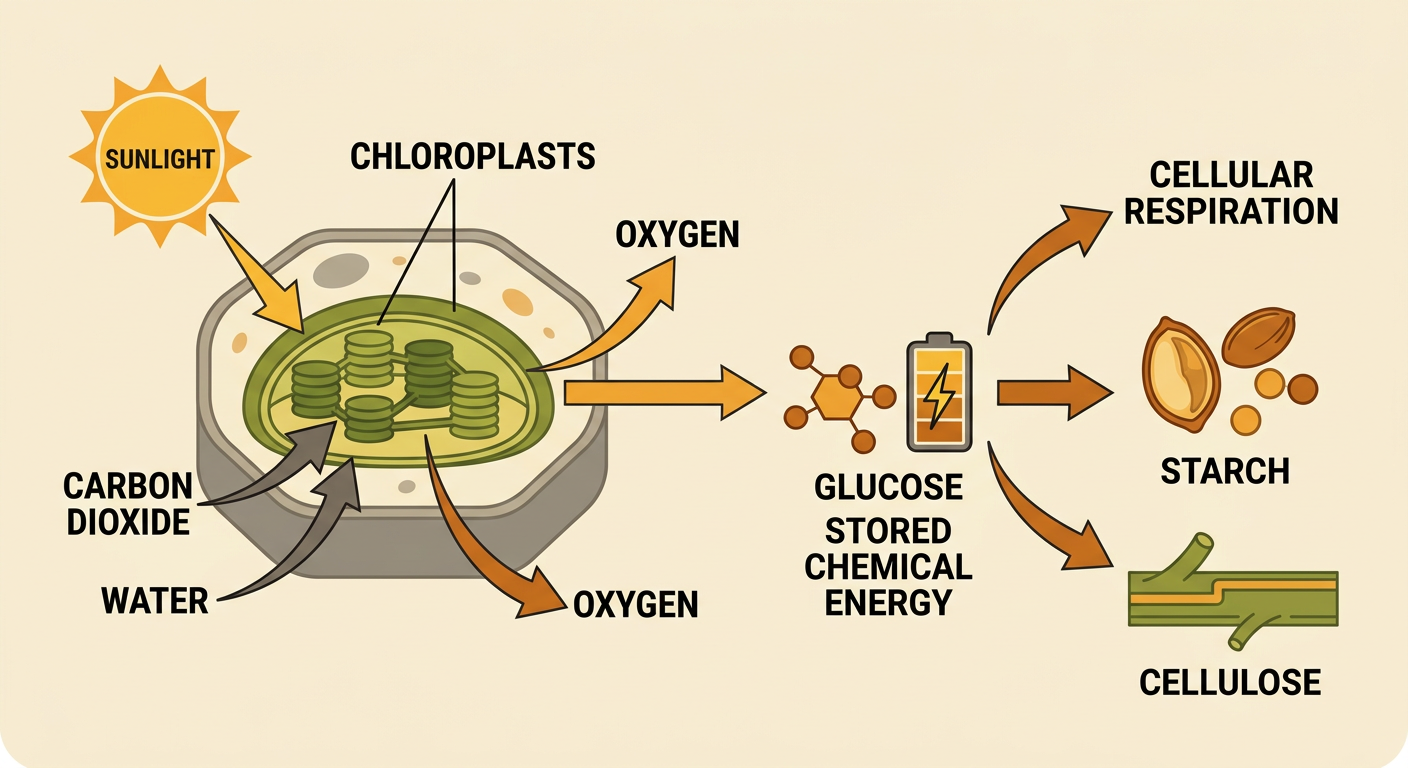
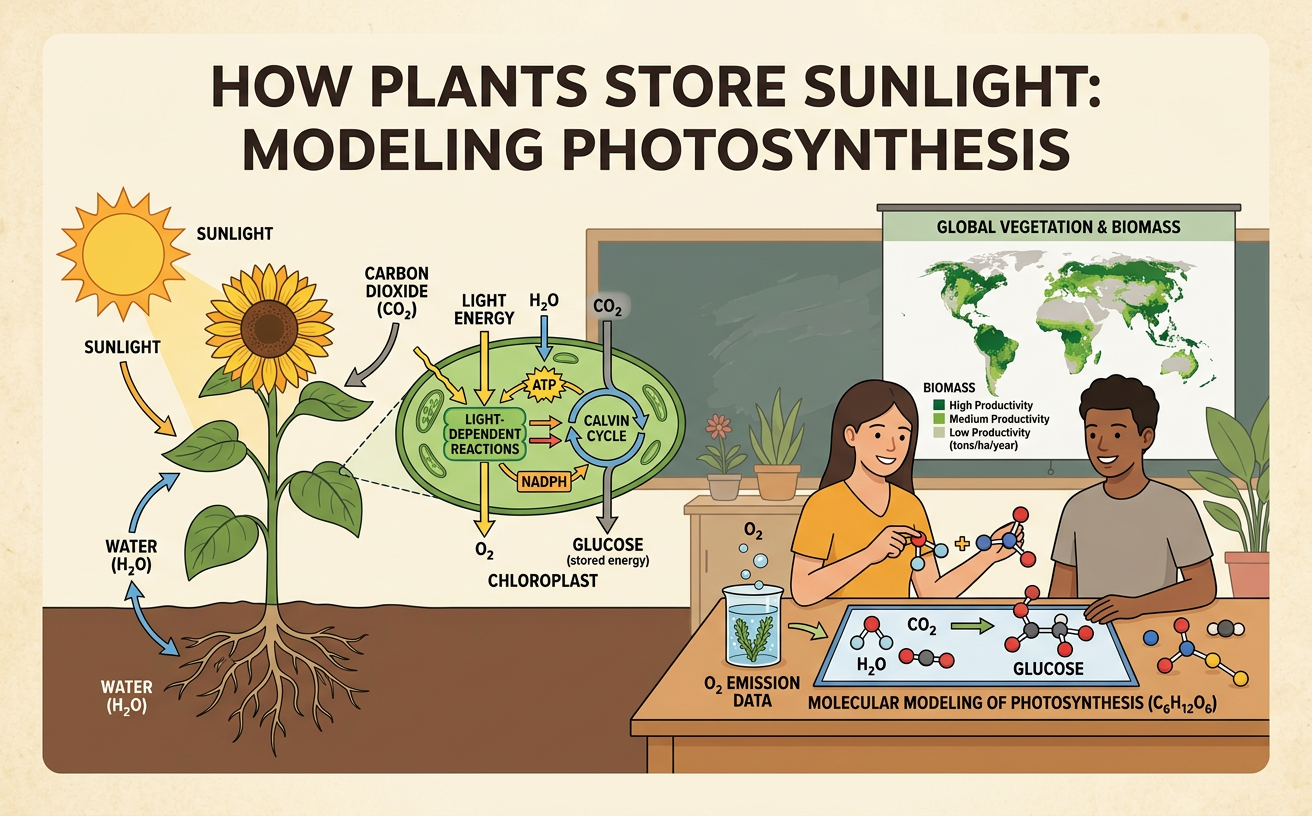
Photosynthesis can be summarized by the equation 6CO2 + 6H2O + light energy → C6H12O6 + 6O2. The reactants are carbon dioxide and water, and light supplies the energy that drives the process. The products shown in this simplified equation are glucose and oxygen. In a leaf, carbon dioxide enters through small openings called stomata, water arrives through veins, and chlorophyll absorbs light inside chloroplasts. For example, an aquatic plant exposed to bright light may release visible oxygen bubbles into the water. The glucose produced contains stored chemical energy. A plant can use glucose in cellular respiration, join glucose units to make starch or cellulose, or use its atoms to make other molecules. Photosynthesis therefore changes both matter and energy: atoms are rearranged, while light energy is transformed into chemical energy.

Build a Molecular Model
Use colored pieces to represent atoms: black for carbon, white for hydrogen, and red for oxygen. Build six carbon dioxide molecules and six water molecules on the reactant side. You should have 6 carbon atoms, 12 hydrogen atoms, and 18 oxygen atoms. Rearrange the same pieces to form one glucose molecule and six oxygen molecules on the product side. Count again; each type of atom must have the same total before and after the reaction. This demonstrates conservation of matter because photosynthesis does not create or destroy atoms. For example, the six carbon atoms that began in six carbon dioxide molecules all appear in glucose. Add a light arrow above the model to represent energy entering the system, but do not model light as an atom. The model is useful but simplified because photosynthesis occurs through many intermediate reactions rather than one single step.

Interpret Light-Intensity Data
A graph can show how photosynthesis responds to changing light intensity. Place light intensity on the horizontal axis and photosynthesis rate, measured as oxygen production, on the vertical axis. Suppose oxygen production rises from 2 units at low light to 8 units at medium light, then remains near 9 units as light increases further. The upward region indicates that light is limiting the rate. The nearly flat region is a plateau, where another factor such as carbon dioxide concentration or temperature limits photosynthesis. To make a fair comparison, keep plant type, temperature, carbon dioxide availability, and measurement time constant. For example, doubling light intensity may nearly double oxygen production at low light but cause little change near the plateau. Interpret the overall pattern rather than assuming every increase in light produces the same increase in photosynthesis.

Explore Global Vegetation Patterns
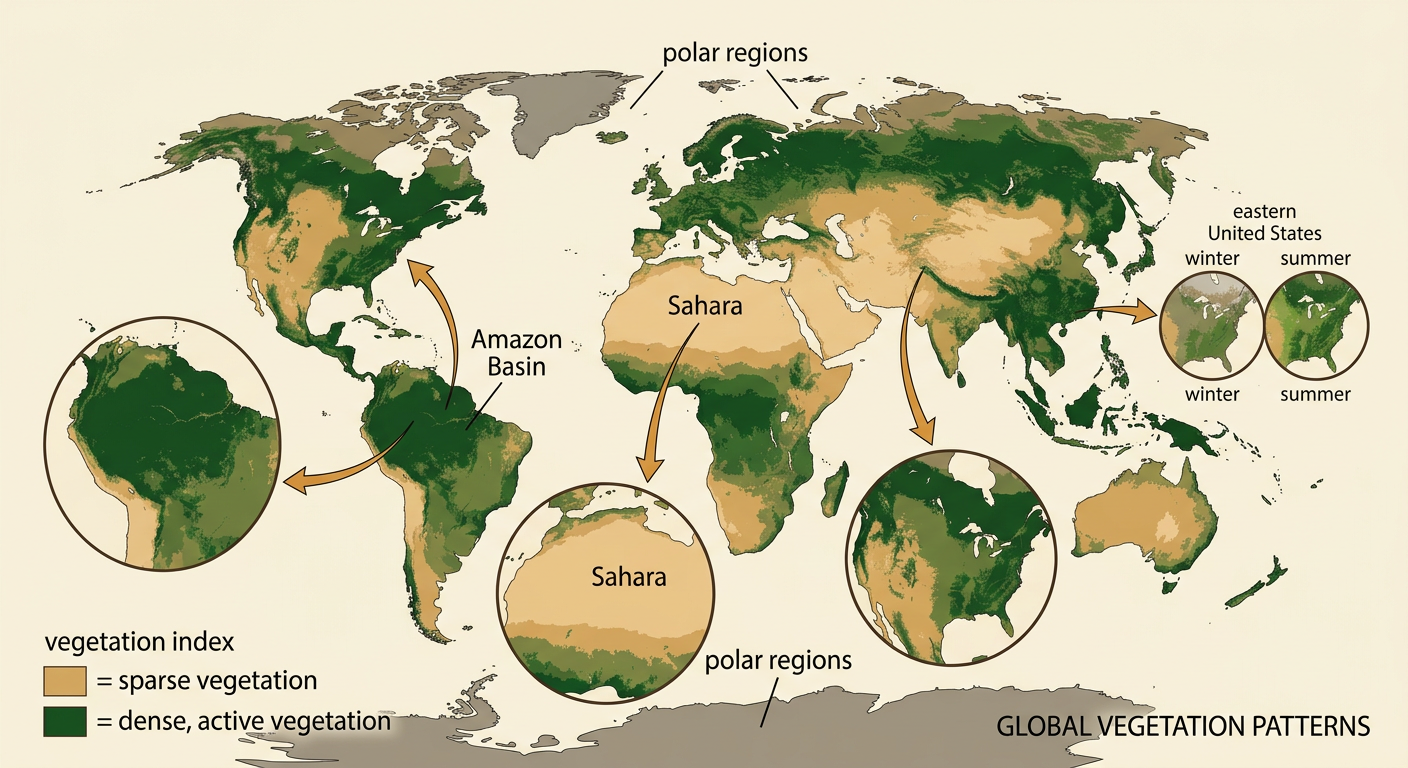
Satellite vegetation maps use reflected light to estimate the amount and activity of green vegetation. High vegetation index values often appear in warm, wet regions such as the Amazon Basin, where plants can photosynthesize during much of the year. Low values occur in dry deserts such as the Sahara and in polar regions where cold temperatures, ice, or long dark seasons restrict plant growth. Patterns also vary by season and scale. For example, the eastern United States becomes greener from spring into summer, while cities, farms, and forests create smaller local differences within the region. A green map color does not directly measure stored sugar; it is evidence of leaf cover and photosynthetic activity. To explain a pattern, compare the map with geographic data about sunlight, rainfall, temperature, elevation, and land use rather than attributing vegetation to sunlight alone.
Explain How Sunlight Becomes Food
Sunlight does not turn directly into matter. Instead, chlorophyll in chloroplasts absorbs light energy, and photosynthetic reactions use that energy to rearrange carbon dioxide and water into energy-rich carbon compounds. Glucose is commonly used in models as the main product. Its chemical bonds represent stored chemical energy that can later be released during cellular respiration. A sunflower, for example, may use some glucose immediately for respiration, store some as starch in its seeds, and convert some into cellulose for a stronger stem. Oxygen is released as a product of the overall process. A complete explanation should connect three ideas: matter is conserved as atoms are rearranged, energy changes form from light energy to chemical energy, and environmental conditions affect the rate and geographic pattern of photosynthesis. Models, graphs, and maps provide different kinds of evidence for this explanation.