
How Plot Events Reveal Character
Students analyze how a character’s responses to key events reveal traits, motivations, and changes over the course of a story.
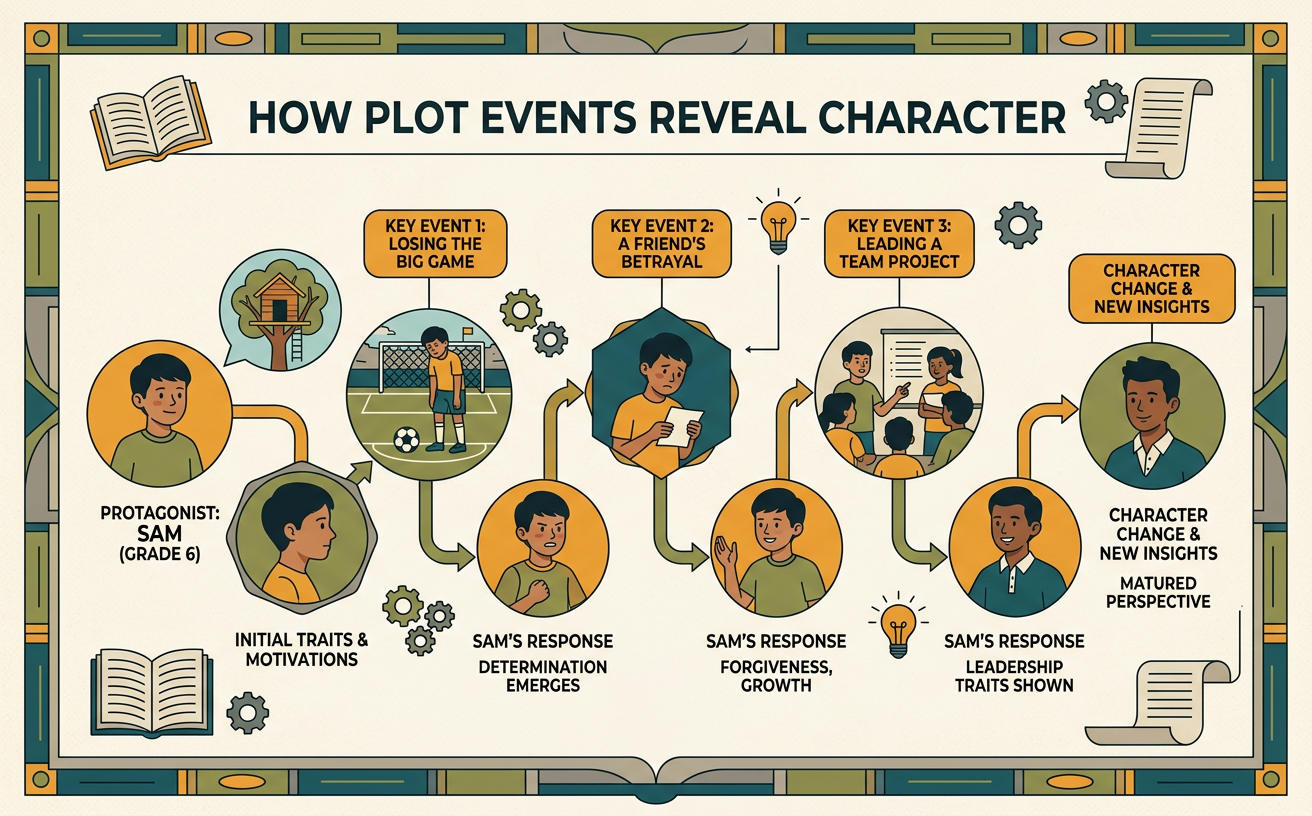
Illustrations are auto-generated and may be placeholders. They can be refreshed to match the narration.
Identify Key Plot Events
A plot unfolds through episodes, or connected groups of events. Key plot events are moments that create a problem, force a decision, raise the stakes, or move the story toward a resolution. Minor details may add interest, but they do not strongly affect what happens next. Imagine a story about Maya, who wants to win a school robotics contest. First, her team’s robot stops working the night before the contest. Next, Maya discovers that a teammate connected two wires incorrectly. Instead of giving up, the team repairs the robot and competes. The breakdown, discovery, repair, and contest are key events because each one changes the situation. To identify key events, ask, “If this event were removed, would the conflict, character, or outcome be different?” If the answer is yes, the event is probably important to the plot.

Examine the Character’s Responses
A character’s response is what the character does, says, thinks, or feels after an event. Responses matter because different characters may react to the same problem in different ways. In the robotics story, Maya first stares at the broken robot and worries that the team will fail. Then she takes a breath, asks everyone to check one part, and carefully tests the wires. Her feelings show that she is afraid, but her actions show that she does not let fear control her. When examining a response, connect it directly to the event that caused it. Notice dialogue, actions, thoughts, facial expressions, and decisions. Also consider the result of the response. Maya’s decision to organize the team helps them find the error. A useful pattern is event, response, and result: the robot fails, Maya organizes a careful inspection, and the team discovers the problem.

Infer Traits and Motivations
A trait is a quality that describes what a character is usually like, such as patient, loyal, impulsive, or determined. A motivation is the reason a character acts. Authors do not always state traits and motivations directly, so readers infer them by combining story clues with logical thinking. When Maya divides the repair work, listens to suggestions, and keeps testing the robot, readers can infer that she is organized and determined. Her motivation is not simply to win; she also wants to protect the team’s hard work and avoid disappointing her friends. A strong inference must fit several details, not just one action. For example, one careful action does not prove that a character is always patient. Look for patterns in choices, dialogue, thoughts, and responses. Then explain your reasoning: Maya keeps working after a serious setback, so her behavior suggests determination.

Trace Character Change
Characters may change as they face problems and experience the consequences of their choices. To trace change, compare the character near the beginning, middle, and end of the story. Ask what the character believes, feels, or does at each stage and which events cause a shift. At the beginning of the robotics story, Maya believes that a good leader must solve every problem alone. After the robot breaks, she becomes overwhelmed because she tries to inspect everything herself. In the middle, a teammate suggests dividing the work, and Maya agrees. By the end, she trusts each team member to handle a task and thanks them for their ideas. The repair experience changes her understanding of leadership. She remains determined, but she becomes more cooperative. Some characters do not change; in that case, explain how their consistent response affects the resolution.

Support Analysis with Text Evidence
Text evidence is a specific detail or quotation that supports an idea about a character. Begin with a claim, add relevant evidence, and explain how the evidence proves the claim. Suppose the story says, “Maya pushed her own tools aside and handed each teammate a checklist.” You might write: Maya becomes a more cooperative leader. When she gives each teammate a checklist, she stops trying to complete every repair herself. This action shows that she now trusts the group. The quotation alone is not enough; the explanation connects it to the claim. Choose evidence from important moments, and use more than one detail when possible. You can also compare evidence from early and late episodes. An early detail showing Maya refusing help and a later detail showing her sharing responsibility provide strong proof that she changes as the plot moves toward its resolution.
