
How Pushes and Pulls Change Motion
Students investigate how the strength and direction of a push or pull can change an object's speed or direction of motion.

Illustrations are auto-generated and may be placeholders. They can be refreshed to match the narration.
Notice Objects in Motion
Motion means a change in where an object is. Look at a toy car on the floor. At first, the car is still. When you push it, the car begins to move away from your hand. A push is a force that moves something away from the source of the force. A pull is a force that moves something toward the source of the force. You can describe motion by noticing an object’s speed and direction. Speed tells how fast or slow it moves. Direction tells which way it moves, such as left, right, forward, or backward. Observe carefully before, during, and after a push or pull. These observations help you explain how a force changed the car’s motion.

Explore Gentle and Strong Pushes
The strength of a push can change an object’s motion. A gentle push uses a small amount of force. A strong push uses more force. Place the same toy car at the same starting line for each test. First, give it a gentle push and measure how far it travels. Then return it to the line and give it a stronger push in the same direction. On the same smooth surface, the stronger push will usually make the car start faster and travel farther before it stops. Keep everything else the same so the test is fair. Use only enough force to move the car safely. Compare the two distances to tell how changing the strength of the push affected the car’s motion.

Test Different Push and Pull Directions
The direction of a push or pull can change the direction an object moves. Put a toy car in the center of a smooth floor area. Push the car from behind, and it moves forward. Push it gently from the right side, and its path turns left. Tie a string securely to the car and pull the string toward you. The car moves toward you because a pull acts in that direction. Test one direction at a time and keep the strength as similar as you can. Use arrows to show where the force acts and where the car goes. Never pull a string near anyone’s face. Comparing these tests shows that changing the direction of a force can start motion, stop motion, or turn a moving object.

Record and Graph Results
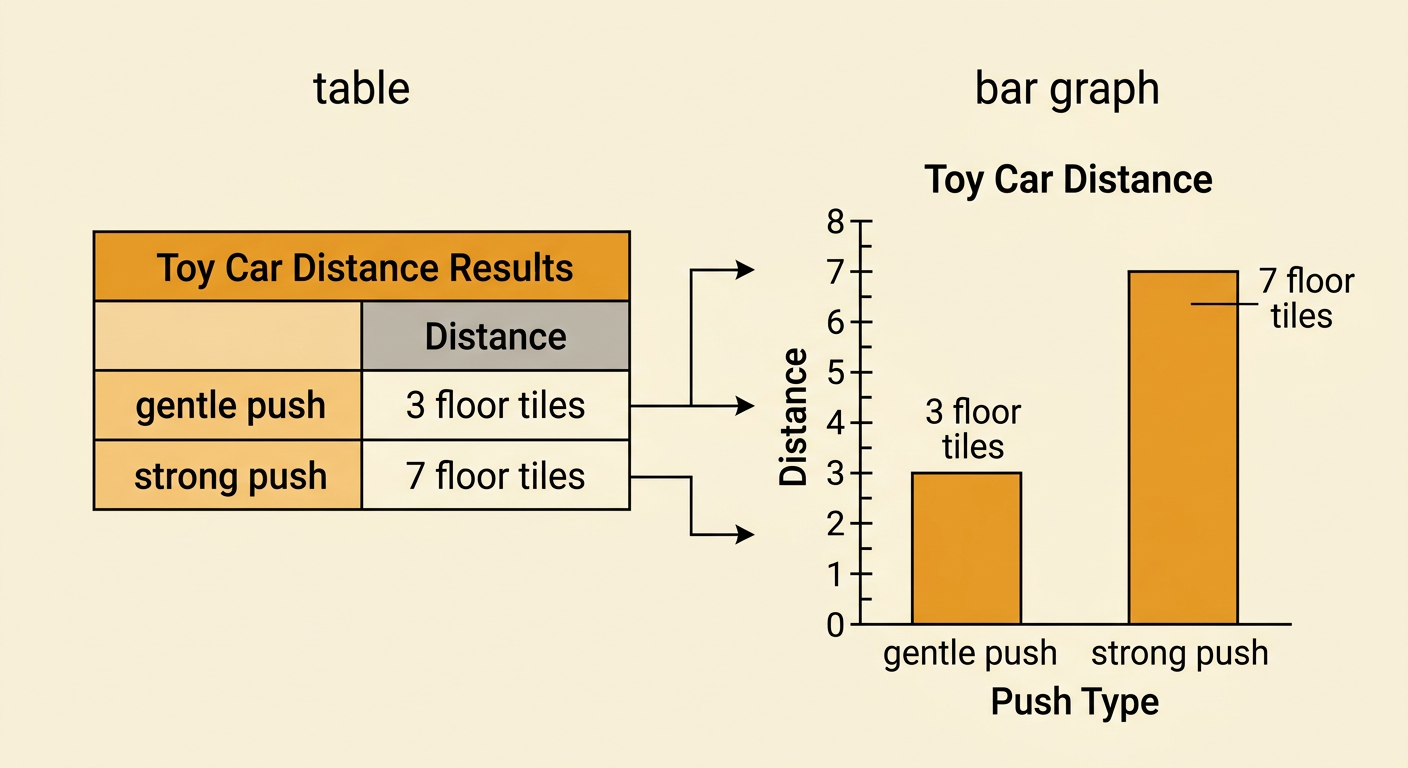
Scientists record results so they can compare tests. Make a table with one row for a gentle push and one row for a strong push. Measure how far the toy car travels using equal units, such as floor tiles or inches. Complete several safe trials if time allows. Then make a bar graph. Write the type of push along the bottom and distance along the side. Draw one bar for each push. Each block on the graph must represent the same distance. For example, if a gentle push moves the car 3 floor tiles and a strong push moves it 7 floor tiles, the strong-push bar should be taller. Add a title and clear labels. The graph helps you see and explain which push moved the car farther.
Explain How Motion Changed
Use your observations, measurements, and graph to explain what happened. Put events in time order: before, during, and after the force. For example, before the test, the toy car was still at the starting line. During the test, a student pushed it forward with a strong push. After the push, the car moved quickly, traveled 7 floor tiles, slowed down, and stopped. This sequence tells how the motion changed over time. Include evidence from the investigation in a shared class report. You might write, “The strong push made the car travel farther than the gentle push on the same surface.” You can also explain direction: “A pull toward me made the car move toward me.” Evidence makes your explanation clear and supports your ideas.
