
How Search Engines Index and Rank Information
Students model a simplified search engine by calculating relevance scores for sample webpages, comparing rankings, and evaluating why ranking does not necessarily indicate credibility.
Illustrations are auto-generated and may be placeholders. They can be refreshed to match the narration.
From Web Crawling to Indexing
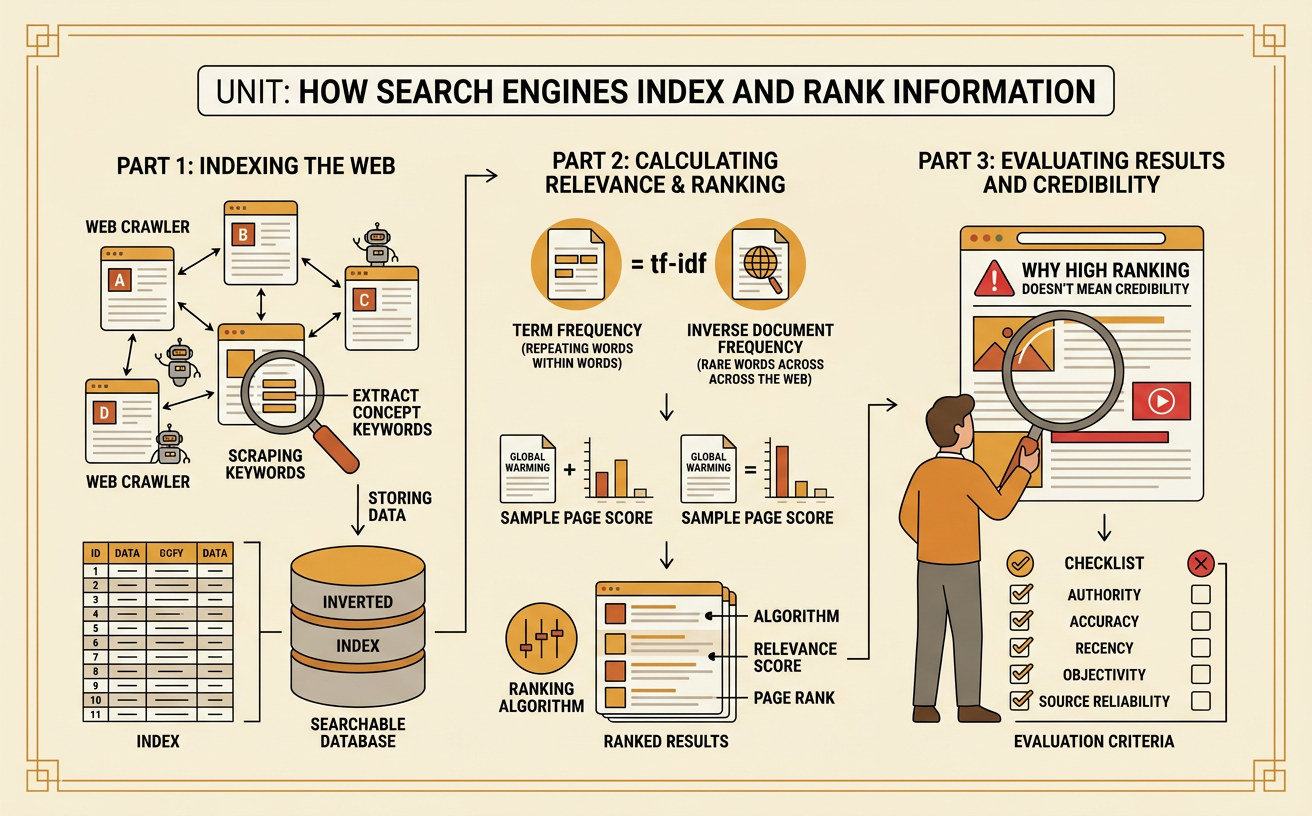
A search engine first discovers webpages with automated programs called crawlers. A crawler follows links from one page to another, downloads permitted content, and records information such as the page title, text, URL, and update date. The search engine then processes the content into an index. An index is organized somewhat like the index in a textbook: it connects important terms to the pages containing them. For example, after visiting three pages, the engine might connect the term “solar” to Pages A and C and the term “battery” to Pages A and B. It may also record where each term appears and how often it occurs. Crawlers do not reach every page. A page may be private, newly published, blocked from crawling, disconnected from other pages, or difficult for the crawler to interpret. Therefore, search results come from the engine’s index, not directly from the entire web.

Calculate Term-Relevance Scores
A search engine can estimate relevance by assigning points for matches between a query and indexed pages. Use the query “solar battery storage” and this simplified rule: add 3 points when a query term appears in the page title, then add 1 point for each occurrence in the body, with body points capped at 3 per term. Page A has “solar” and “battery” in its title, earning 6 title points. Its body earns 1 point for solar, 2 for battery, and 3 for storage, so its total is 12. Page B has “storage” in its title for 3 points. Its body earns 3 points for solar, 3 for battery, and 1 for storage, producing a total of 10. Page C receives 3 title points for solar and 4 body points, producing a total of 7. This model uses measurable evidence but greatly simplifies real algorithms.

Rank the Sample Pages
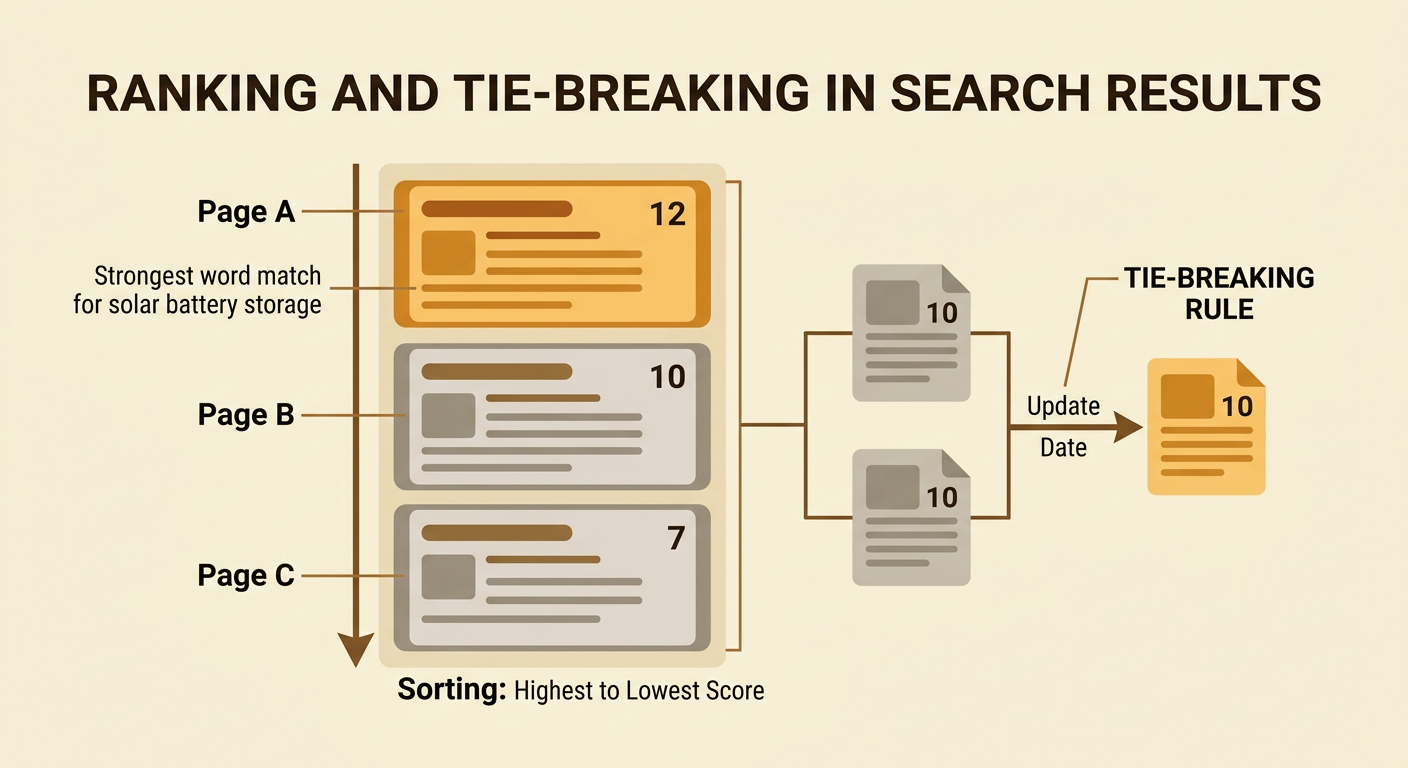
To create a results list, sort the pages from the highest relevance score to the lowest. Using the calculated scores, Page A ranks first with 12 points, Page B ranks second with 10 points, and Page C ranks third with 7 points. This ordering suggests that Page A most closely matches the words in the query “solar battery storage” under the chosen rules. It does not prove that Page A gives the best explanation or the most trustworthy advice. A complete ranking system may use many additional signals, including link relationships, location, freshness, page usability, and the meaning of the full query. It also needs a tie-breaking rule. If two pages both score 10, the system might place the more recently updated page first. Students should state the rule clearly because different rules can create different rankings from the same indexed information.
Test Changes to the Ranking Rules
Ranking is an engineering solution shaped by priorities, trade-offs, and constraints. Test its sensitivity by changing one rule at a time. Suppose title matches are reduced from 3 points to 1 point while the body rule stays the same. Page A changes from 12 to 8 because it has two title matches and 6 body points. Page B also changes to 8 because it has one title match and 7 body points. Page C changes to 5. The new rule creates a tie between Pages A and B. If the system then adds a 2-point freshness bonus and Page B was updated recently, Page B rises to 10 and ranks first. Freshness can help with changing topics, but it may unfairly lower older sources that remain accurate. Designers must evaluate whether each signal improves useful results without making the system too easy to manipulate or too costly to operate.

Compare Relevance and Credibility
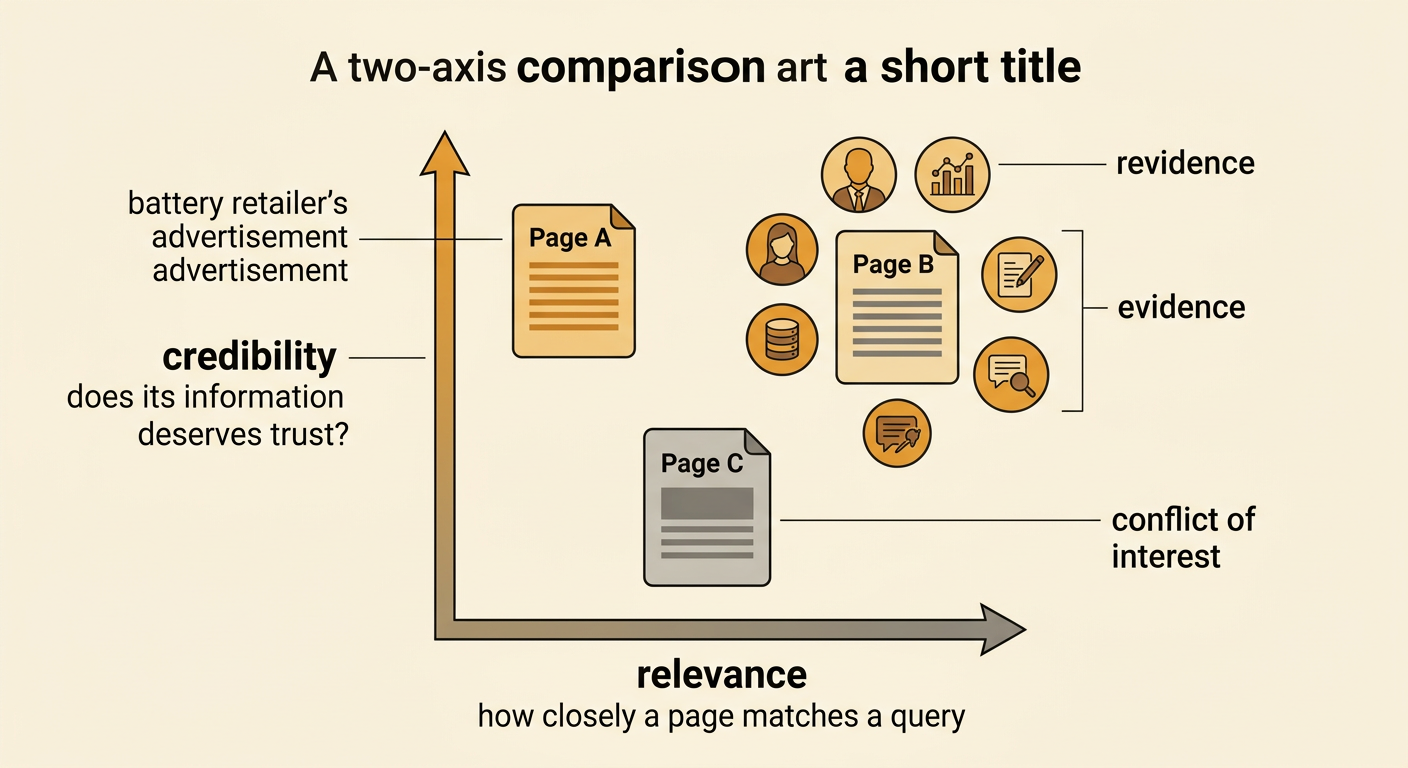
Relevance measures how well a page matches a query, while credibility concerns whether its information deserves trust. Imagine that Page A, the top-ranked result, is a battery retailer’s advertisement. It repeats the query terms accurately but makes claims without evidence. Page B is a Department of Energy report written by identified specialists, supported by data, and reviewed by technical experts. Page C is an anonymous blog post with no citations. Page A may remain the most relevant under the scoring rule, but Page B has stronger credibility indicators. To evaluate a source, examine the author’s expertise, publication organization, evidence, citations, review process, purpose, and date. Also check how knowledgeable experts refer to or use the source. A financial interest does not automatically make a claim false, but it creates a possible conflict that should be considered. Students should compare multiple sources rather than treating rank as proof.
Identify Limits of Search Rankings
Search rankings are useful filters, but they have important limits. A search engine can rank only content it has discovered and indexed, so private databases, unlinked pages, and newly published material may be missing. Ranking signals can also favor popular sites, widely used languages, or organizations with resources for search engine optimization. Personalization and location may cause two people to receive different results. For example, a search for “local flood safety” might emphasize nearby news stories, while overlooking an older government evacuation map that remains essential. Repeatedly promoting already popular pages can create a feedback loop in which visibility produces more links and even greater visibility. Advertisements may also appear near regular results and should be identified separately. Responsible users revise search terms, inspect results beyond the first page, distinguish sponsored content, compare independent sources, and verify important claims with authoritative evidence before making a decision.