How Search Engines Rank Results
Students model how a search engine scores and orders results, then evaluate how ranking rules can affect relevance, reliability, and fairness.

Illustrations are auto-generated and may be placeholders. They can be refreshed to match the narration.
What a Search Engine Does
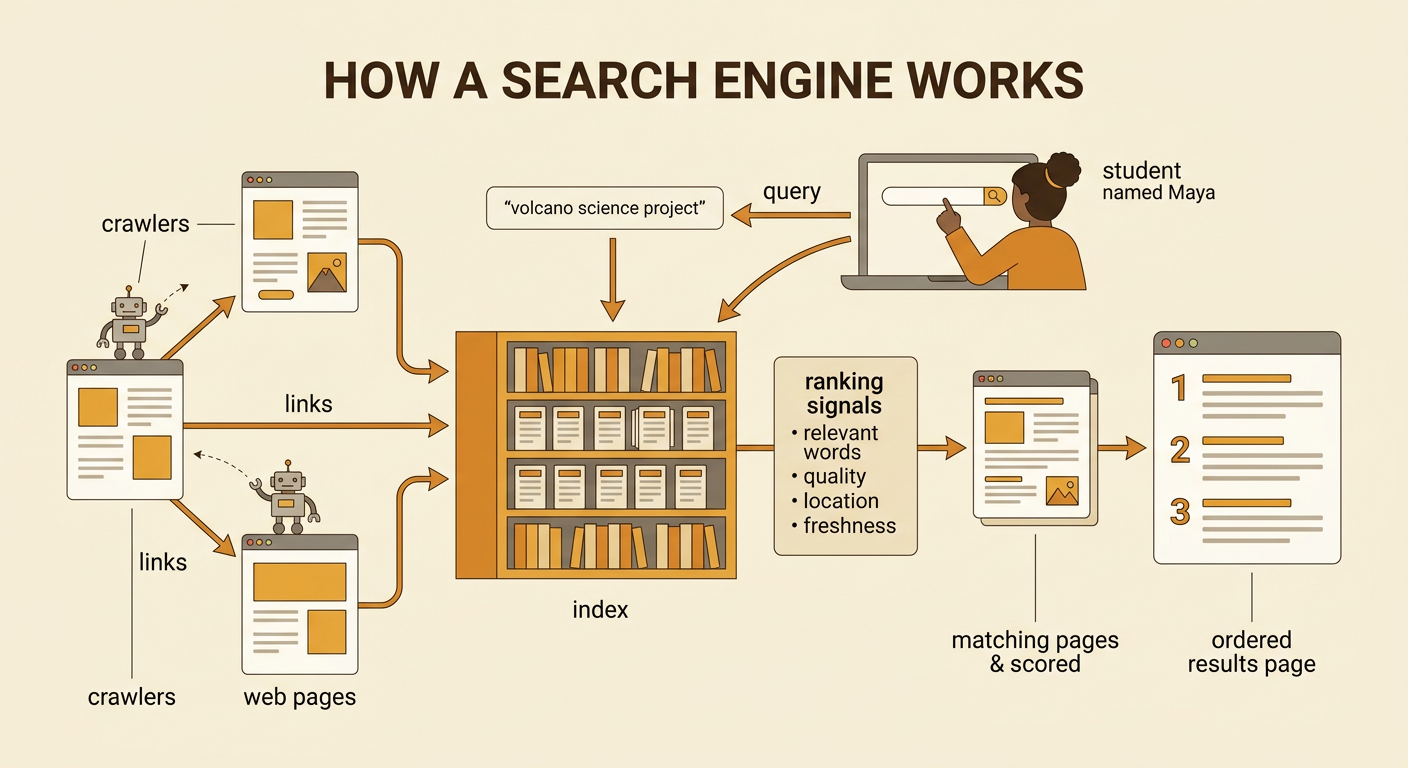
A search engine helps users find information on the web. First, automated programs called crawlers discover public web pages by following links. The search engine records information about those pages in an index, which works somewhat like a giant library catalog. When a user enters a query, the engine searches its index rather than checking the entire web at that moment. It then scores and orders matching pages using many signals, such as keyword relevance, page quality, location, and freshness. For example, if Maya searches for “volcano science project,” the engine may place a clear, recent museum activity above a page that only mentions volcanoes once. A high position does not prove that a result is true or best. Search engines use complicated ranking systems, so users must still evaluate results carefully.
Keywords and Relevance Scores
Keywords are important words in a query that describe what the user wants. A simple classroom ranking model can assign points when a page contains those words. Suppose the query is “safe bicycle helmet.” Give each page 2 points for “bicycle,” 2 points for “helmet,” and 1 point for “safe.” Page A contains all three words, so it earns 5 out of 5 possible points, or 5:5. Page B contains “bicycle” and “helmet,” so it earns 4 out of 5, or 80 percent. Page C contains only “helmet,” so it earns 2 out of 5, or 40 percent. Page A has the highest keyword relevance score in this model. However, repeated keywords do not automatically make information accurate. Real search engines also examine meaning, quality, and other signals rather than merely counting words.

Rank a Set of Results
To rank results, calculate each page’s score in the same way and order the totals from greatest to least. Imagine three pages responding to “water-saving garden.” In a classroom model, keyword relevance is worth up to 6 points, recent information is worth up to 2 points, and useful evidence is worth up to 2 points. The Garden Club page earns 5 + 1 + 1 = 7 points. A university extension page earns 5 + 2 + 2 = 9 points. A store advertisement earns 6 + 2 + 0 = 8 points. The order is university extension first, store advertisement second, and Garden Club third. Notice that the advertisement has more keyword points but no evidence points. A systematic scoring table makes the decision visible, repeatable, and easier to question or improve.

Compare Ranking Rules
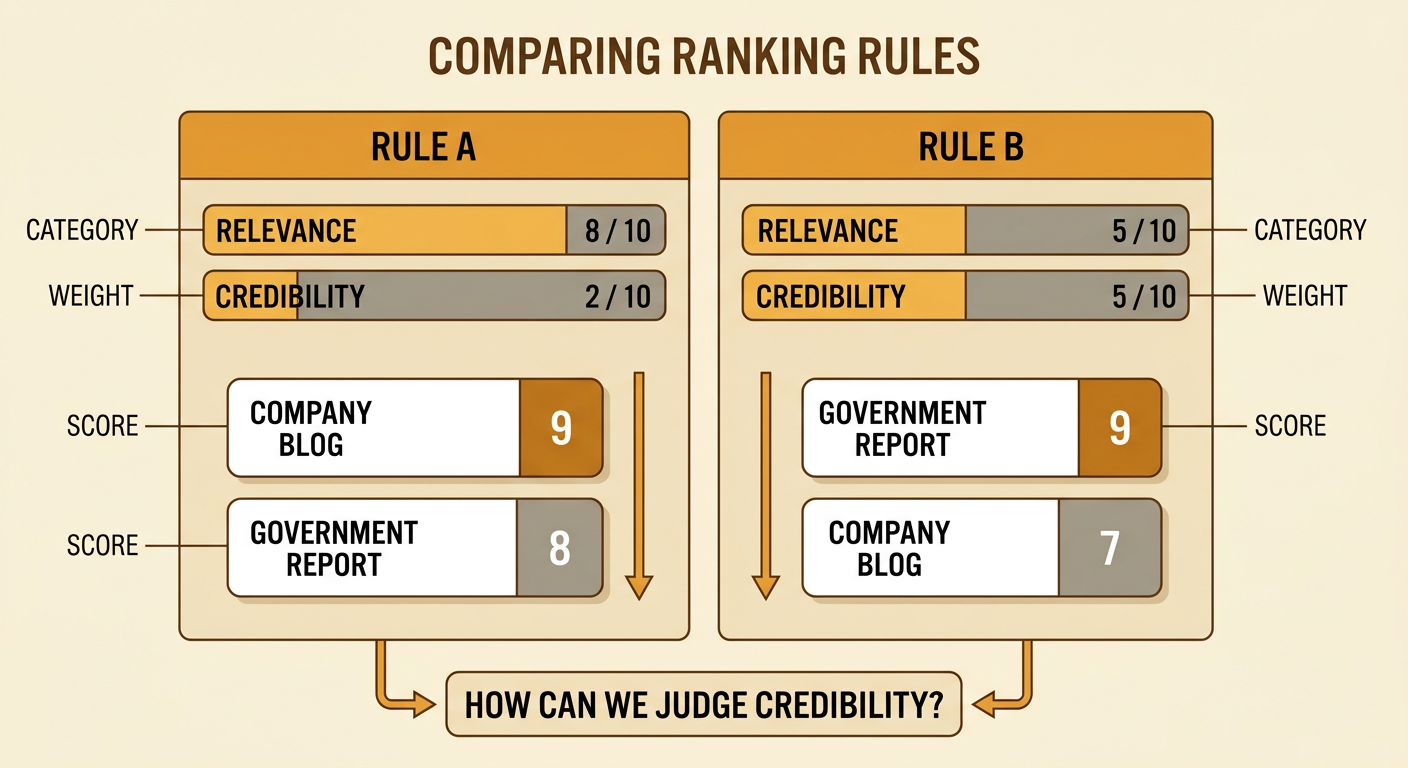
Different ranking rules can produce different result orders. Consider two rules for pages about reducing plastic waste. Rule A weights relevance heavily: relevance counts for 8 of 10 points, while credibility counts for 2. Rule B balances the categories: each counts for 5 of 10 points. A company blog has 8 out of 8 relevance points and 1 out of 2 credibility points under Rule A, for 9 out of 10. A government report has 6 relevance points and 2 credibility points, for 8 out of 10. Under Rule B, suppose the blog earns 5 + 2 = 7, while the report earns 4 + 5 = 9. The top result changes. To evaluate competing rules systematically, use the same pages, record every score, compare outcomes, and decide which rule better fits the search goal.
Check Sources for Credibility
Ranking and credibility are not the same. A top result may be popular or relevant but still make weak claims. Check who created the page, when it was updated, what evidence it provides, and whether other trustworthy sources agree. Also ask whether the source directly answers the query. For example, a student researching whether energy drinks improve athletic performance finds a sports influencer’s post and a health agency report. The post is recent and easy to read, but it sells a product and gives no study results. The agency report names medical experts, links to research, explains possible risks, and states its publication date. The report is more credible because its claims are supported by evidence, although the student should still read it critically. A useful source should be both relevant to the question and supported by dependable evidence.

Reflect on Bias and Fairness
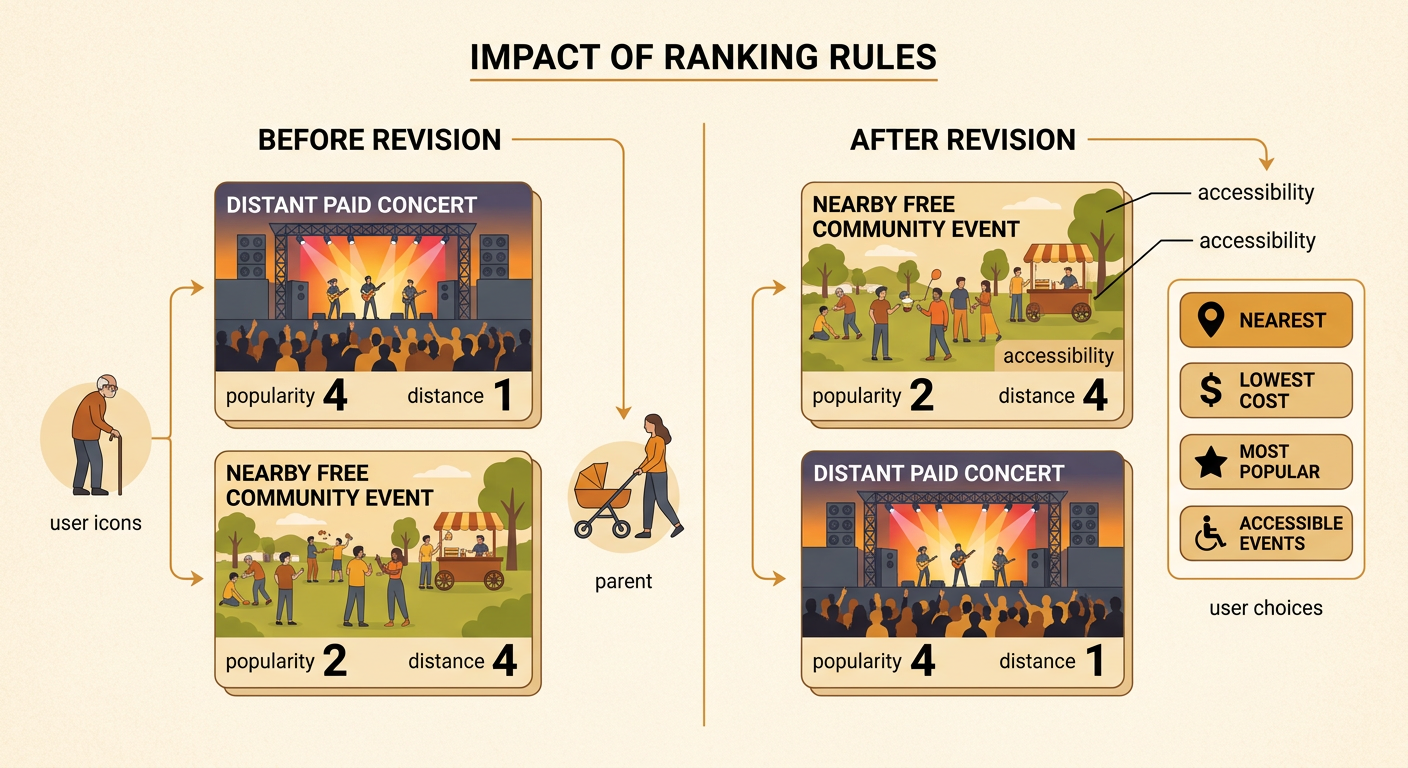
A ranking system can create unfair outcomes even when it follows its programmed rules. Bias can enter through the selected data, scoring factors, or assumptions about what users value. For example, a local-events search may give 4 points for popularity and only 1 point for distance. A large event across town could outrank a small free event at a nearby community center. This rule may favor organizations with bigger advertising budgets and may not serve users who lack transportation. A fairer design might reduce the popularity weight, add accessibility information, or let users choose “nearest,” “lowest cost,” or “most popular.” No single ranking is perfectly fair for every person. Designers should test results for different users, explain important ranking factors, gather feedback, and revise the system when patterns of disadvantage appear. Users should also compare several results rather than trusting the first link automatically.