
How Temperature Changes Particle Motion and State
Students use particle models to explain how adding or removing thermal energy changes particle motion and can cause matter to melt, freeze, evaporate, or condense.

Illustrations are auto-generated and may be placeholders. They can be refreshed to match the narration.
Reviewing Solids, Liquids, and Gases
Matter can exist as a solid, liquid, or gas. A solid has a definite shape and volume. A liquid has a definite volume but takes the shape of its container. A gas has neither a definite shape nor a definite volume, so it spreads out to fill its container. A substance can change state without becoming a different substance. For example, an ice cube, liquid water, and water vapor are all made of water particles. Ice keeps its shape, liquid water flows and takes the shape of a glass, and water vapor spreads through the air. Visible mist above hot water is made of tiny liquid droplets, not individual gas particles. State depends partly on temperature and thermal energy.

Modeling Particles in Each State
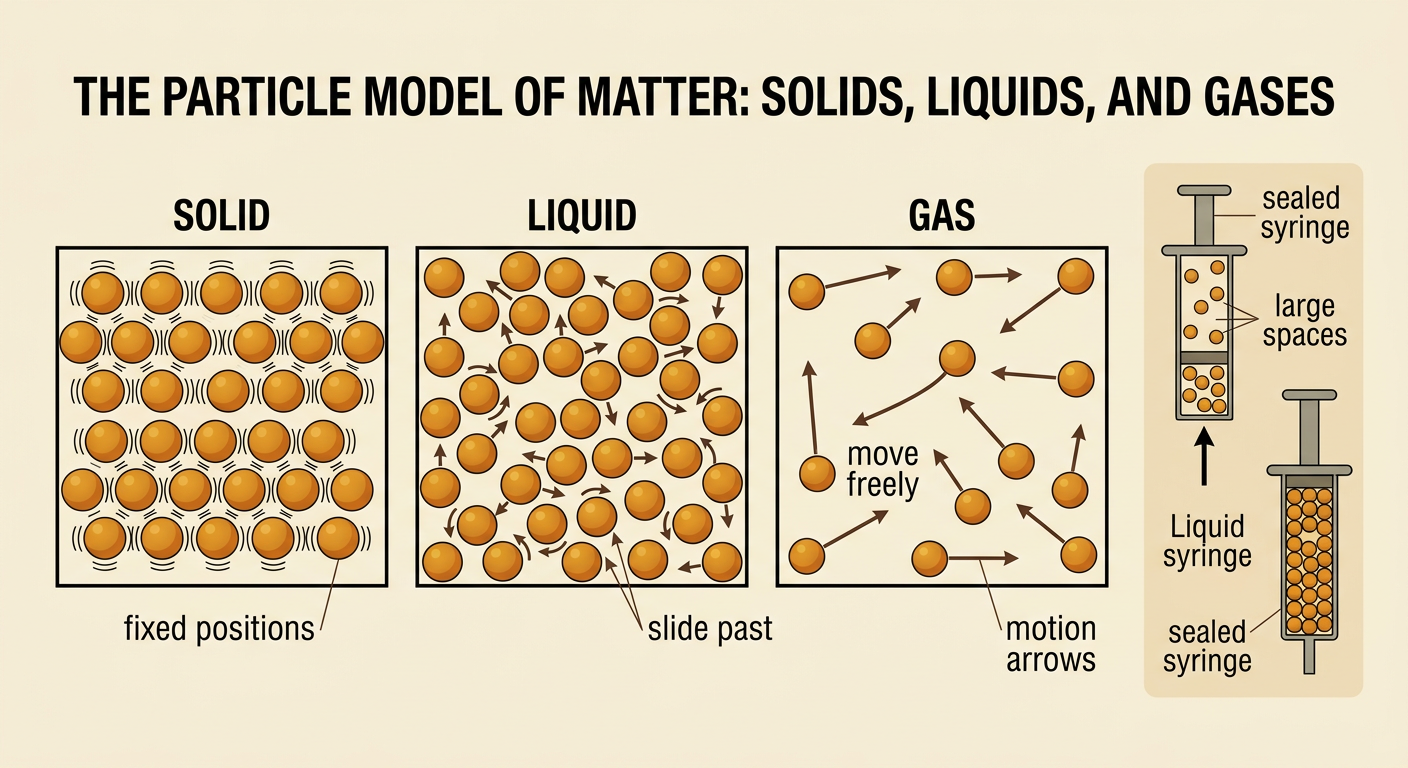
Particle models help explain properties that are too small to see directly. In a solid, particles are packed closely in an orderly arrangement and vibrate around fixed positions. In a liquid, particles remain close together but slide past one another, allowing the liquid to flow. In a gas, particles are much farther apart and move freely in many directions. Motion arrows in a model show particle movement; longer arrows can represent faster average motion. The particles themselves do not grow or shrink when temperature changes. For example, air can be pushed into a smaller space inside a sealed syringe because gas particles have large spaces between them. Liquid water is much harder to compress because its particles are already close together.
Adding Thermal Energy
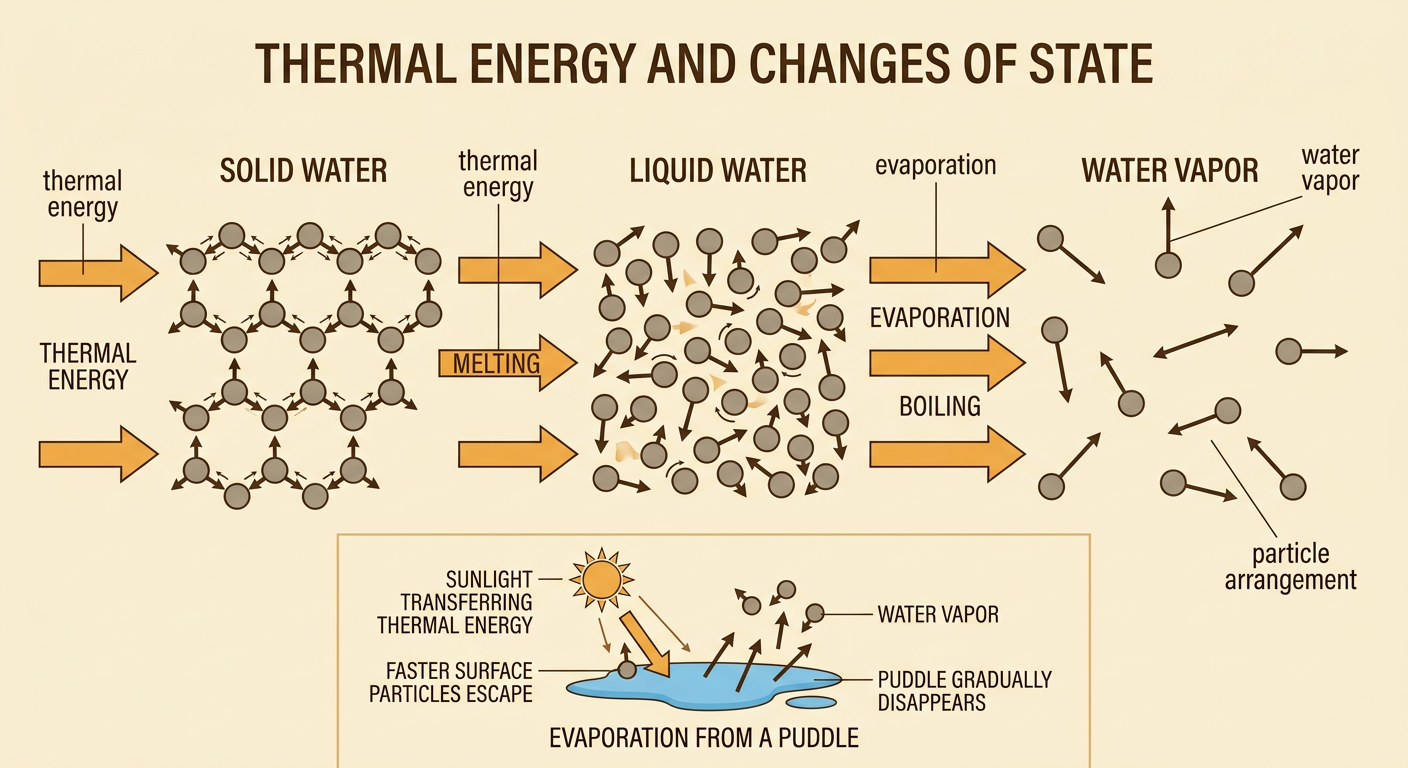
Adding thermal energy usually makes particles move faster, so the temperature rises. If a solid receives enough energy, its particles can move out of their fixed positions, and the solid melts into a liquid. With further energy transfer, liquid particles may escape and become a gas through evaporation or boiling. During melting or boiling, the temperature can remain nearly constant because the added energy is being used to change the particle arrangement rather than increase average particle speed. For example, sunlight transfers thermal energy to a puddle. Faster-moving water particles at the surface escape into the air as water vapor, so the puddle gradually disappears. Heating does not create larger particles or destroy them; it changes their motion, spacing, and arrangement.
Removing Thermal Energy
Removing thermal energy usually slows particle motion and lowers temperature. When gas particles lose enough energy, they move more slowly and come closer together, forming a liquid through condensation. When a liquid loses more energy, its particles become locked into fixed positions, forming a solid through freezing. During condensation or freezing, temperature may stay nearly constant while the particle arrangement changes. For example, water vapor in warm air can condense into liquid droplets on the outside of a cold glass. In a freezer, liquid water loses thermal energy and becomes solid ice. These changes affect daily life in different climates. People may scrape frost from cars, protect crops from freezing, make ice for food storage, or collect water formed by condensation.

Explaining Changes of State with Evidence
A strong scientific explanation connects observations, measurements, and a particle model. Suppose a student heats ice and records the temperature every minute. The temperature rises while the solid warms, remains nearly constant while the ice melts, and rises again after all the ice becomes liquid. The flat part of the graph is evidence of a state change, not evidence that energy transfer stopped. The student can explain that thermal energy changed the particles from vibrating in fixed positions to sliding past one another. Models can also make predictions: cooling water enough should slow its particles and cause freezing. Similar evidence helps communities plan for climate conditions. Temperature forecasts can predict snowmelt, icy roads, evaporation from reservoirs, or condensation that provides water in humid places.
