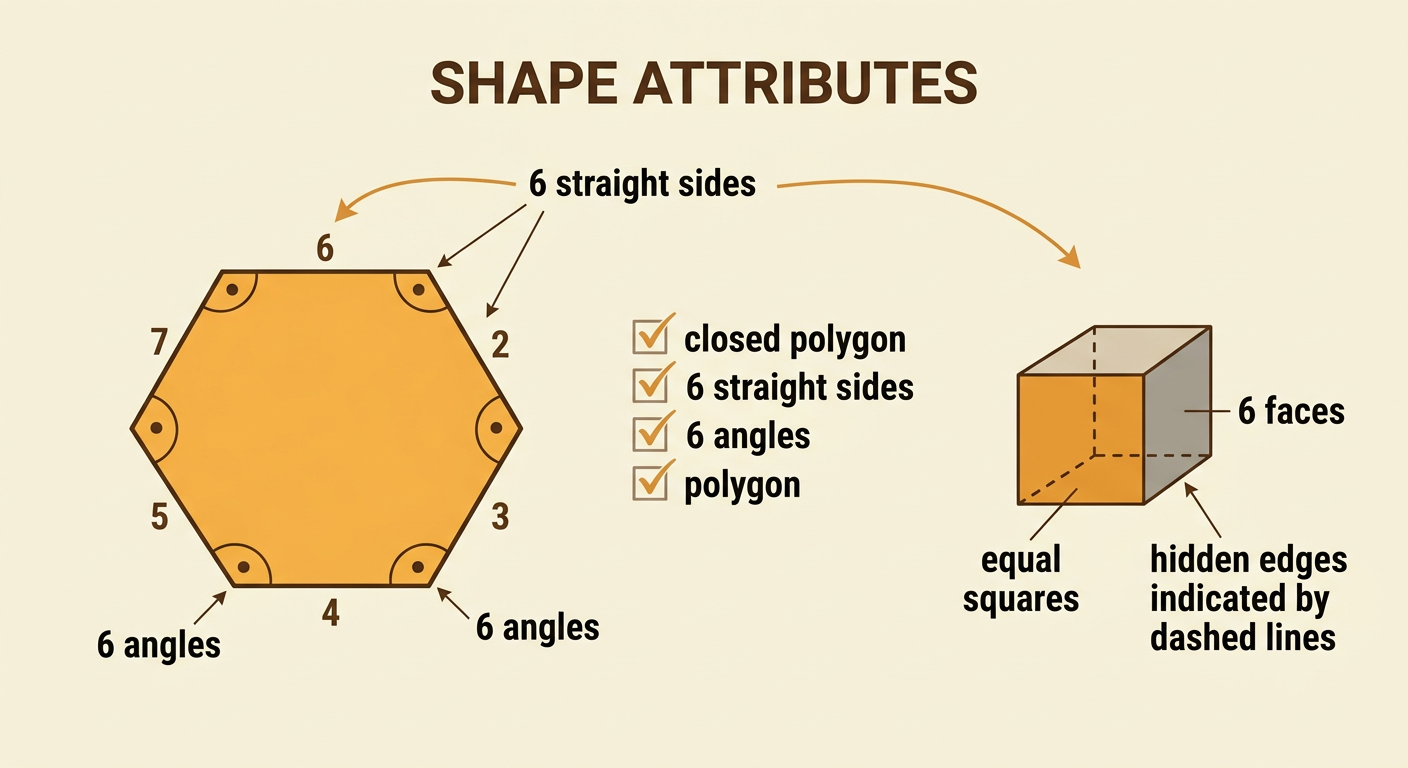
Identify and Draw Shapes by Their Attributes
Students identify, describe, and draw two-dimensional shapes using defining attributes such as the number of sides, angles, and equal faces.
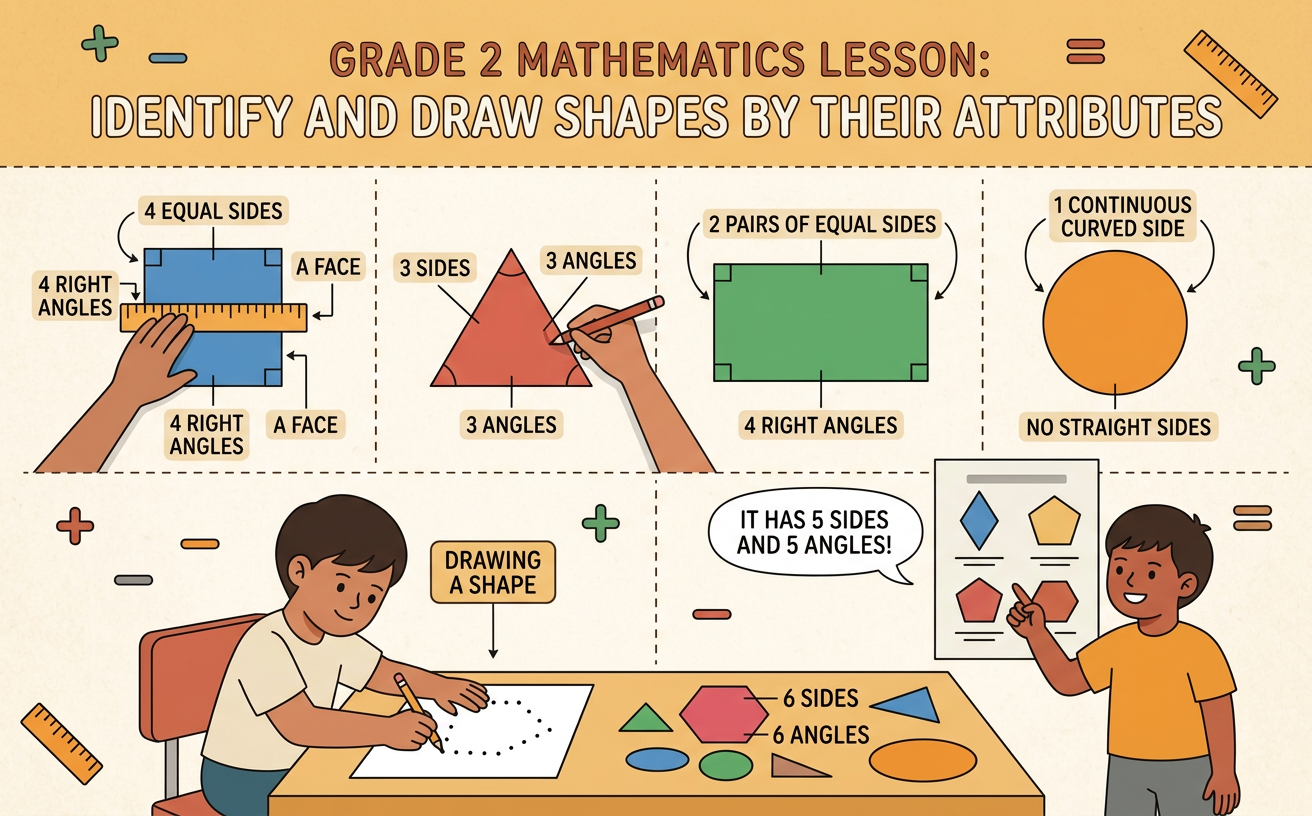
Illustrations are auto-generated and may be placeholders. They can be refreshed to match the narration.
Review Shape Names
Shapes have names that tell us about their form. A triangle is a flat shape with 3 straight sides and 3 angles. A quadrilateral has 4 straight sides and 4 angles. Squares and rectangles are kinds of quadrilaterals. A pentagon has 5 sides and 5 angles, and a hexagon has 6 sides and 6 angles. These are two-dimensional shapes because they are flat. A cube is a three-dimensional solid. It has 6 flat faces, and every face is an equal square. Look at each shape and count carefully. For example, a shape with 5 straight sides is a pentagon even if it is turned sideways or made very large.

Explore Defining Attributes
A defining attribute is a feature that a shape must have. The number of sides and angles are defining attributes of flat shapes. A triangle must have exactly 3 straight sides and 3 angles. Its color, size, direction, and line thickness do not change its name. A quadrilateral must have 4 straight sides and 4 angles, but its sides do not all need to be equal. A square is a special quadrilateral with 4 equal sides and 4 square corners. Solids also have defining attributes. A cube has 6 equal square faces. For example, a small blue triangle and a large red triangle are both triangles because each one has 3 sides and 3 angles.

Sort Shapes by Sides and Angles
You can sort flat shapes by counting their straight sides and angles. Begin at one corner and move around the shape. Touch each side once as you count. The number of angles will match the number of sides in these polygons. Put every 3-sided shape in the triangle group. Put every 4-sided shape in the quadrilateral group, including squares and rectangles. Put 5-sided shapes in the pentagon group and 6-sided shapes in the hexagon group. For example, a long, thin shape with 4 straight sides and 4 angles belongs with the quadrilaterals. It does not need to look like a square. Count the attributes instead of guessing from the shape’s position or appearance.

Draw Shapes from Clues
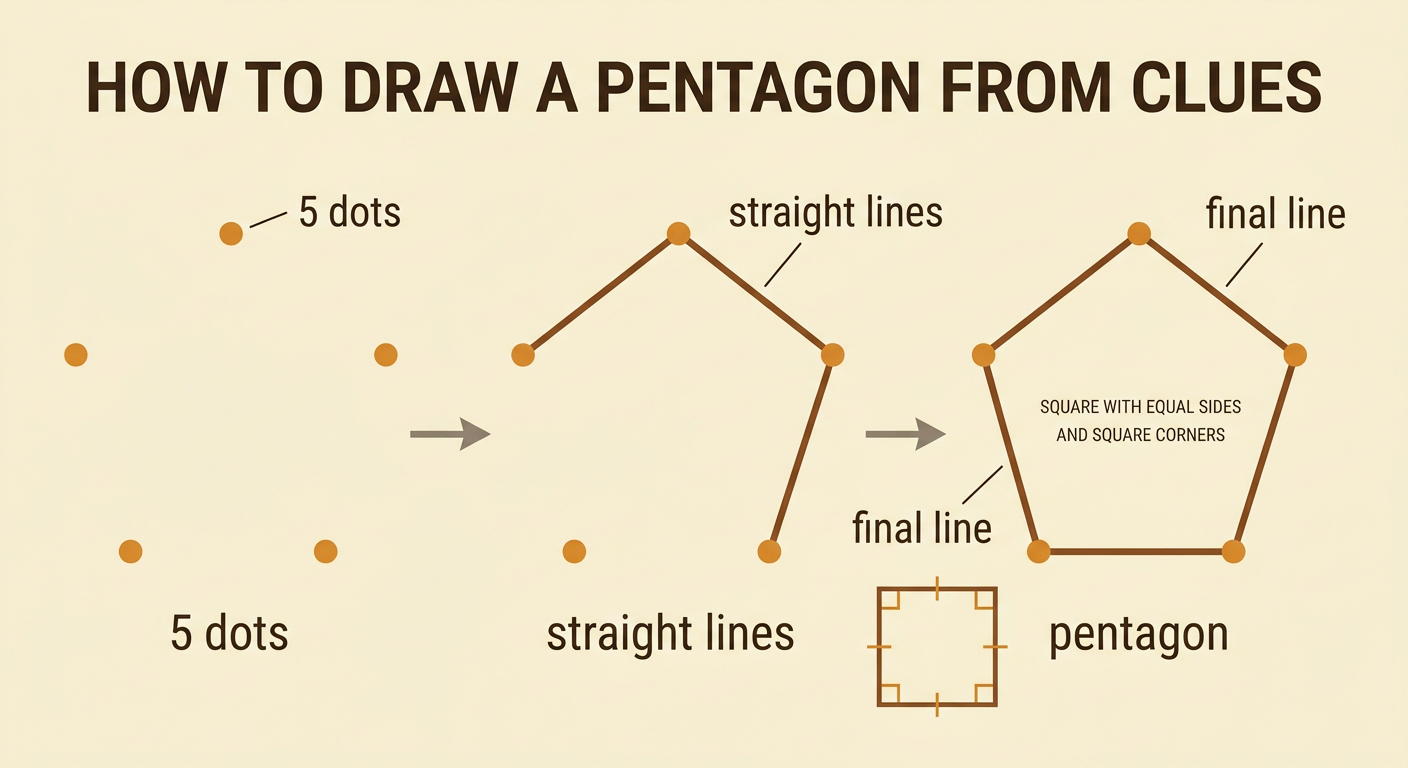
A shape clue tells you which defining attributes to draw. First, read the clue and find the required number of sides or angles. Next, make dots for the corners. Then connect the dots with straight lines and close the shape so there are no gaps. Suppose the clue says, “Draw a shape with 5 sides and 5 angles.” Make 5 dots and connect them in order, including a final line back to the first dot. The result is a pentagon. Many correct pentagons are possible because their sides can have different lengths. To draw a square, you need 4 equal sides and 4 square corners. Use the attributes in the clue rather than copying only one familiar-looking example.
Explain and Check
After identifying or drawing a shape, explain how its attributes prove its name. Use a sentence such as, “This shape is a hexagon because it has 6 straight sides and 6 angles.” Then check your work. Trace around the shape and count every side once. Mark each angle as you count it. Make sure the last side connects back to the first side. If the clue asks for equal sides or equal faces, compare them too. For example, a drawing with 6 sides but only 5 marked angles needs to be checked again because a closed 6-sided polygon has 6 angles. For a cube, check that all 6 faces are equal squares. A careful explanation should name the shape and give the defining attributes that support the answer.