
Identifying Materials by Their Properties
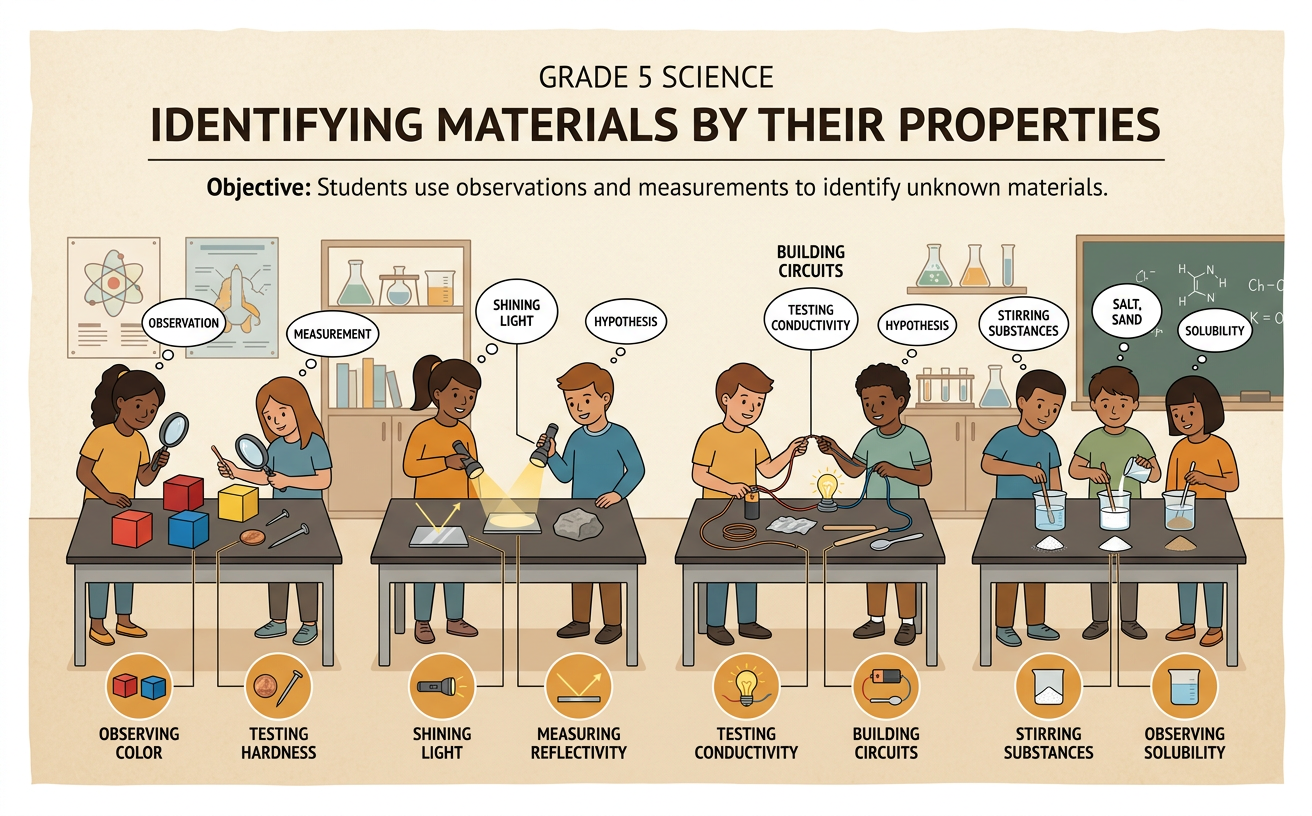
Students use observations and measurements of properties such as color, hardness, reflectivity, conductivity, and solubility to identify unknown materials.
Illustrations are auto-generated and may be placeholders. They can be refreshed to match the narration.
What Is a Physical Property?
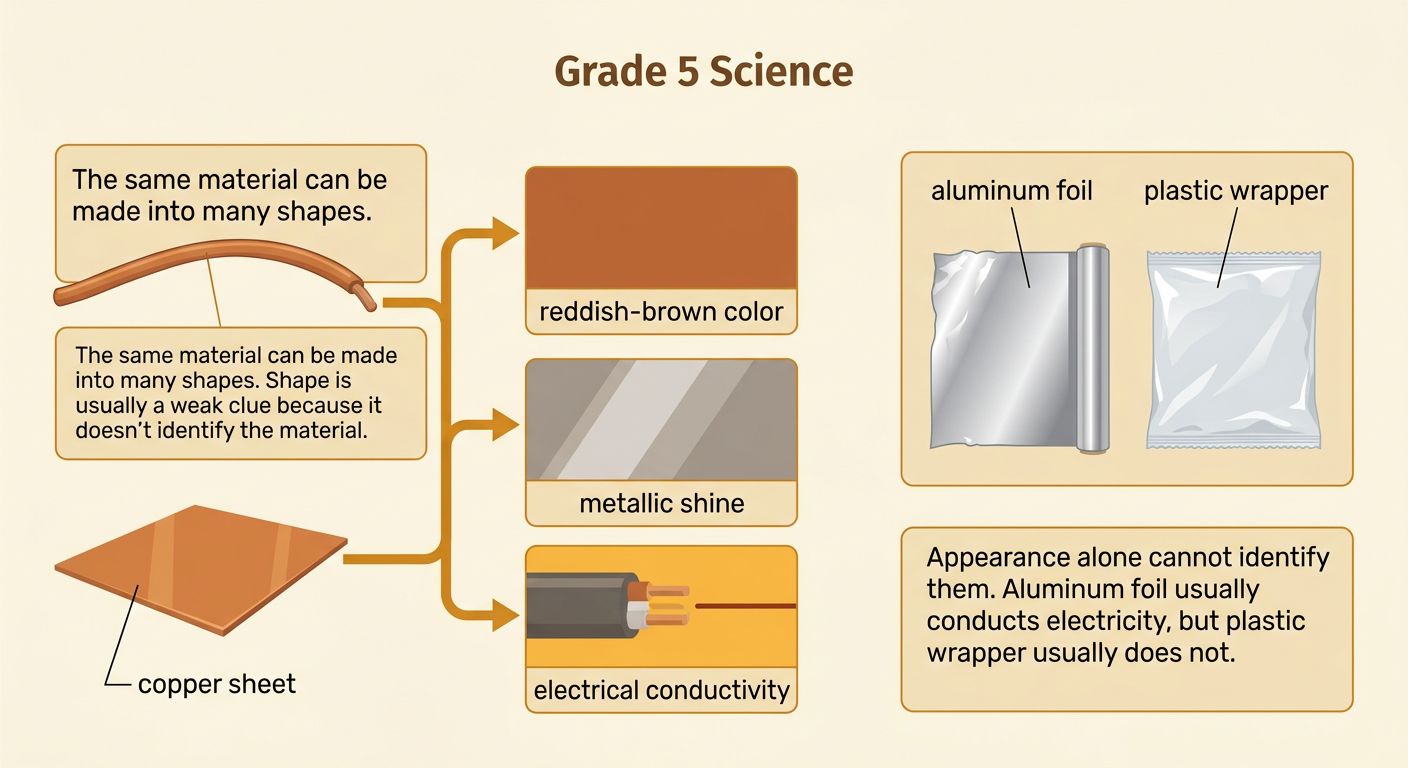
A physical property is a feature of matter that can be observed or measured without changing the material into a different substance. Color, texture, hardness, mass, reflectivity, electrical conductivity, and solubility are physical properties. Scientists use several properties together because one property may not be enough to identify a material. For example, both aluminum foil and a silver-colored plastic wrapper may look shiny. However, aluminum conducts electricity, while most plastics do not. Testing conductivity provides evidence that helps tell them apart. The size or shape of a sample is usually not useful for identifying its material because the same material can be cut into many shapes. A copper wire and a copper sheet look different, but both are made of copper and share properties such as color and electrical conductivity.
Observable and Measurable Properties
Some properties can be observed directly with the senses, while others are measured or tested with tools. You can safely observe color, shine, texture, and whether a sample is transparent, translucent, or opaque. Tools make observations more precise. A balance measures mass, a ruler measures size, and a simple low-voltage circuit tests electrical conductivity. Hardness can be compared with a scratch test: if one sample scratches another, the scratching sample is harder. Solubility describes how well a substance dissolves in a liquid. For example, equal spoonfuls of salt and sand can be stirred into equal amounts of water. The salt dissolves, but the sand does not. Scientists keep conditions, such as water amount and stirring time, the same so the comparison is fair.

Testing Mystery Materials
To identify mystery materials, scientists plan safe tests that compare the same properties for every sample. Suppose three samples may be aluminum, plastic, or wood. First, observe each sample’s color, texture, and reflectivity. Next, use the same object, such as a wooden craft stick, in each hardness test and apply similar pressure. Then place each sample, one at a time, into a simple circuit powered by a small battery. A glowing bulb shows that the sample conducts electricity. Finally, if the samples are safe to place in water, test solubility using equal sample sizes, equal amounts of water, and equal stirring times. Never taste an unknown material, and wear safety goggles when directed. Repeating each test helps determine whether the result is dependable rather than an accident.

Recording and Comparing Evidence
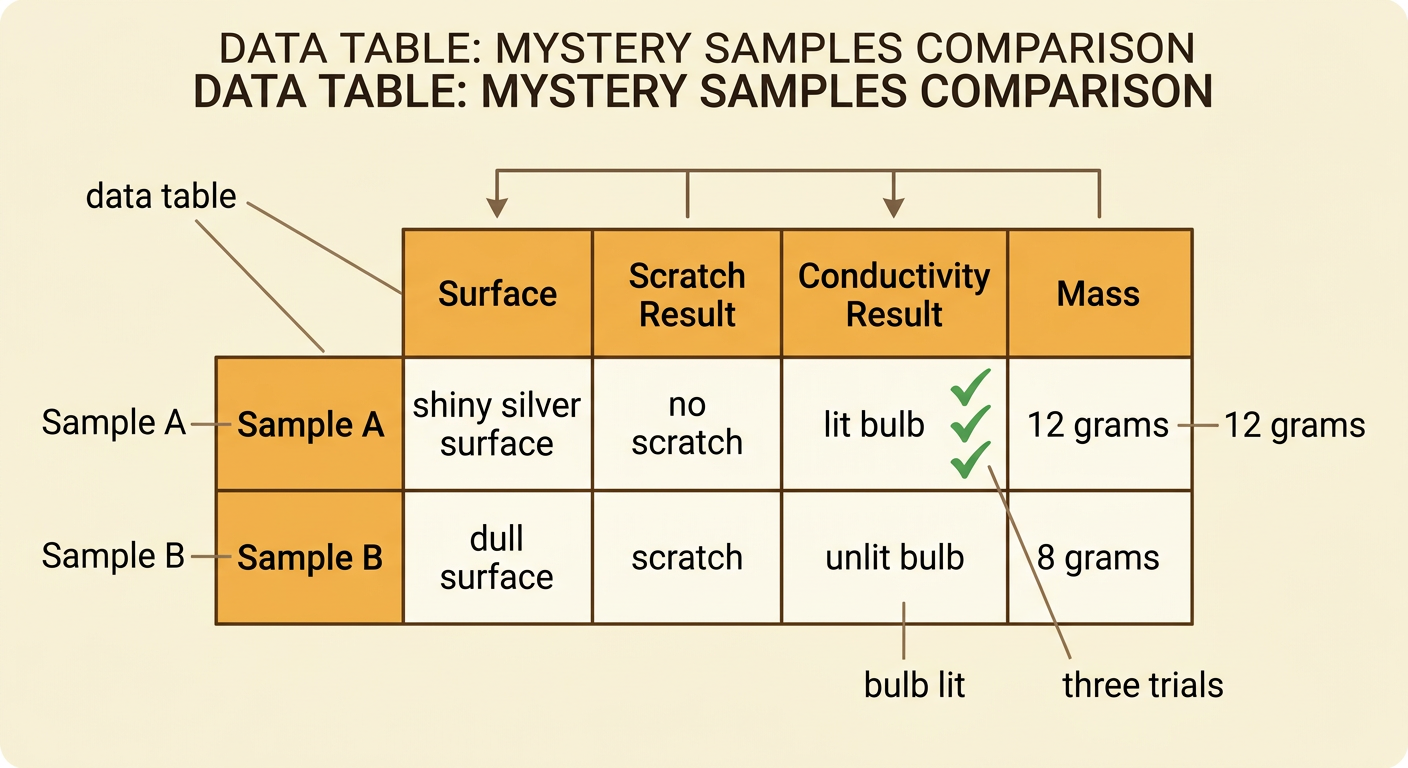
Scientists record results so they can compare evidence instead of relying on memory. A useful data table lists each mystery sample in a row and each tested property in a column. Observations should be specific. Write “shiny silver surface” instead of “looks nice,” or record “bulb lit” instead of “worked.” Measurements should include numbers and units whenever possible, such as a mass of 12 grams. Imagine that Sample A is shiny, cannot be scratched by a craft stick, and lights the bulb. Sample B is dull, is scratched by the stick, and does not light the bulb. These results show a relationship between each sample and its set of properties. Repeated results can also be recorded. If the bulb lights during all three trials for Sample A, conductivity is strong evidence for its identity.
Identifying Each Material
To identify a material, compare the mystery sample’s evidence with reliable information about known materials. Look for a match across several properties, not just one. For example, a mystery sample that is shiny, silver-colored, lightweight, and electrically conductive may be aluminum. A shiny appearance alone is not enough because some plastics are coated to look metallic. If another sample is dull, has visible grain, does not conduct electricity, and does not dissolve in water, the evidence may support identifying it as wood. Sometimes the evidence does not give a certain answer. Two materials may share many properties, or a test may produce an unclear result. In that case, scientists report the best-supported conclusion, explain the evidence, and recommend another test. Claims become stronger when multiple observations and measurements agree.

Using Material Properties in Everyday Decisions
Knowledge of material properties helps people choose safe and useful materials. An electrician selects copper for the inside of a wire because copper conducts electricity well. The wire is covered with plastic because plastic is an electrical insulator, which helps protect people from electric current. A community choosing material for an outdoor bench might compare hardness, water resistance, cost, and durability. Metal may be strong but could rust unless it is protected. Some plastics resist water but may create concerns about waste. Treated wood may fit the surroundings but requires maintenance. Scientific findings do not always make the decision by themselves. Individuals, communities, and organizations also consider safety, cost, environmental effects, and appearance. Property data provide evidence that helps decision-makers explain why one material is more suitable than another for a particular purpose.
