Identifying Materials by Their Properties
Students observe and measure properties such as color, hardness, solubility, and conductivity to identify materials and consider why communities choose particular natural resources for specific uses.

Illustrations are auto-generated and may be placeholders. They can be refreshed to match the narration.
Observe Mystery Materials
Scientists begin identifying an unknown material by making careful observations. Look at each mystery sample without tasting it or touching it unless your teacher says it is safe. Record its color, shape, texture, shine, and state of matter. Use precise words instead of guesses. For example, describe a sample as “a dull, gray solid with small grains” rather than saying, “It looks like a rock.” Observations are information gathered with the senses, while measurements use tools and numbers. Two materials may look alike but have different properties, so appearance alone is not enough for identification. Table salt and sugar are both white, grainy solids, but later tests can distinguish them. Label each mystery material with a letter or number so that your notes remain organized and unbiased.

Review Physical Properties
A physical property is a characteristic that can be observed or measured without changing a material into a different substance. Color describes how a material looks, while luster tells whether its surface is shiny or dull. Hardness describes how well a material resists scratching. Solubility tells whether and how much of a substance dissolves in a liquid such as water. Electrical conductivity describes how well electricity can move through a material. Magnetism, mass, texture, and flexibility are other useful physical properties. No single property always identifies a material, so scientists compare several properties. For example, copper is reddish brown, shiny when polished, and a good electrical conductor. Plastic can be made in a similar color, but it usually does not conduct electricity. A set of properties gives stronger evidence than color alone.

Test and Measure Properties
A fair test changes only one condition at a time and uses the same procedure for every sample. First, measure an equal mass of each material with a balance. To test solubility, place the same mass into separate cups containing equal volumes of room-temperature water. Stir each cup for the same amount of time and observe how much dissolves. To compare hardness, use an approved scratch tool with gentle, similar pressure. To test conductivity, use only a teacher-provided low-voltage circuit or conductivity tester. Never use a wall outlet, taste a sample, or mix unknown materials. For example, if 5 grams of salt and 5 grams of sand are added to 50 milliliters of water, salt dissolves much more completely. Equal amounts and consistent procedures make the comparison more reliable.

Record and Compare Evidence
Scientists organize observations and measurements in a data table so patterns are easy to see. Give each row a mystery sample and each column a tested property. Record numbers with units whenever possible, such as 5 grams or 50 milliliters. For descriptive results, use consistent terms such as shiny, dull, soluble, insoluble, conductor, or insulator. Repeating a test can show whether the result is dependable. You can also use mathematics to compare materials. For example, suppose Sample A dissolves completely, does not conduct as a solid, and cannot scratch a copper coin. Sample B does not dissolve, conducts electricity, and scratches the coin. The table reveals that the samples have different combinations of properties. A simple score, such as three matching properties out of four, can help model how closely an unknown sample matches a known material.

Identify Each Material
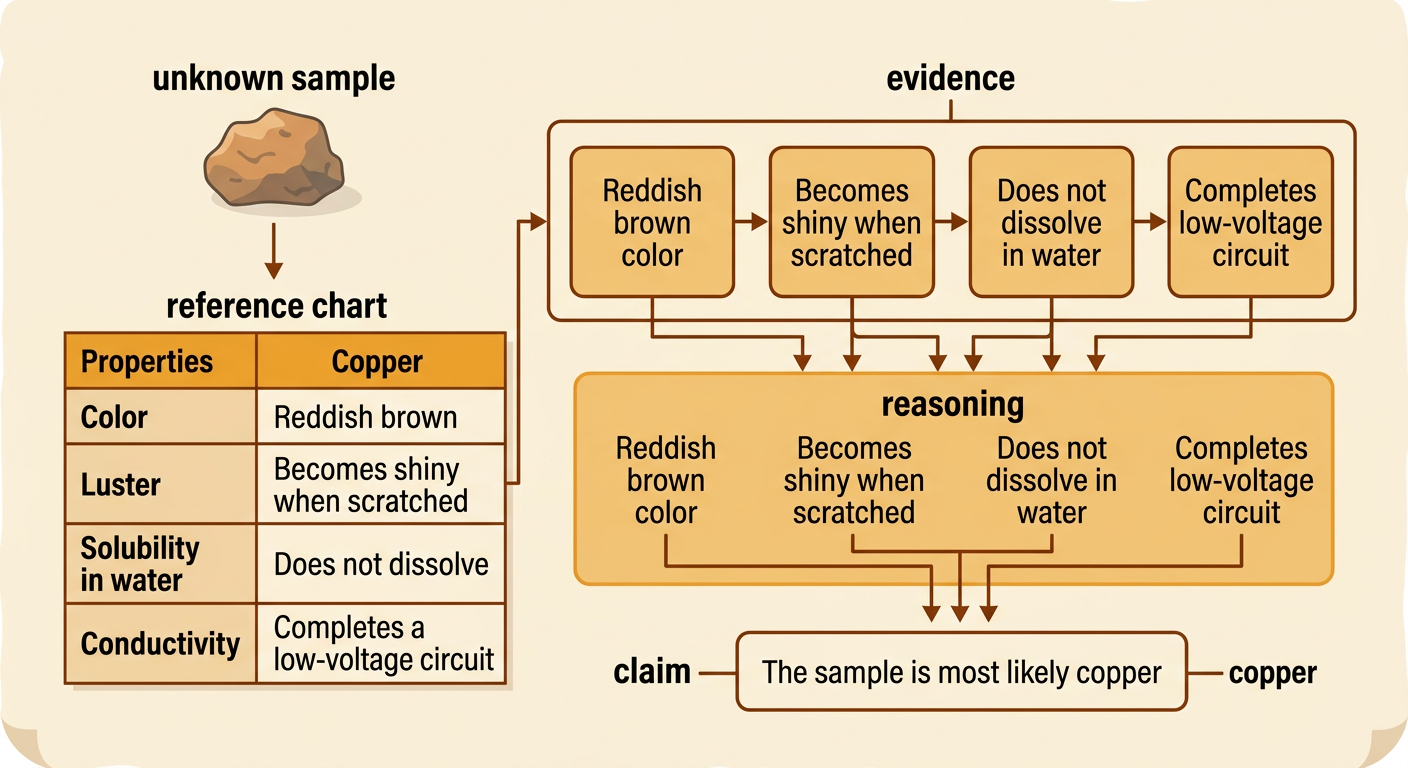
To identify a mystery material, compare its full set of measured properties with reliable reference information. Make a claim, support it with evidence, and explain your reasoning. Avoid deciding from one property because different materials can share a color or texture. Imagine that an unknown sample is reddish brown, shiny when scratched, does not dissolve in water, and completes a low-voltage circuit. A reference chart shows that copper has the same tested properties. A strong conclusion is: “The sample is most likely copper because its color, luster, low solubility, and conductivity match copper.” The phrase “most likely” recognizes that classroom tests have limits. If results conflict, repeat the test, check the procedure, or gather another kind of evidence. An informative explanation should name the material, report relevant facts, and connect those facts logically to the identification.
Connect Properties to Resource Uses
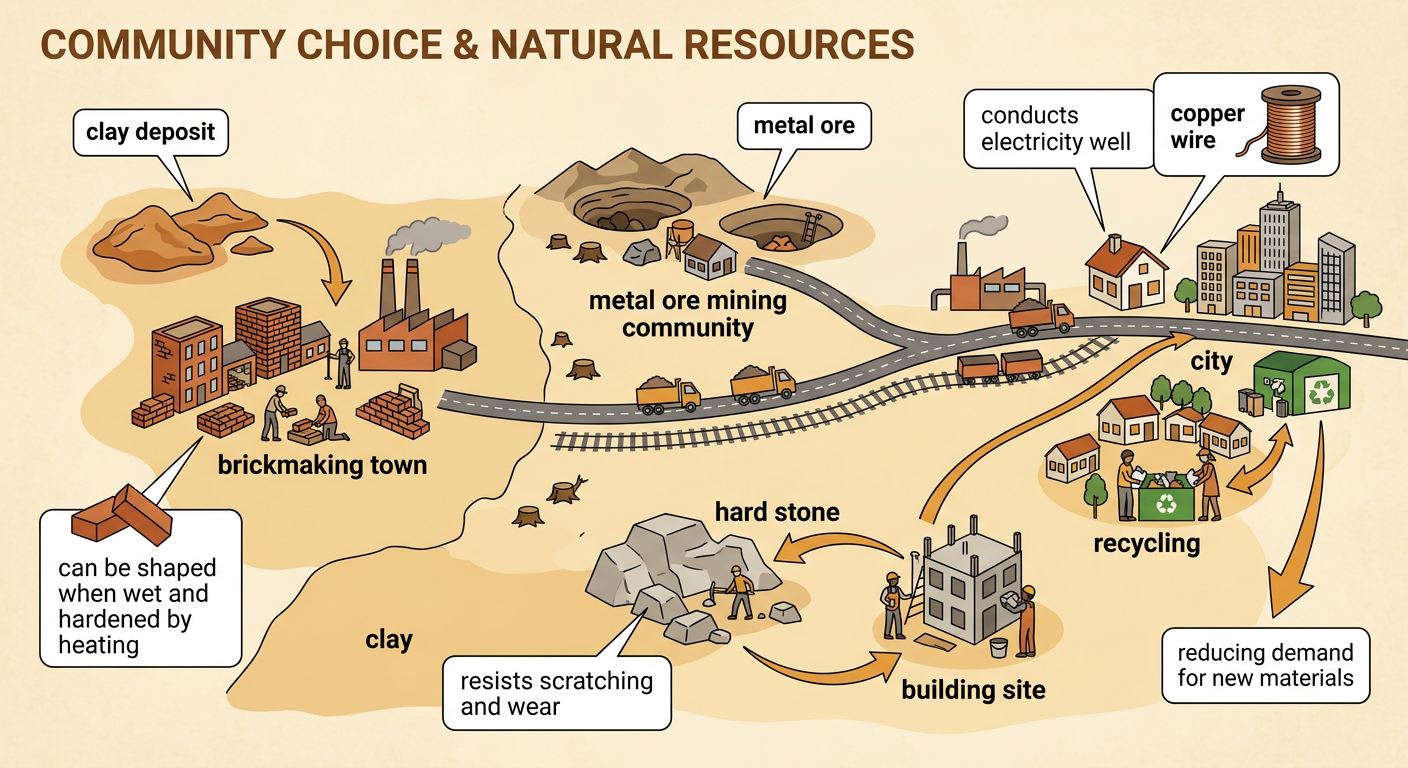
Communities choose natural resources for uses that fit their properties, cost, availability, and environmental effects. Copper conducts electricity well, so it is used in wires. Hard stone resists scratching and wear, so it can be used in roads and buildings. Clay can be shaped when wet and hardened by heating, making it useful for bricks and pottery. These choices can influence where people work and settle. For example, a town may grow near a clay deposit because brickmaking provides materials and jobs, while a mining community may develop near metal ore. Transportation routes may connect these resources to factories and cities. Resource use also has costs: mining can disturb habitats, and removing too much material can change the land. Communities can compare benefits and impacts, conserve resources, recycle materials, and choose alternatives when possible.