
Identifying Organisms with Dichotomous Keys
Students analyze observable traits, use and construct dichotomous keys, and evaluate how scientific classification tools are revised when new evidence becomes available.
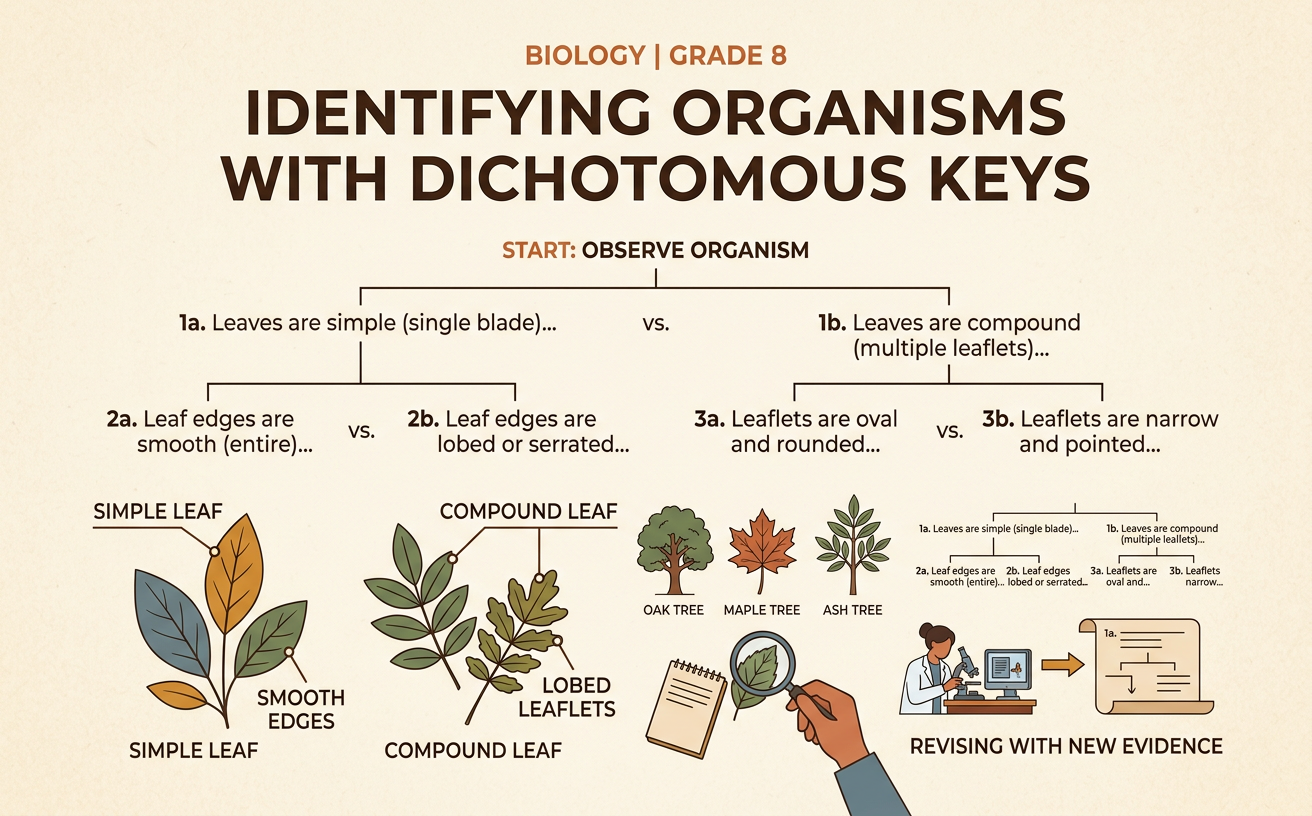
Illustrations are auto-generated and may be placeholders. They can be refreshed to match the narration.
Why Scientists Classify Organisms
Scientists classify organisms to organize biodiversity and communicate clearly about living things. They compare observable traits, such as body covering, number of legs, leaf shape, or presence of a backbone. Shared traits can provide evidence that organisms belong in the same group, while differences can separate them into smaller groups. For example, a bat and an eagle both have wings, but a bat has fur and produces milk, while an eagle has feathers and lays hard-shelled eggs. These additional traits identify the bat as a mammal and the eagle as a bird. Classification also helps scientists make predictions. If an unfamiliar animal is classified as a mammal, scientists can predict that it breathes with lungs and feeds milk to its young. Scientists use several traits rather than relying on one feature because unrelated organisms can sometimes look alike.
Taxonomic Ranks and Scientific Names
Taxonomy is the science of naming and grouping organisms. The major ranks, from broadest to most specific, are domain, kingdom, phylum, class, order, family, genus, and species. Each lower rank contains organisms with more traits in common. The red fox belongs to Domain Eukarya, Kingdom Animalia, Phylum Chordata, Class Mammalia, Order Carnivora, Family Canidae, Genus Vulpes, and Species Vulpes vulpes. A scientific name uses binomial nomenclature, a two-part naming system consisting of the genus and species. The genus begins with a capital letter, the species begins with a lowercase letter, and both words are printed in italics when possible. Scientific names prevent confusion caused by different common names. Although “red fox” may be translated or used differently in various places, Vulpes vulpes identifies the same species worldwide.
Reading Paired Trait Choices
A dichotomous key identifies organisms through a series of paired statements called couplets. Each statement describes an observable trait, and the two choices should be mutually exclusive, meaning only one choice fits a specimen. Begin with both statements in the first couplet. Select the statement supported by evidence, then follow its direction to another couplet or an identification. Suppose a leaf key begins with “leaf edge smooth” and “leaf edge toothed.” A leaf with small points along its margin follows the toothed choice, even if its color resembles a smooth-edged leaf. Later couplets might compare opposite and alternate leaf arrangement or simple and compound leaves. Read both choices before deciding, use the same part of the organism named in the statements, and avoid guessing about traits that are hidden or damaged. Careful observation makes the identification reproducible.
Using a Dichotomous Key
Using a dichotomous key is a multistep procedure, so record each choice in order. First, observe the whole specimen without deciding its identity. Next, start at couplet 1, compare both statements, and choose the statement that matches visible evidence. Follow the listed number or name, and repeat until reaching an identification. For example, an unknown arthropod with six legs goes past the choice for eight legs. If its front wings are hardened into protective covers, the next choice identifies it as a beetle. Record the path as “1b, 2a, beetle” so another student can check the work. Never skip directly to a likely answer based on appearance. If neither statement fits, return to the previous step, inspect the specimen again, and consider whether a feature was overlooked or the organism is missing from the key.
Designing and Testing a Key
To design a dichotomous key, first list the organisms and record consistent, observable traits. Select a trait that divides the full set into two clear groups. Then divide each smaller group again until every organism has its own endpoint. For four shells, a first couplet might separate coiled shells from uncoiled shells. The coiled group could then be divided by a smooth or ridged surface, while the uncoiled group could be divided by two matching valves or one cap-shaped piece. Use objective wording and avoid choices such as “pretty” or “large” unless a measurable boundary is provided. Test the finished key with each known specimen and with another student. If a specimen matches both choices, neither choice, or the wrong endpoint, revise the couplet. A useful key produces repeatable results for different observers.
Revising Classification with New Evidence
Classification systems are scientific models, so they can change when new evidence becomes available. Early systems relied mainly on visible form and anatomy. Microscopes later revealed cell structures, evolutionary theory emphasized common ancestry, and modern DNA comparisons provided molecular evidence. Some features remain useful over time, showing continuity, while newly discovered relationships produce historical change. For example, whales were long recognized as mammals because they breathe air, produce milk, and have mammalian bones. Later fossil and DNA evidence showed that whales share a relatively recent common ancestor with hippopotamuses. Scientists therefore revised diagrams of mammal relationships to place whales and hippos close together within the even-toed ungulate lineage. This revision did not mean earlier observations were worthless. Instead, scientists combined old anatomical evidence with new evidence. Identification keys and classifications should be updated when a new species or better evidence no longer fits the existing choices.