
Impulse and Momentum Conservation
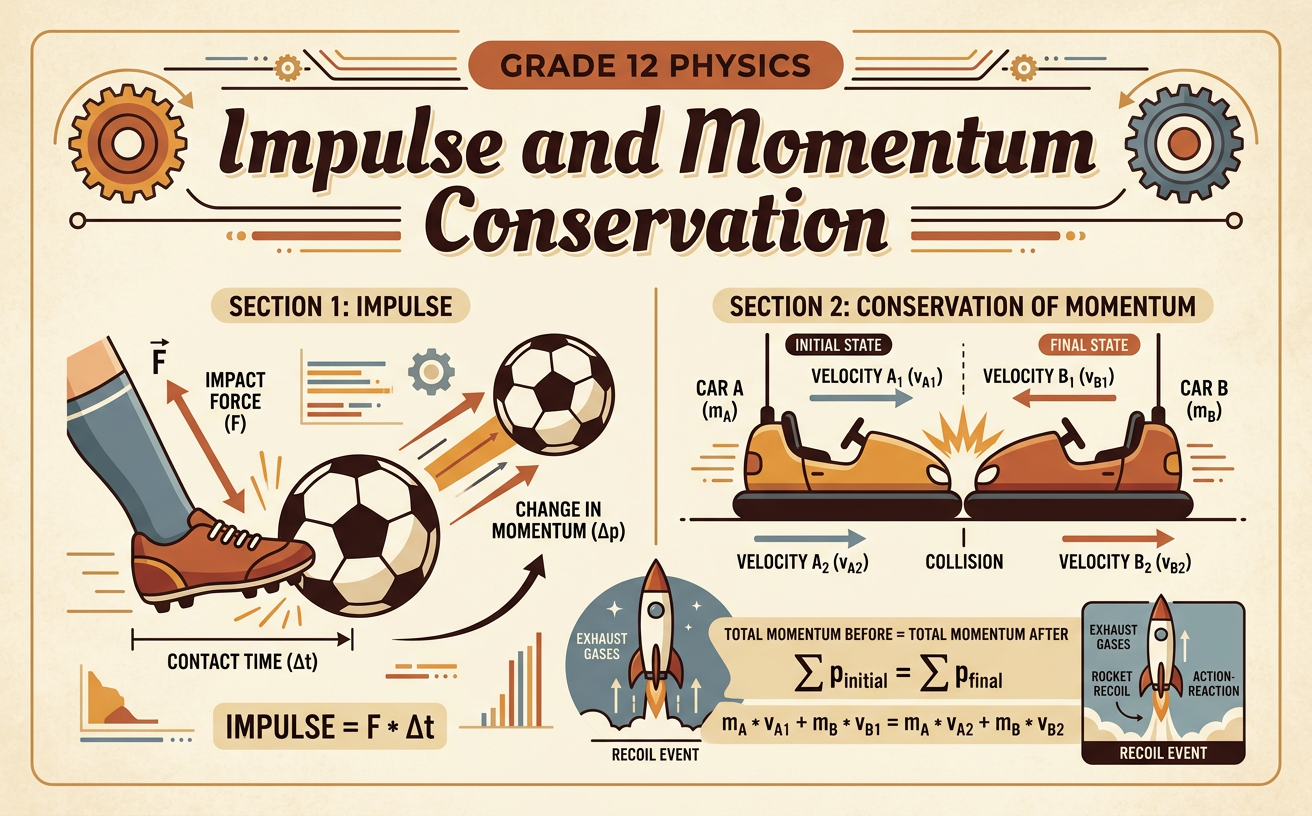
Students relate force and time to impulse and use conservation of momentum to analyze collisions and recoil events.
Illustrations are auto-generated and may be placeholders. They can be refreshed to match the narration.
Defining Momentum
Momentum describes the motion of an object by combining its mass and velocity. It is calculated with p = mv, where p is momentum, m is mass, and v is velocity. The SI unit of momentum is kilogram-meter per second, kg·m/s. Because velocity is a vector, momentum also has direction. A 1,000 kg car traveling east at 20 m/s has a momentum of 20,000 kg·m/s east. A car with the same mass and speed traveling west has momentum of the same magnitude but the opposite direction. When solving one-dimensional problems, choose one direction as positive and use signs to represent direction. An object at rest has zero momentum, regardless of its mass. Increasing either mass or speed increases the magnitude of momentum.
Impulse and Force-Time Graphs
Impulse measures the effect of a force acting over a time interval. For a constant force, impulse is J = FΔt. More generally, impulse equals the area under a force-versus-time graph. The impulse-momentum theorem states that J = Δp = pf − pi, so a larger force or a longer interaction time produces a greater change in momentum. For example, if a constant 600 N force acts forward on a 0.20 kg ball for 0.010 s, the impulse is 6.0 N·s forward. The ball’s momentum changes by 6.0 kg·m/s because N·s is equivalent to kg·m/s. Airbags and padded surfaces increase collision time. For the same required momentum change, increasing the time decreases the average force, reducing the likelihood of injury or damage.
Momentum Conservation
In an isolated system, the total momentum remains constant. A system is isolated when the net external impulse is zero or negligible during the interaction. Forces that objects exert on each other are internal forces; they change each object’s momentum but not the system’s total momentum. Therefore, total momentum before an interaction equals total momentum after it: Σpbefore = Σpafter. Suppose a 2.0 kg cart moving right at 3.0 m/s collides with a 1.0 kg cart initially at rest, and the carts stick together. Their initial total momentum is 6.0 kg·m/s to the right. The combined mass is 3.0 kg, so its final velocity is 2.0 m/s to the right. Momentum is conserved even though each cart’s individual momentum changes during the collision.
Elastic and Inelastic Collisions
Momentum is conserved in every collision within an isolated system, but kinetic energy is conserved only in an elastic collision. In an elastic collision, objects rebound without a net loss of total kinetic energy. In an inelastic collision, some kinetic energy is transformed into thermal energy, sound, or deformation. A perfectly inelastic collision occurs when objects stick together. For example, a 1.0 kg cart moving at 4.0 m/s strikes an identical stationary cart. If the collision is elastic, the first cart stops and the second moves at 4.0 m/s. Both momentum and kinetic energy remain unchanged. If the carts instead stick, their shared speed is 2.0 m/s. Momentum is still 4.0 kg·m/s, but kinetic energy decreases from 8.0 J to 4.0 J as energy changes form.
Recoil and Explosions
Recoil and explosions are also analyzed with conservation of momentum. Internal forces push parts of a system in opposite directions, creating equal and opposite momentum changes. If a system begins at rest, its total initial momentum is zero, so the vector sum of the final momenta must also be zero. Consider a 4.0 kg launcher that fires a 0.20 kg projectile to the right at 50 m/s. The projectile’s momentum is 10 kg·m/s to the right. The launcher must therefore have 10 kg·m/s of momentum to the left, giving it a recoil velocity of 2.5 m/s left. Kinetic energy may increase during an explosion because stored chemical, elastic, or nuclear energy is converted into motion. Momentum is still conserved if the external impulse during the event is negligible.