
Indices, Standard Form, and Approximation
Students apply the laws of indices, express numbers in standard form, and estimate values to specified levels of accuracy.
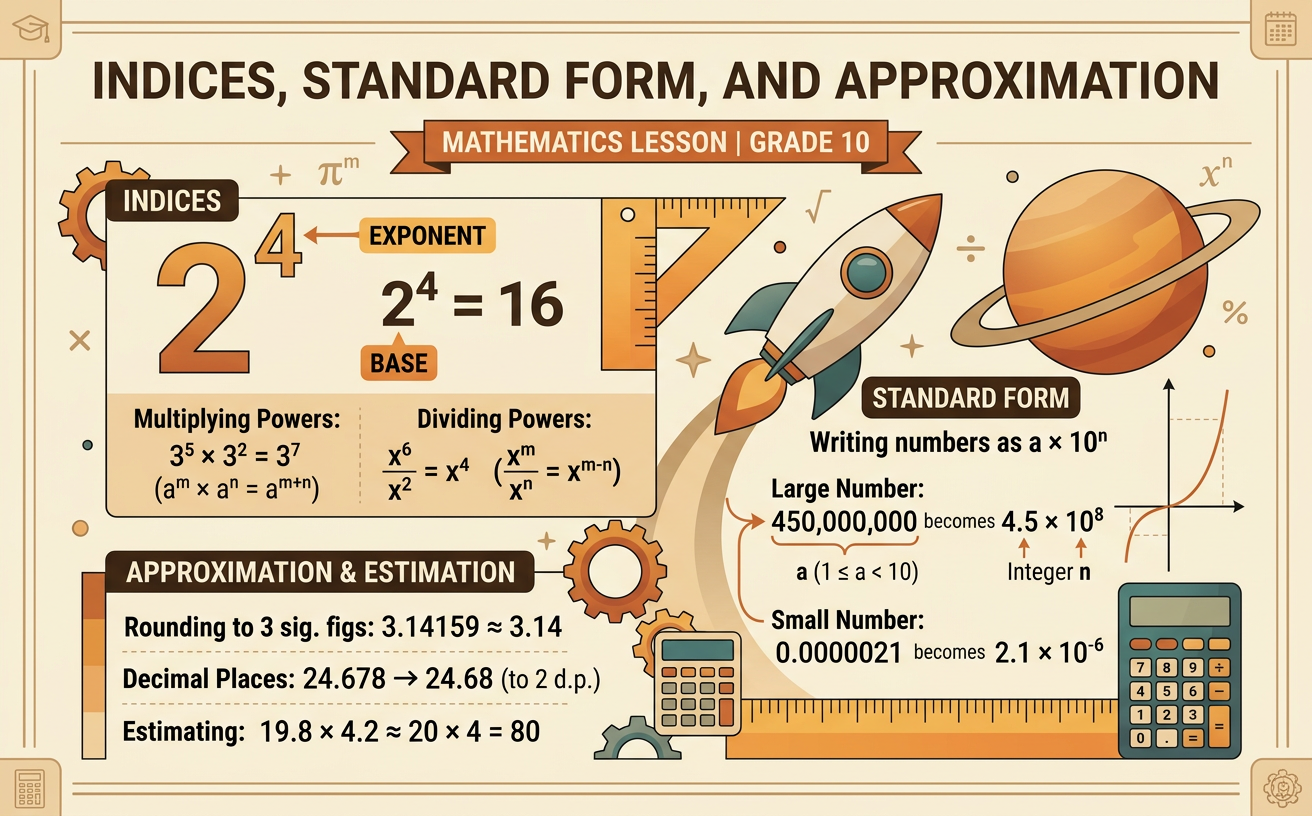
Illustrations are auto-generated and may be placeholders. They can be refreshed to match the narration.
Laws of Indices
An index, or exponent, shows how many times a base is used as a factor. When powers with the same base are multiplied, add the exponents: am × an = am+n. When they are divided, subtract the exponents: am ÷ an = am−n, provided a is not zero. When a power is raised to another power, multiply the exponents: (am)n = amn. Also, (ab)n = an bn. For example, simplify 23 × 25 ÷ 24. Apply the product and quotient laws to obtain 23+5−4 = 24 = 16. These laws apply to multiplication and division, not addition. For instance, 23 + 25 cannot be simplified to 28.
Zero and Negative Indices
For any nonzero base a, the zero-index law states that a0 = 1. This follows from division: am ÷ am = am−m = a0, while any nonzero number divided by itself equals 1. A negative index indicates a reciprocal, not a negative value. For any nonzero a, a−n = 1/an. Similarly, 1/a−n = an. For example, 5−2 = 1/52 = 1/25. To simplify 34 × 3−2, add the exponents: 34+(−2) = 32 = 9. These rules require a nonzero base because division by zero is undefined. Be careful to distinguish 2−3, which equals 1/8, from -23, which equals -8.
Standard Form
Standard form, also called scientific notation, writes a number as A × 10n, where 1 ≤ A < 10 and n is an integer. For a large number, move the decimal point left until one nonzero digit remains before it; the number of moves gives a positive exponent. Thus, 4,560,000 = 4.56 × 10⁶. For a small number, move the decimal point right; the number of moves gives a negative exponent. Therefore, 0.00072 = 7.2 × 10⁻⁴. To multiply numbers in standard form, multiply the coefficients and add the exponents. For example, (3 × 10⁴)(2 × 10³) = 6 × 10⁷. If the coefficient is not between 1 and 10, adjust it and change the power of 10 accordingly.
Decimal Places and Significant Figures
Decimal places count digits to the right of the decimal point. To round 12.476 to two decimal places, keep 12.47 and inspect the next digit, 6. Since 6 is at least 5, increase the hundredths digit to obtain 12.48. Significant figures begin at the first nonzero digit and describe the precision of the whole number. In 0.004582, the first significant digit is 4, so the number to three significant figures is 0.00458 because the next digit is 2. Zeros between nonzero digits are significant, while leading zeros are not. For example, 2,050 has three significant figures when the final zero is only a placeholder. Always identify the required place, inspect the next digit, and round up only when that digit is 5 or greater.
Estimation and Percentage Error
Estimation gives a value close to the exact answer and helps check whether a calculation is reasonable. Round numbers to convenient values before calculating. For example, 19.8 × 3.04 can be estimated as 20 × 3 = 60. The exact product is 60.192, so the estimate is sensible. Approximation introduces error. Absolute error is the positive difference between the approximate value and the exact value. Percentage error is calculated as |approximate value − exact value| ÷ exact value × 100%. If a length of 48.6 cm is recorded as 49 cm, the absolute error is |49 − 48.6| = 0.4 cm. The percentage error is 0.4 ÷ 48.6 × 100% ≈ 0.82%. A smaller percentage error generally indicates a more accurate approximation.