
Indigenous American Civilizations, Exploration, and Global Exchange
Students investigate major Indigenous civilizations of the Americas and analyze how exploration, conquest, and trade connected the Eastern and Western Hemispheres.
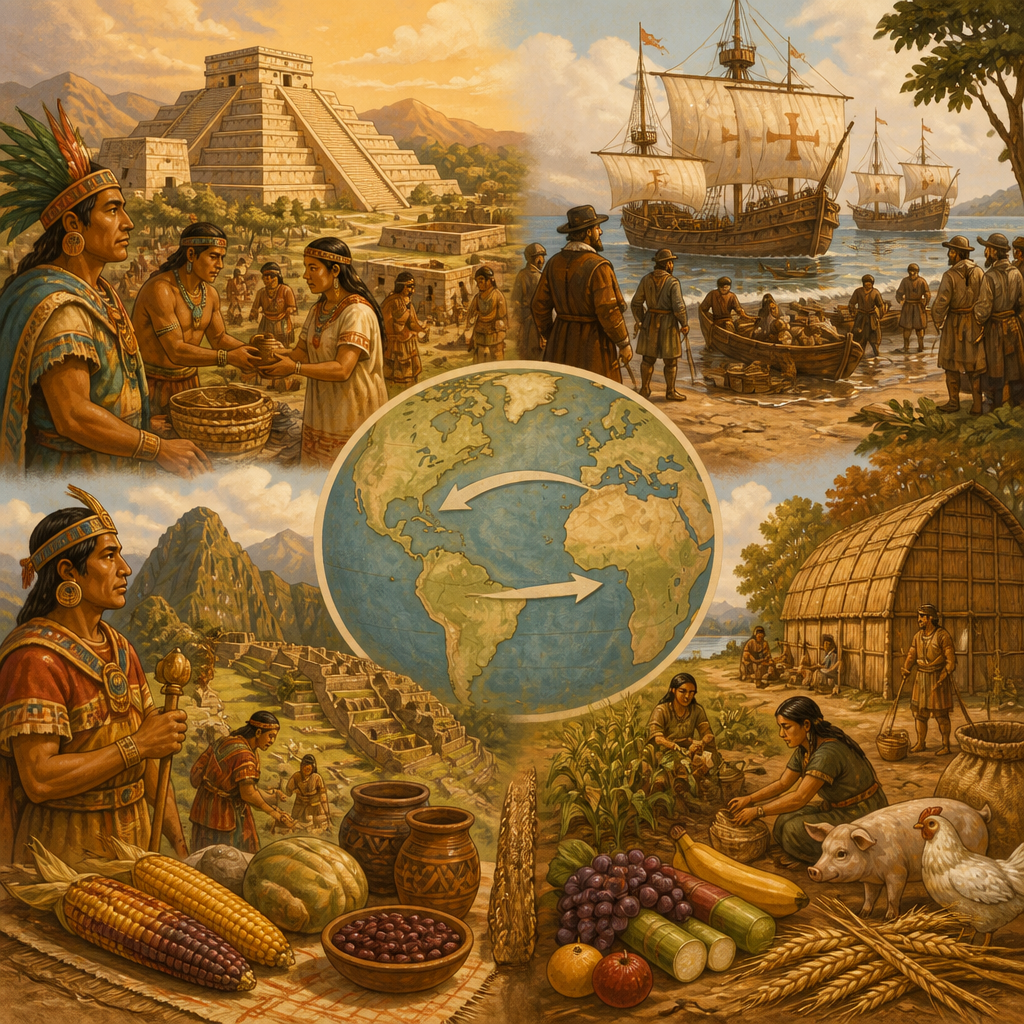
Illustrations are auto-generated and may be placeholders. They can be refreshed to match the narration.
Maya, Aztec, and Inca Achievements
Complex civilizations developed in the Americas long before sustained contact with Europeans. The Maya built city-states in Mesoamerica and made advances in writing, mathematics, astronomy, and calendars. The Aztec created a powerful empire centered on Tenochtitlan, a large island city with markets, temples, and causeways. The Inca governed a vast Andean empire connected by roads and suspension bridges. Each civilization adapted to its environment. For example, Aztec farmers used chinampas, raised fields built in shallow lake water, to grow crops near Tenochtitlan. Inca farmers cut terraces into steep mountain slopes, reducing erosion and creating level farmland. These examples show that Indigenous societies were organized, innovative, and diverse. They developed political systems, religious traditions, trade networks, and technologies suited to different geographic conditions.
Motives and Technology for Exploration
During the 1400s and 1500s, European rulers and merchants sought new sea routes to Asian markets. They wanted valuable goods such as spices and silk, as well as wealth, territory, and opportunities to spread Christianity. Improvements in navigation made long voyages more practical. Sailors used tools such as the compass and astrolabe, while shipbuilders developed vessels that could travel effectively across oceans. For example, Portuguese sailors traveled around Africa to reach Indian Ocean trade routes. In 1492, Christopher Columbus sailed west for Spain and reached Caribbean islands, believing he had approached Asia. His voyage did not represent the first human arrival in the Americas, which had been inhabited for thousands of years. It did begin a period of sustained contact that transformed societies on both sides of the Atlantic.
Conquest and Its Human Consequences
Spanish expeditions conquered the Aztec and Inca empires during the 1500s. Spanish forces had steel weapons and horses, but technology alone does not explain their victories. They also formed alliances with Indigenous groups that opposed Aztec or Inca rule. Disease caused the greatest loss of life. Indigenous Americans had little immunity to illnesses such as smallpox, which spread rapidly and weakened communities. For example, a smallpox outbreak struck Tenochtitlan during the Spanish campaign, killing many residents and defenders. Conquest brought forced labor, land loss, cultural destruction, and European political control. Indigenous people resisted in many ways, including military action and the preservation of languages and traditions. Understanding conquest requires examining multiple causes and recognizing the experiences of people whose communities were invaded.
The Columbian Exchange and Atlantic Trade
The Columbian Exchange was the movement of plants, animals, diseases, people, and ideas between the Eastern and Western Hemispheres after 1492. Europeans introduced horses, cattle, wheat, and sugarcane to the Americas. American crops such as potatoes, tomatoes, maize, and cacao spread to Europe and other regions. Potatoes, for example, became an important food in parts of Europe because they produced many calories in a small area. Exchange also had devastating effects. Diseases killed millions of Indigenous Americans, and European colonies increasingly relied on the forced migration and enslavement of Africans. Atlantic trade connected Europe, Africa, and the Americas, generating wealth for merchants and empires while causing enormous human suffering. The exchange changed diets, environments, populations, and economies across the world.