
Industrialization and Social Change
Students investigate how new technology, factory production, and urban growth transformed work, communities, and economies in Europe and the Americas.
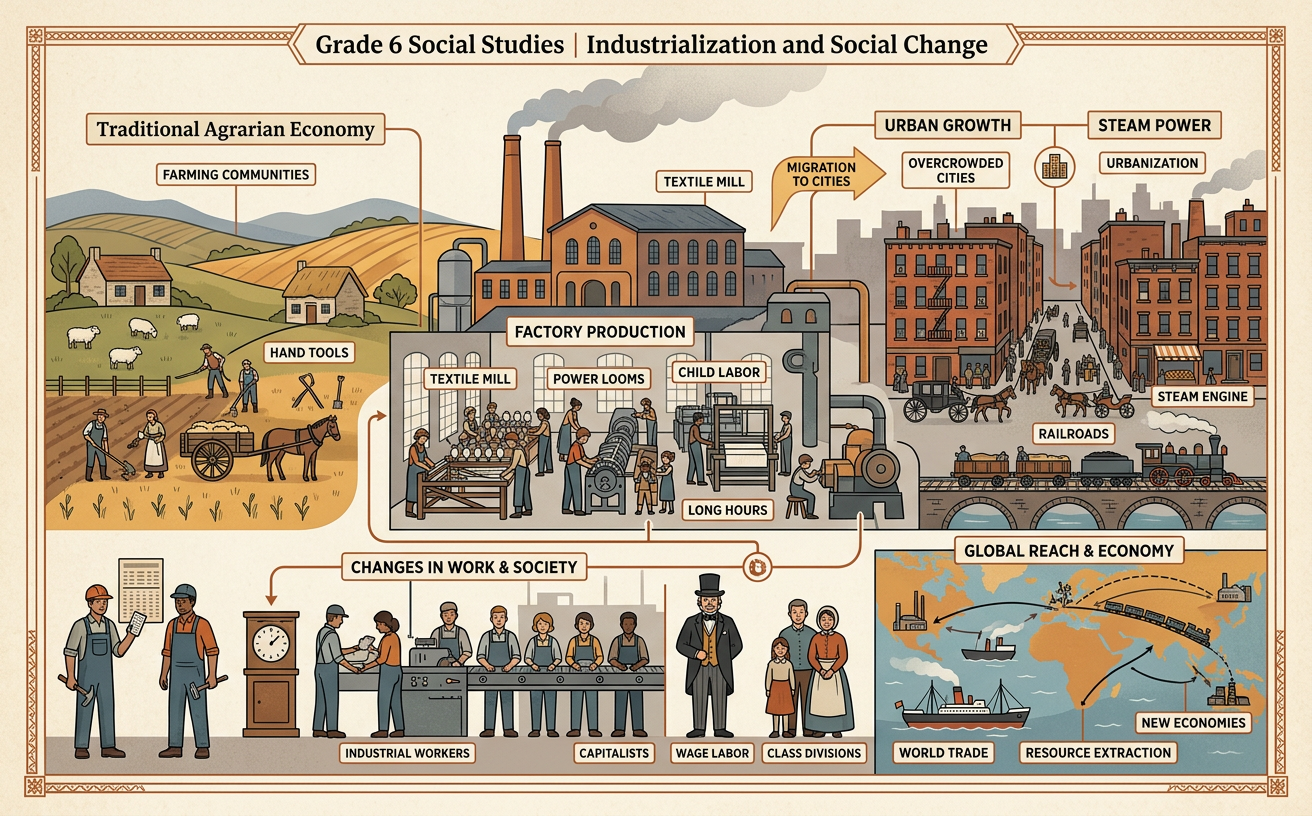
Illustrations are auto-generated and may be placeholders. They can be refreshed to match the narration.
Why Industrialization Began
The Industrial Revolution began in Great Britain during the late 1700s. Britain had coal and iron deposits, investment money, overseas markets, and waterways that supported transportation. Improvements in agriculture increased the food supply and population while reducing the number of farmworkers needed in some areas. Many people moved to towns in search of paid work. Inventors developed machines that produced goods more quickly than skilled workers could make them by hand. For example, mechanized spinning and weaving allowed textile factories to produce large amounts of cloth at lower cost. Steam engines supplied power where moving water was unavailable. Industrial methods later spread to continental Europe, the United States, and other regions. Industrialization was not one invention but a connected transformation involving energy, labor, transportation, investment, and production.

Factories, Workers, and Cities
Factory production changed where and how people worked. Instead of completing tasks at home or in small workshops, laborers reported to factories at fixed times and operated machines owned by employers. Early factory employees commonly worked long hours for low wages in noisy and unsafe conditions. Women and children were hired because owners could often pay them less than adult men. Industrial cities grew rapidly, but housing, clean water, and sanitation did not always keep pace. For example, a family might live in one crowded room near a factory, where smoke polluted the air and untreated waste spread disease. Workers eventually organized unions and demanded shorter hours, safer workplaces, and better pay. Reformers also supported laws that limited child labor and required improvements in factories.

Transportation and Expanding Markets
New transportation systems connected farms, mines, factories, cities, and ports. Steam locomotives moved people and freight faster than wagons, while steamships made river and ocean travel more dependable. Railroads allowed factories to receive raw materials and sell finished goods across larger markets. Telegraph lines also enabled information to travel quickly over long distances. In the United States, railroads connected interior farming and mining regions with industrial cities and coastal ports. For example, grain grown far from the Atlantic coast could be shipped by rail to a city, processed into flour, and exported overseas. These connections lowered some transportation costs and encouraged businesses to expand. They also increased pressure on Indigenous lands and tied distant communities more closely to national and international economies.

Benefits, Costs, and Reform
Industrialization produced both benefits and serious costs. Factories made clothing, tools, and household goods more widely available. New jobs and transportation systems helped some families improve their standard of living. Industrial growth also created wealthy business owners and a growing middle class of managers, professionals, and shopkeepers. At the same time, workers faced dangerous conditions, economic insecurity, and crowded neighborhoods. Coal smoke polluted cities, and industrial waste contaminated water. Governments responded gradually as journalists, workers, and reformers publicized these problems. For example, reports about children injured while operating machinery helped build support for minimum working ages and school attendance laws. Studying industrialization requires comparing perspectives: a factory owner might emphasize productivity, while a worker might focus on wages, hours, and safety.