Industrialization and the Growth of American Cities
Students examine how late nineteenth-century industrialization drove urban growth while transforming working conditions, immigration patterns, and the environment.
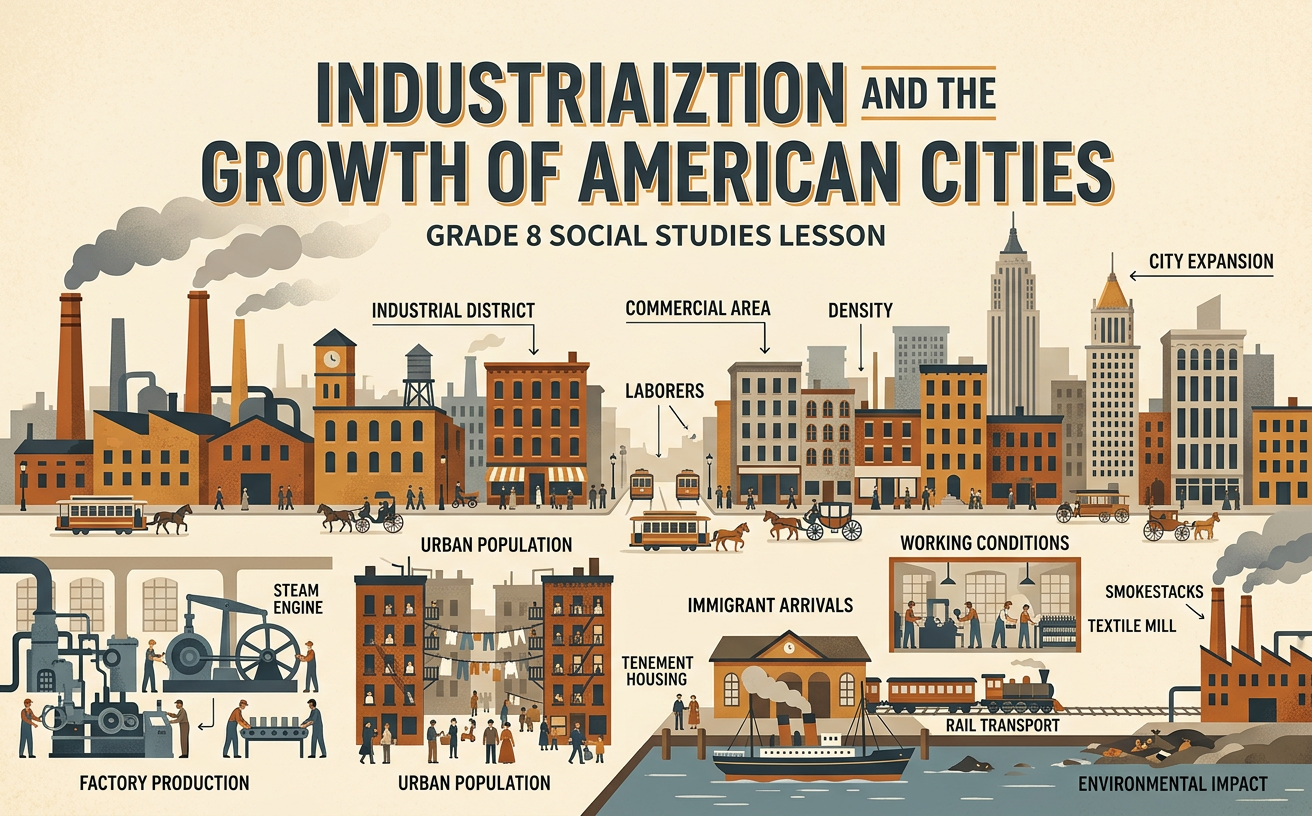
Illustrations are auto-generated and may be placeholders. They can be refreshed to match the narration.
Factories and Mass Production
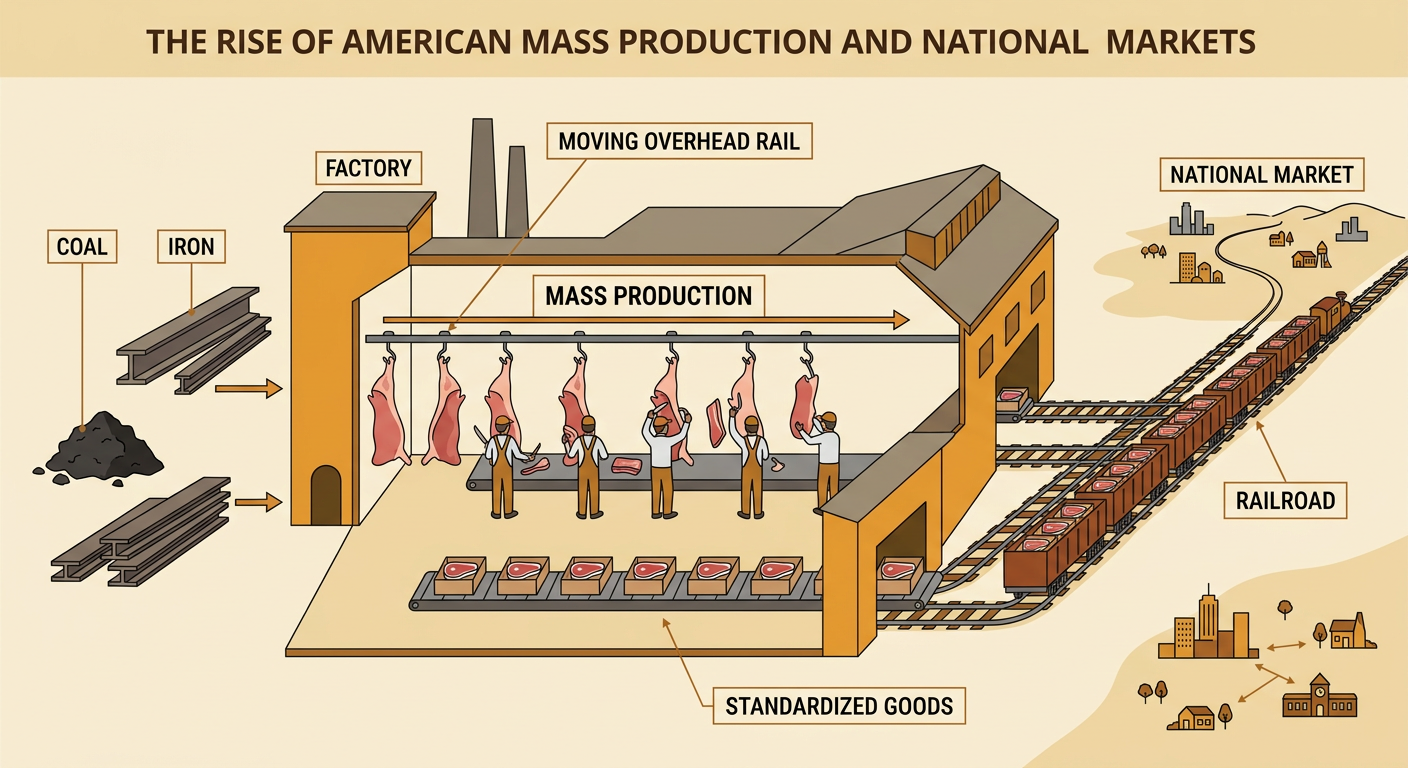
After the Civil War, new machines, large supplies of coal and iron, expanding railroads, and growing investment helped American factories produce goods rapidly. Factory owners divided production into specialized tasks, allowing less-skilled workers to make standardized products in large quantities. This system lowered prices but also reduced workers’ control over the pace and methods of their labor. For example, Chicago meatpacking plants used moving overhead rails to carry animal carcasses from one worker to another. Each worker repeated a particular task, making processing faster than if one person completed every step. Railroads then transported packaged meat to distant markets. Industrial growth therefore resulted from several connected causes: available resources, technological innovation, investment, labor, transportation, and consumer demand.
Immigration and Urban Growth
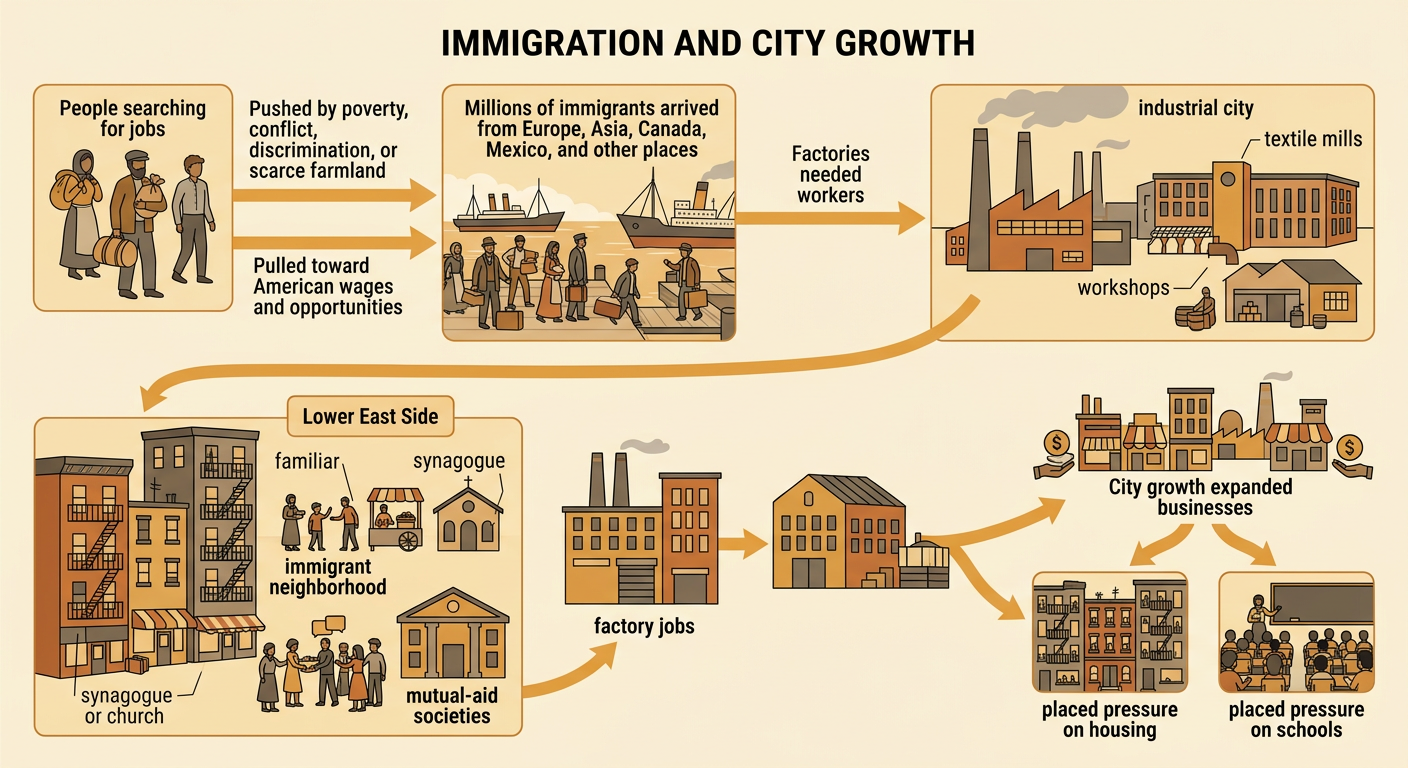
Industrial cities grew because factories needed workers and people needed jobs. Millions of immigrants arrived from Europe, Asia, Canada, Mexico, and other regions during the late nineteenth century. Some left their homes because of poverty, political conflict, discrimination, or limited farmland. American wages and opportunities attracted them, although their experiences varied widely. Many newcomers settled near factories and transportation centers where work was available. They formed neighborhoods that supported familiar languages, religions, foods, and mutual-aid societies. New York City’s Lower East Side, for example, became home to many Jewish and Italian immigrants who worked in garment shops, construction, and other urban industries. Rapid population growth expanded city economies, but it also increased demand for housing, clean water, transportation, schools, and sanitation.
Working and Living Conditions
Industrial employment provided wages, but many workers faced long hours, low pay, dangerous machinery, and little job security. Women and children often earned less than adult men for demanding work. Because cities grew faster than housing construction and regulation, working-class families frequently crowded into tenement buildings with poor ventilation, limited plumbing, and few safe exits. These problems encouraged workers to organize labor unions and demand change. During the 1892 Homestead Strike in Pennsylvania, steelworkers resisted wage cuts at a Carnegie Steel plant. A violent conflict followed when the company brought in private guards, and the union was defeated. The strike shows how disagreements over wages, working conditions, and control of production could create serious conflict among workers, business owners, and government authorities.

Environmental Effects of Industrial Cities
Industrial cities changed Earth systems by consuming large amounts of resources and producing concentrated waste. Factories and homes burned coal for power and heat, releasing smoke, soot, and gases into the atmosphere. Growing populations required more water, food, lumber, and land, while factories and households often dumped waste into rivers. Polluted water could damage aquatic ecosystems and spread diseases such as cholera and typhoid. Pittsburgh, a major steel-producing city, became known for coal smoke that darkened the air and covered buildings with soot. An evidence-based environmental argument should connect population and resource use to measurable effects. For example, more residents and factories increased coal consumption; increased coal burning worsened air pollution. Industrialization created jobs and goods, but its environmental costs were often carried by nearby working-class communities.

Analyzing Historical Evidence
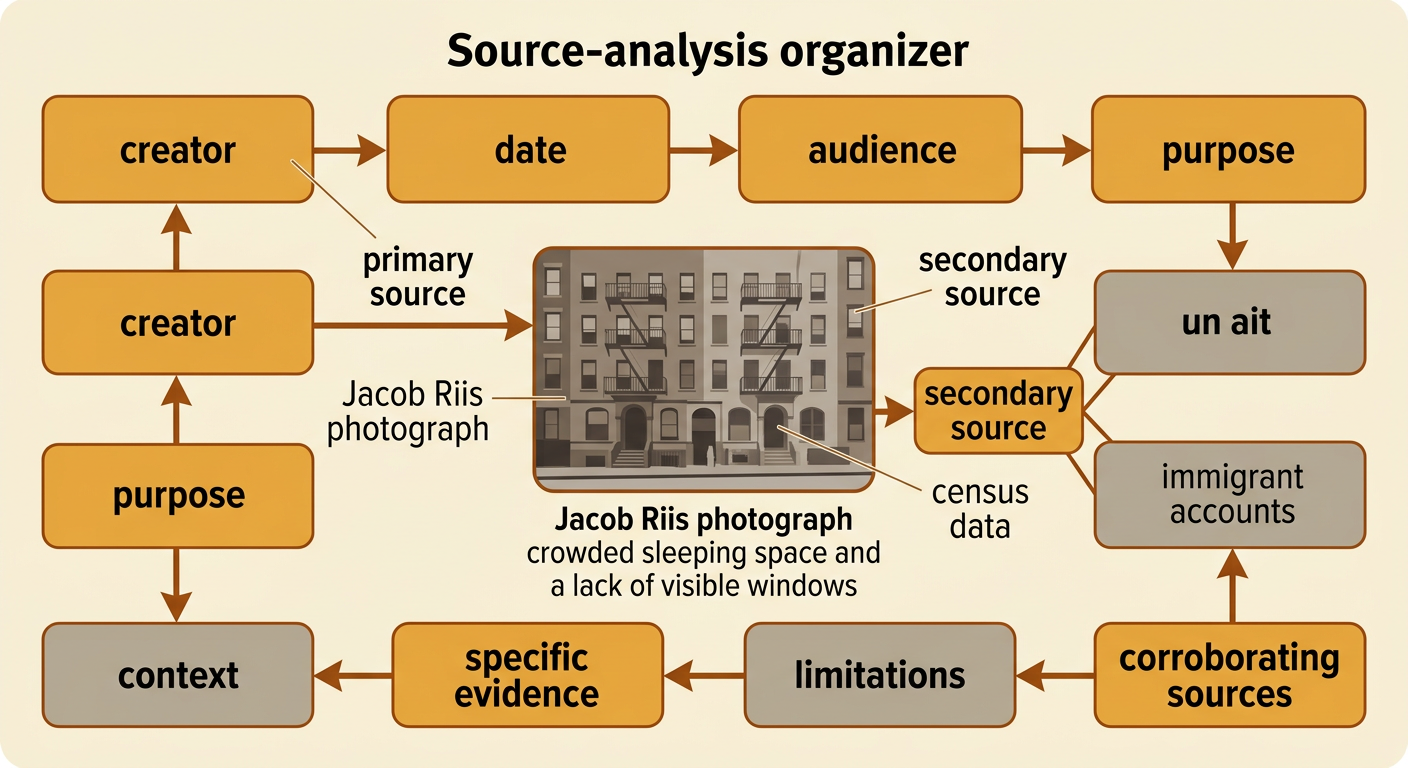
Historians use primary and secondary sources to investigate industrial cities. Primary sources were created during the period and include photographs, letters, newspapers, maps, census records, and factory reports. Secondary sources are later interpretations based on historical evidence. A strong analysis identifies the creator, date, audience, purpose, and historical context of each source. It also cites specific details rather than making unsupported claims. For example, a student examining a Jacob Riis photograph of a New York tenement might cite the crowded sleeping area and lack of visible windows as evidence of poor living conditions. However, one photograph cannot represent every home or reveal every resident’s experience. Students should compare it with census data, building inspections, immigrant accounts, and historians’ research. Corroborating several sources creates a more reliable interpretation.
Causes, Effects, and Reform
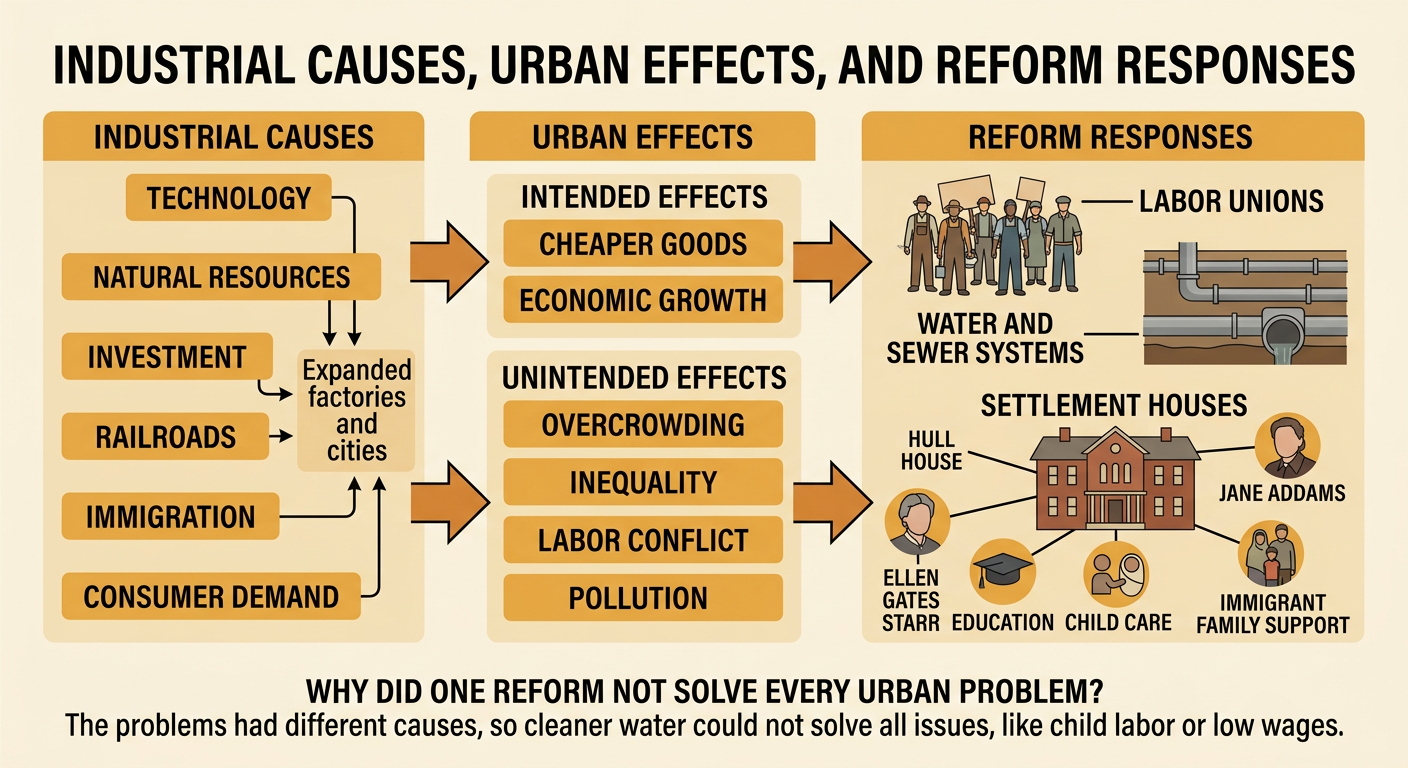
Industrialization and urban growth had multiple connected causes and effects. New technology, natural resources, investment, railroads, immigration, and demand for goods expanded factories and cities. The results included cheaper products, economic growth, crowded neighborhoods, labor conflict, inequality, and pollution. Reformers responded in different ways. Labor unions organized workers, city governments improved water and sewer systems, and settlement houses offered education, child care, and other services. In 1889, Jane Addams and Ellen Gates Starr founded Hull House in Chicago. It served many immigrant families while reformers studied neighborhood conditions and advocated public improvements. No single reform solved every problem, and change often occurred slowly. To explain this history accurately, students should trace several causes, identify both intended and unintended effects, and support claims about reform with evidence from reliable sources.