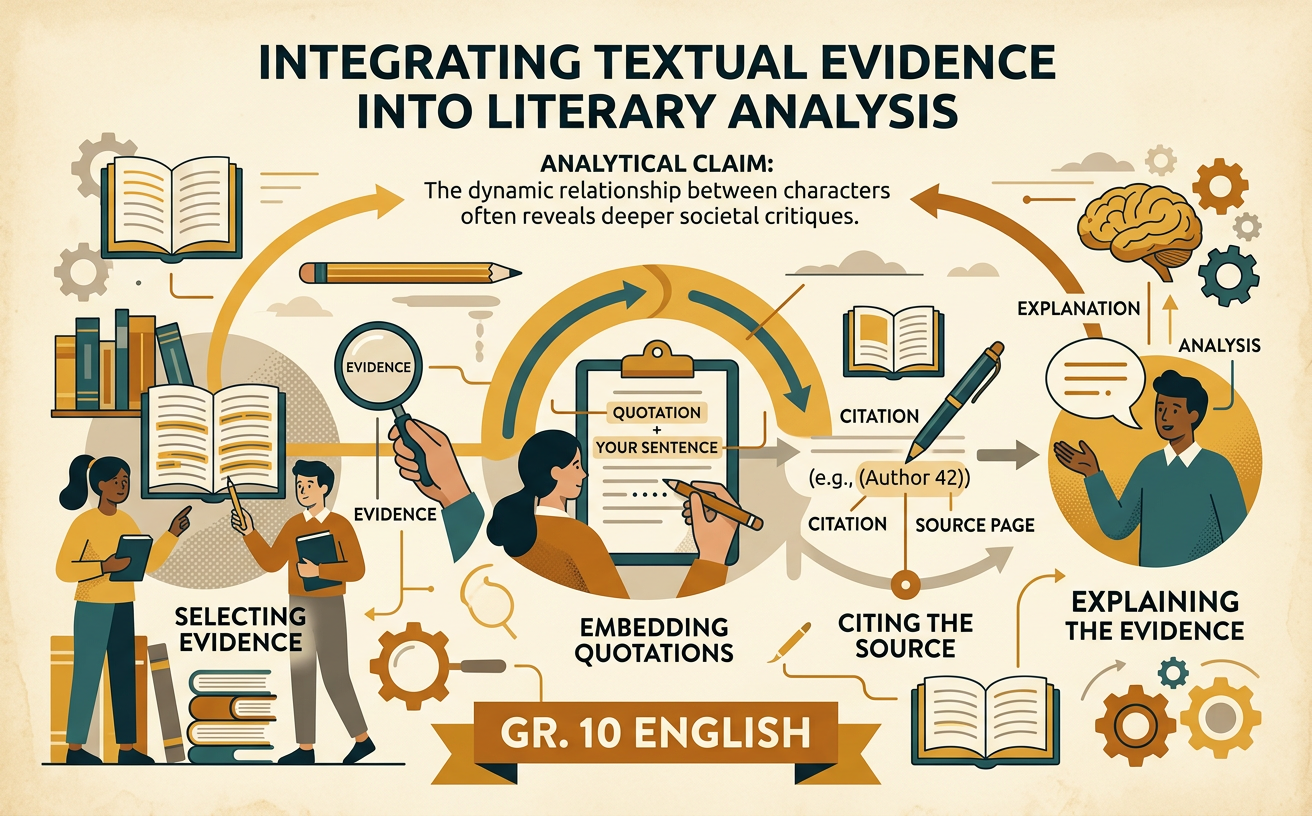
Integrating Textual Evidence into Literary Analysis
Students will select, embed, cite, and explain quotations that directly support an analytical claim about a literary text.
Illustrations are auto-generated and may be placeholders. They can be refreshed to match the narration.
Connect Claims to Evidence
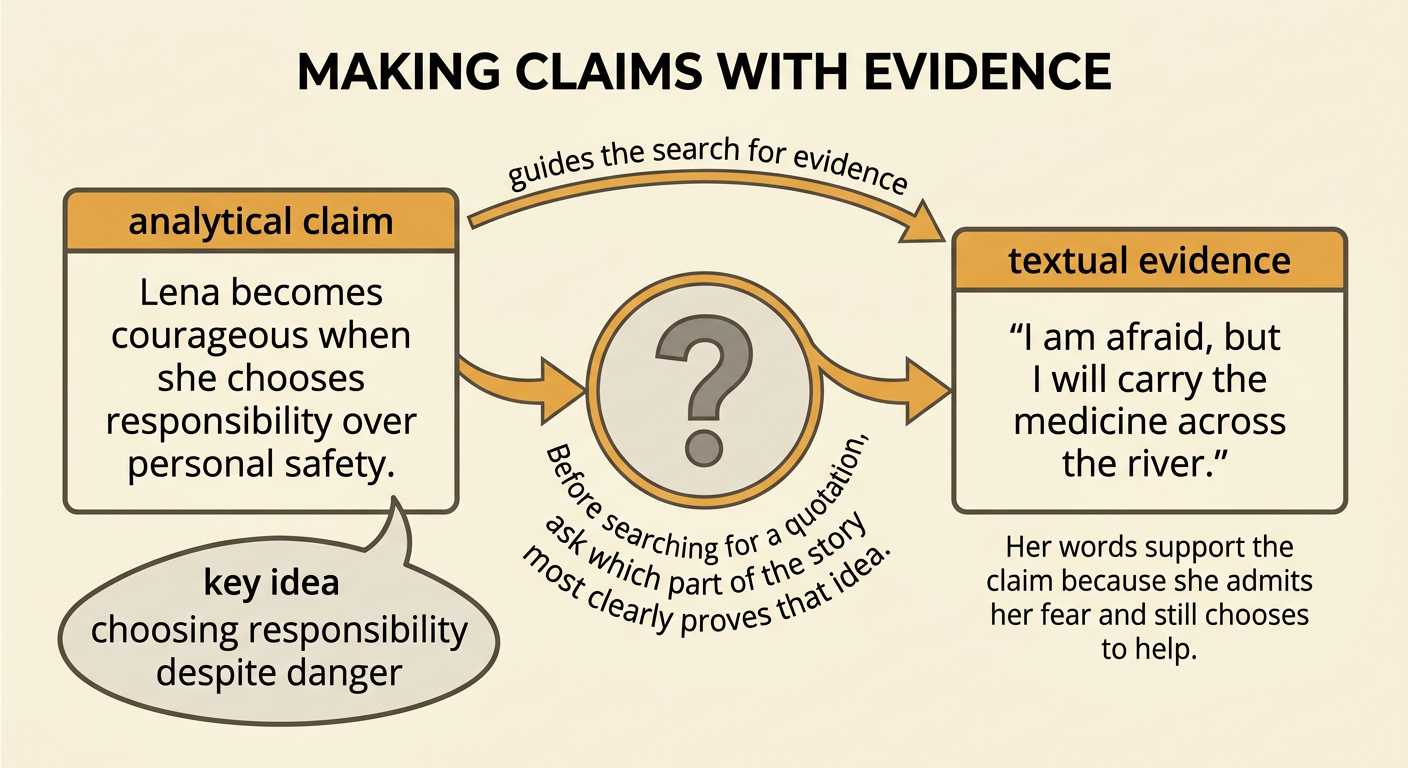
An analytical claim states an interpretation that a reader could support or challenge. Textual evidence provides the specific words, details, or events that make the interpretation convincing. Before choosing a quotation, underline the key idea in your claim and ask, “What part of the text most clearly proves this idea?” For example, suppose a claim about a sample story states, “Lena becomes courageous when she chooses responsibility over personal safety.” A strong supporting quotation might describe Lena saying, “I am afraid, but I will carry the medicine across the river.” The quotation connects directly to courage because Lena admits her fear and acts anyway. Evidence should not merely relate to the same character or topic; it should help prove the exact interpretation stated in the claim.
Select Relevant Quotations
Choose a quotation because it offers precise support, not simply because it sounds dramatic or interesting. First, identify the part of the claim that needs proof. Then compare possible quotations and select the one that reveals the most useful action, description, dialogue, or narration. Keep the quotation as short as possible while preserving its meaning. If the claim is “Lena’s courage develops through deliberate choices,” the sentence “The river was dark beneath the moon” creates mood but does not show courage. The statement “I am afraid, but I will carry the medicine across the river” is more relevant because it shows both fear and a decision to act. Avoid quotations that require excessive explanation before a reader can see their connection to the claim.

Embed Quotations Smoothly
An embedded quotation fits grammatically into your own sentence. Introduce the quotation with context or blend quoted words into your syntax so that readers understand who is speaking and what is happening. Avoid dropping a quotation into a paragraph as a sentence with no introduction. A weak example is: “I am afraid, but I will carry the medicine across the river.” This appears without context. A smoother version is: Although Lena recognizes the danger, she accepts responsibility when she says, “I am afraid, but I will carry the medicine across the river.” You can also quote only the most useful words: Lena shows courage by admitting that she is “afraid” while still promising to cross the river. Read the complete sentence aloud to check its grammar and flow.

Cite Evidence Correctly
A citation tells readers where the evidence appears and allows them to locate it. Follow the citation style required by your teacher. In MLA style, a quotation from a paginated literary work usually ends with the author’s last name and page number in parentheses. Place the period after the parenthetical citation: Lena accepts the dangerous task, saying, “I will carry the medicine across the river” (Chen 42). If the author’s name appears in the sentence, include only the page number: Chen shows Lena accepting the task when she promises to “carry the medicine across the river” (42). Plays, poems, and digital texts may use act, scene, line, stanza, or paragraph numbers instead. Check the source and record its location while taking notes so the citation remains accurate.

Explain How Evidence Supports the Claim
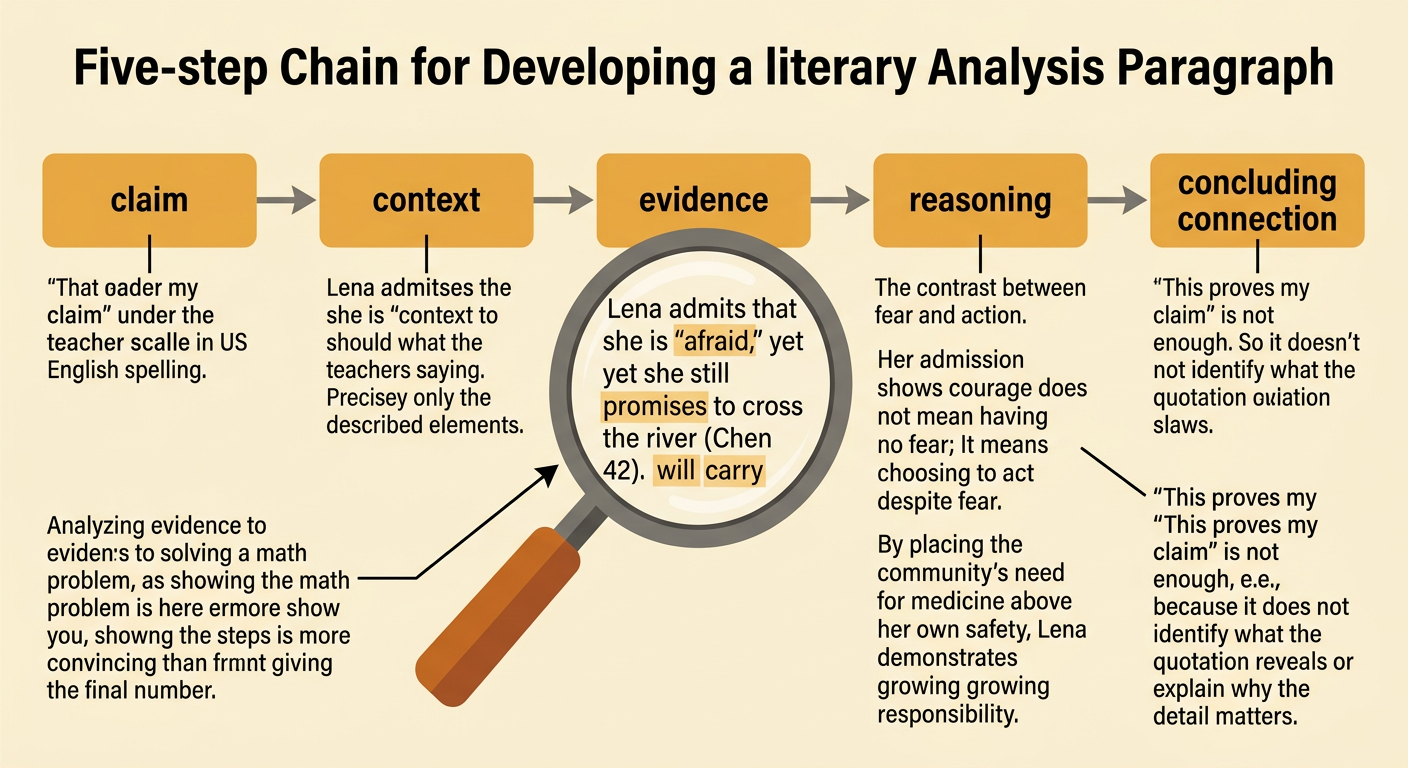
Evidence does not explain itself. After a quotation, interpret important words or details and show how they support the claim. Avoid simply repeating the quotation or writing, “This proves my claim.” Instead, name what the evidence reveals and connect it to the larger idea. For example: Lena admits that she is “afraid,” yet she still promises to cross the river (Chen 42). Her admission shows that courage does not mean lacking fear; it means choosing to act despite fear. By placing the community’s need for medicine above her own safety, Lena demonstrates growing responsibility. This explanation focuses on the contrast between fear and action, then links that contrast to the claim about courage. A useful paragraph pattern is claim, context, evidence, reasoning, and a concluding connection.