Interactions in an Ecosystem
Students examine how organisms interact with living and nonliving components of an ecosystem and how energy moves through food chains and food webs.
Illustrations are auto-generated and may be placeholders. They can be refreshed to match the narration.
Meaning of an Ecosystem
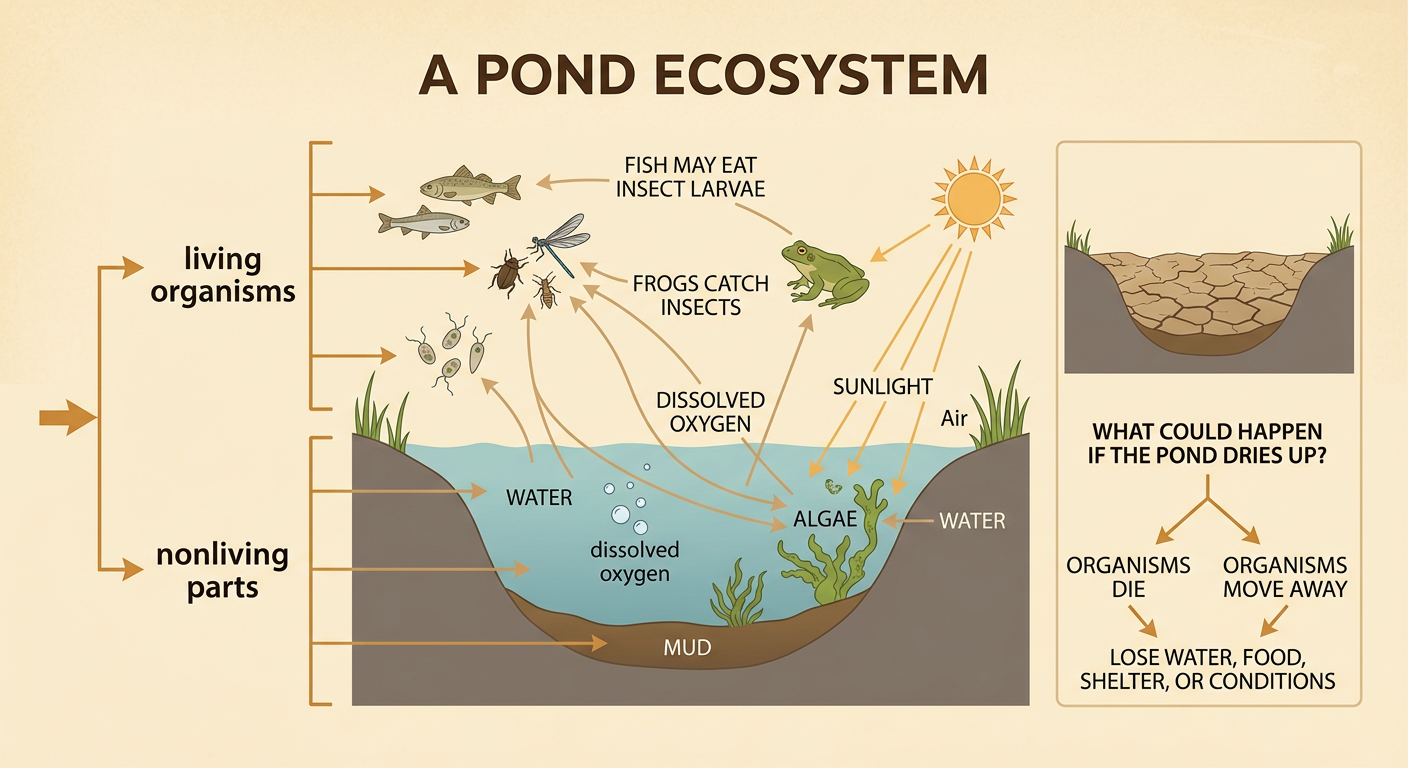
An ecosystem is a community of living organisms interacting with one another and with the nonliving parts of their surroundings. It includes plants, animals, microorganisms, soil, water, air, sunlight, and other environmental conditions in a particular area. An ecosystem may be as small as a puddle or as large as a forest. Its parts are connected, so a change in one part can affect many others. For example, a pond ecosystem contains algae, fish, frogs, insects, water, mud, sunlight, and dissolved oxygen. Fish may eat insect larvae, while frogs feed on insects near the water. If the pond dries up, these organisms may die or move away. Studying an ecosystem helps us understand how organisms obtain food, shelter, water, and suitable conditions for survival.
Biotic and Abiotic Components
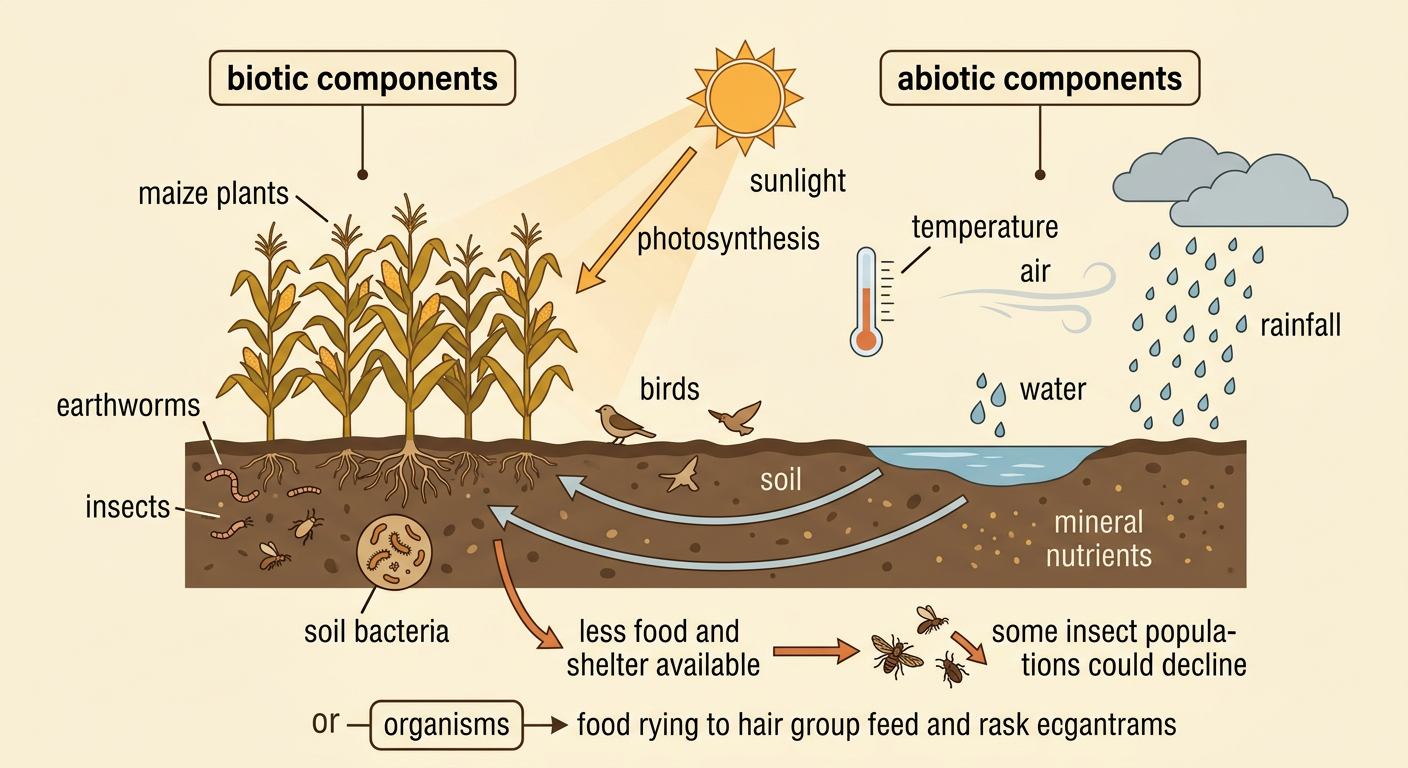
The components of an ecosystem are grouped as biotic and abiotic. Biotic components are the living or once-living parts, including plants, animals, fungi, and microorganisms. Their activities include feeding, growing, reproducing, and competing for resources. Abiotic components are the nonliving physical and chemical factors, such as sunlight, temperature, air, water, soil, minerals, and rainfall. Abiotic factors influence which organisms can survive in an area. For example, in a school garden, maize plants, earthworms, insects, birds, and soil bacteria are biotic components. Sunlight, air, water, soil, and temperature are abiotic components. Maize needs sunlight for photosynthesis, water for growth, and mineral nutrients from the soil. Too little rainfall can reduce plant growth, leaving less food and shelter for insects and other animals.
Producers, Consumers, and Decomposers
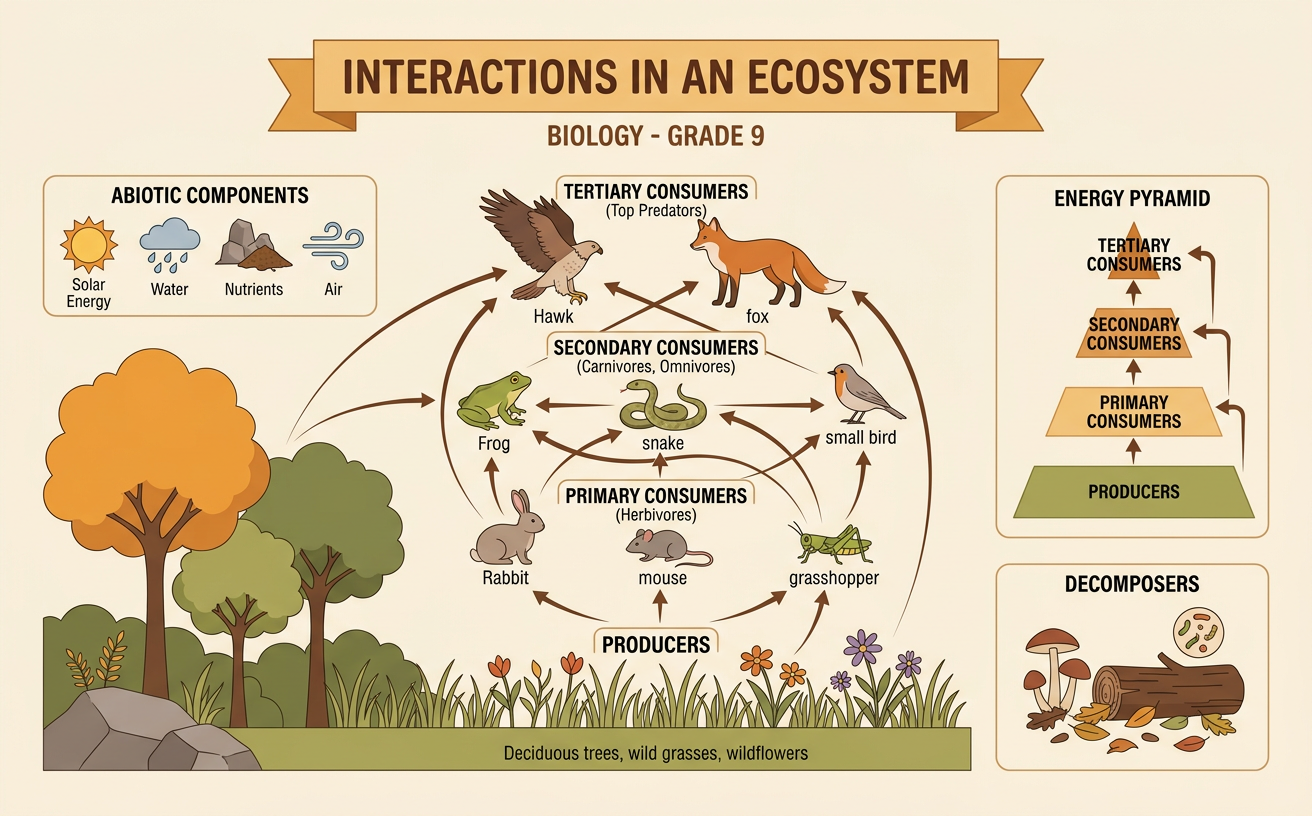
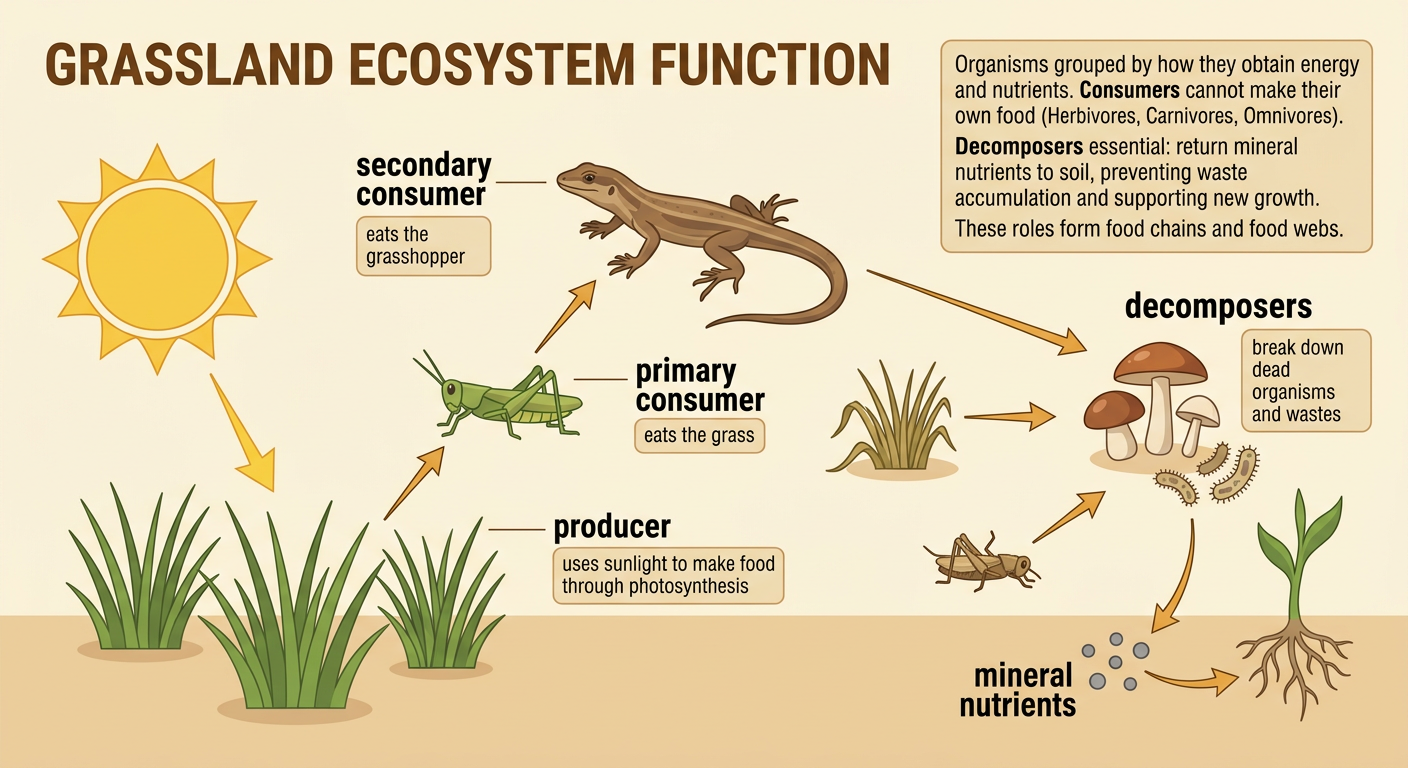
Organisms have different roles according to how they obtain energy and nutrients. Producers, such as green plants and algae, use sunlight to make food through photosynthesis. Consumers cannot make their own food, so they obtain energy by eating plants or other animals. Herbivores eat plants, carnivores eat animals, and omnivores eat both. Decomposers, mainly bacteria and fungi, break down dead organisms and wastes. This process returns mineral nutrients to the soil or water, where producers can use them again. In a grassland, grass is a producer, a grasshopper that eats grass is a primary consumer, and a lizard that eats the grasshopper is a secondary consumer. When these organisms die, fungi and bacteria decompose their remains. Without decomposers, dead material would accumulate and fewer nutrients would be available for new plant growth.
Food Chains and Food Webs
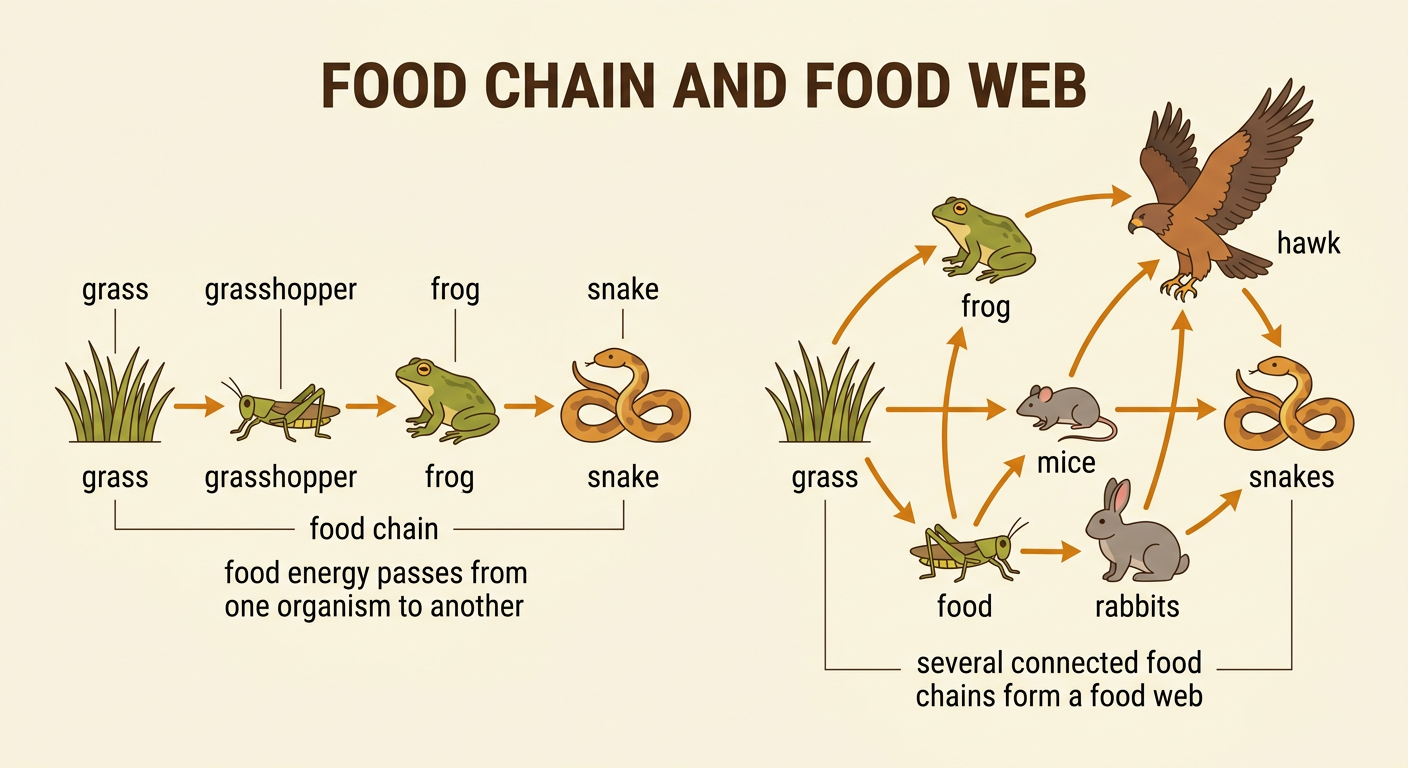
A food chain shows a single pathway through which food energy passes from one organism to another. It usually begins with a producer. Each arrow points from the organism being eaten toward the organism that receives the energy. For example, grass → grasshopper → frog → snake is a food chain. Grass captures sunlight, the grasshopper eats the grass, the frog eats the grasshopper, and the snake eats the frog. In nature, most organisms have more than one food source or predator. Several connected food chains form a food web. In a grassland food web, grass may be eaten by grasshoppers, mice, and rabbits. Snakes may eat frogs and mice, while hawks may eat snakes, mice, or rabbits. Food webs show that a decline in one population can affect several other organisms in the ecosystem.
Energy Flow in Ecosystems
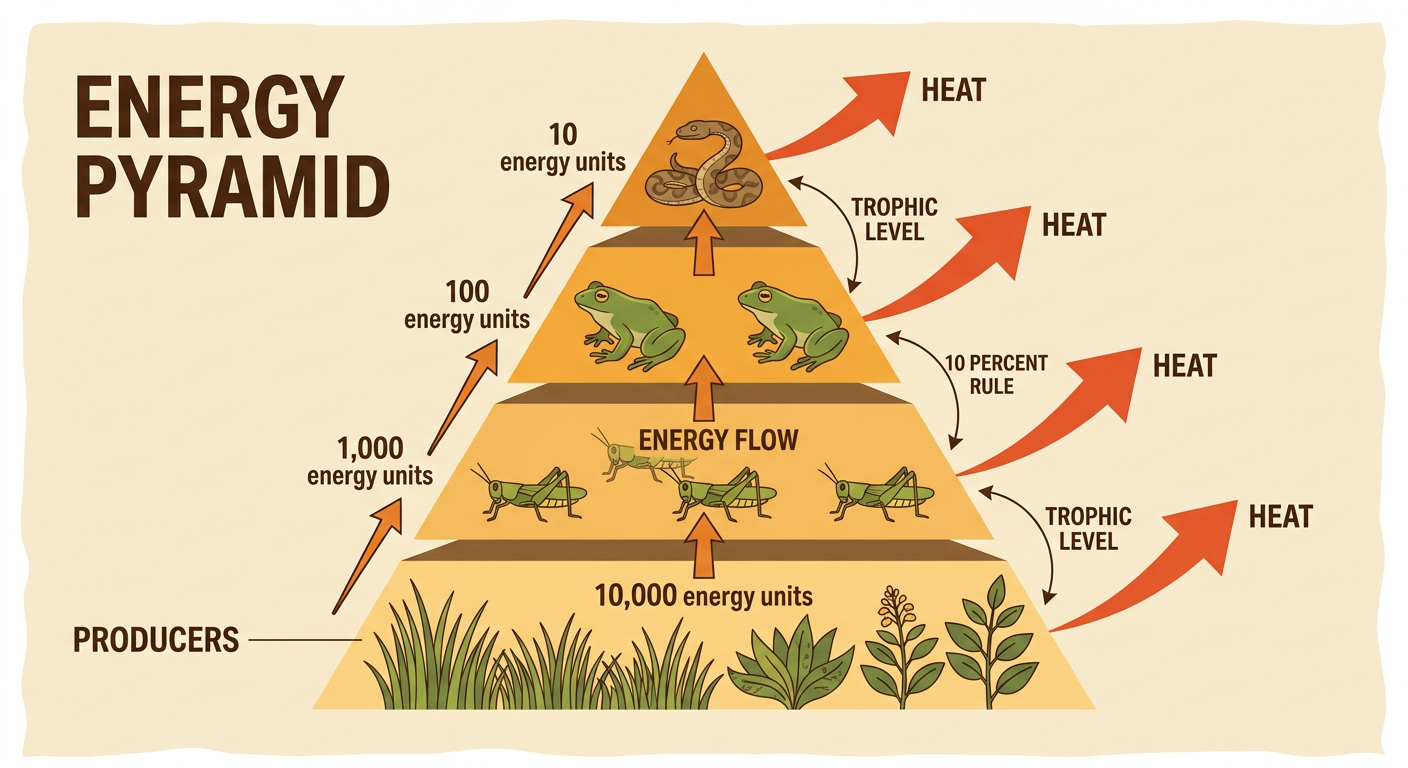
Energy enters most ecosystems as sunlight. Producers capture some light energy during photosynthesis and store it as chemical energy in food. When consumers eat producers or other consumers, part of this energy moves to the next feeding level, called a trophic level. However, much of the energy at each level is used for movement, growth, respiration, and other life processes or is released as heat. Often, only about 10 percent is transferred to the next level. For example, if grass stores 10,000 energy units, grasshoppers may receive about 1,000 units, frogs about 100 units, and snakes about 10 units. Therefore, energy pyramids are wide at the producer level and narrow at higher levels. Energy flows in one direction and is not recycled, although decomposers recycle mineral nutrients.