Intermolecular Forces and Boiling Points
Students use molecular structure and boiling-point data to identify intermolecular forces and explain differences in the physical properties of substances.

Illustrations are auto-generated and may be placeholders. They can be refreshed to match the narration.
Review Polarity and Molecular Structure
Molecular polarity depends on bond polarity and three-dimensional shape. A bond is polar when bonded atoms have different electronegativities, causing electrons to be shared unequally. The more electronegative atom carries a partial negative charge, while the other carries a partial positive charge. Bond dipoles may combine or cancel. Carbon dioxide has two polar C=O bonds, but its linear, symmetrical shape makes the dipoles cancel, so the molecule is nonpolar. Water also has polar bonds, but its bent shape prevents cancellation, making the molecule polar. Use a Lewis structure and molecular geometry together when predicting polarity. Look for lone pairs on the central atom, because they often produce asymmetrical shapes. A molecule’s polarity helps determine which intermolecular forces act between its particles and therefore influences properties such as boiling point and solubility.

Identify Types of Intermolecular Forces
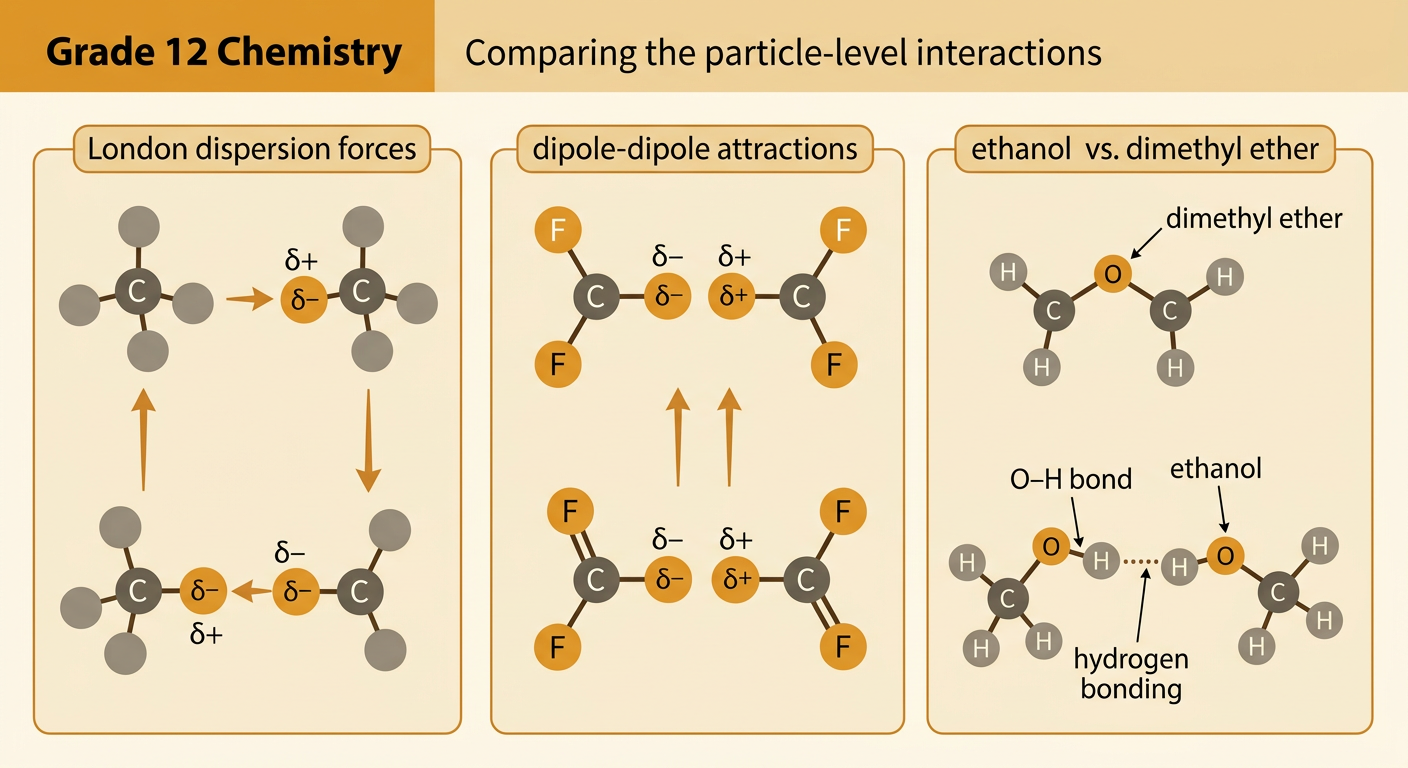
Intermolecular forces are attractions between separate particles, not the bonds holding atoms together within a molecule. London dispersion forces occur in every atom and molecule because electrons form temporary, uneven charge distributions. These forces generally become stronger as electron-cloud size and molecular surface area increase. Polar molecules also experience dipole-dipole attractions between opposite partial charges. Hydrogen bonding is an especially strong dipole-dipole attraction that occurs when hydrogen is directly bonded to nitrogen, oxygen, or fluorine and is attracted to a lone pair on one of those atoms in another particle. For example, ethanol and dimethyl ether have the same molecular formula, C₂H₆O. Both have dispersion forces and permanent dipoles, but only ethanol has an O–H bond and can form hydrogen bonds between its own molecules. A substance may therefore experience several types of intermolecular force at once.
Compare Boiling-Point Data
A liquid boils when its vapor pressure equals the surrounding pressure. Stronger intermolecular attractions require more energy to separate molecules, so they usually produce higher boiling points. Compare values measured at the same pressure, commonly 1 atmosphere. In the straight-chain alkanes, boiling point rises with molecular size: methane boils at about −161.5°C, ethane at −88.6°C, propane at −42.1°C, and butane at −0.5°C. All are nonpolar, so the main attraction is London dispersion. Larger molecules have more electrons and more easily distorted electron clouds, strengthening dispersion forces. Structure also matters when molar mass is similar. Straight-chain pentane boils at about 36.1°C, while compact, highly branched 2,2-dimethylpropane boils at about 9.5°C. The straight-chain molecule has greater surface contact with neighboring molecules, leading to stronger total attractions and a higher boiling point.

Graph Patterns and Explain Outliers
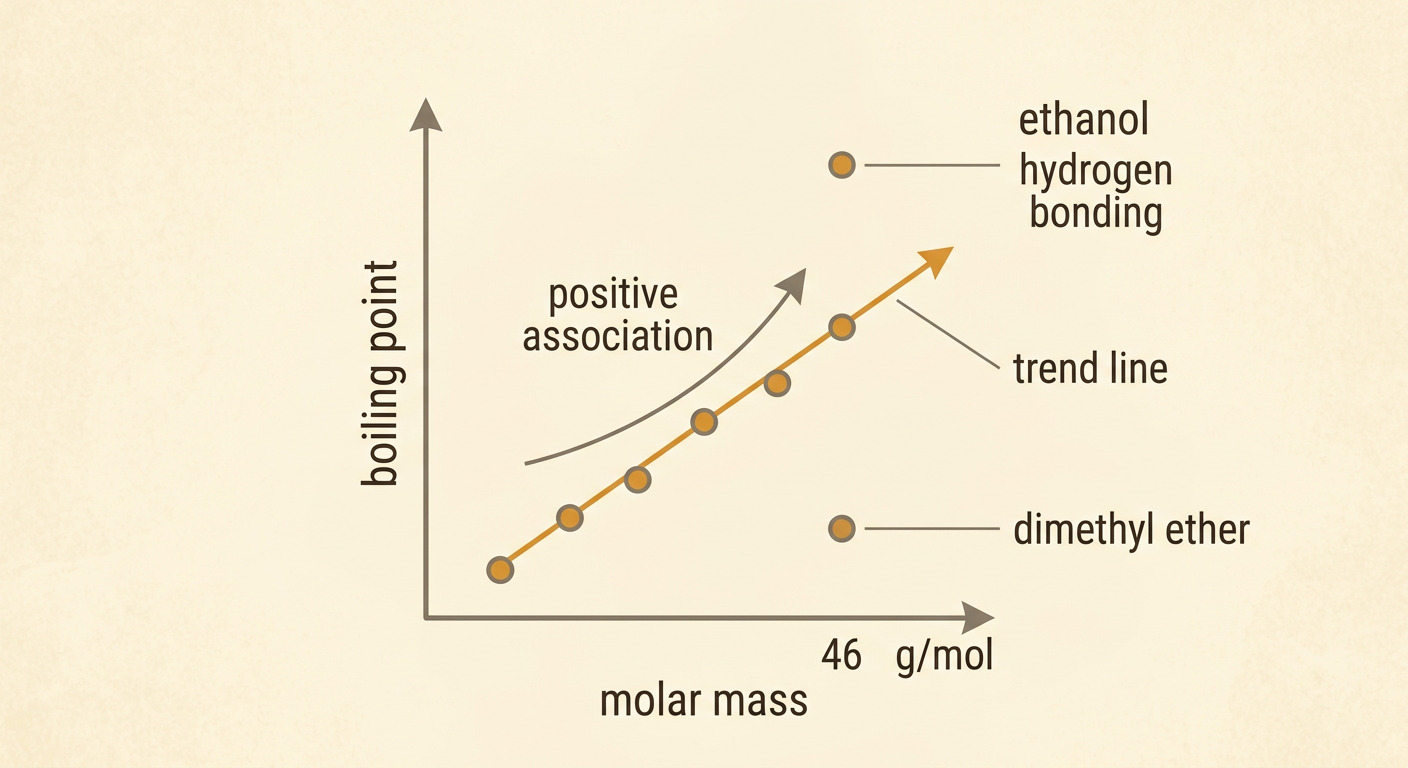
A scatter plot can show the relationship between molar mass and boiling point. Place molar mass on the horizontal axis and boiling point on the vertical axis, then plot substances from a chemically related group. For straight-chain alkanes, the points show a positive association because larger molecules generally have stronger dispersion forces. Draw a trend line only when the data support one, and describe its direction, form, and strength. Do not assume that molar mass alone causes every difference. Ethanol and dimethyl ether both have a molar mass of about 46.07 grams per mole, yet ethanol boils at 78.4°C and dimethyl ether at −24.8°C. Ethanol is an outlier relative to a dispersion-based prediction because its molecules form hydrogen bonds. Branching, polarity, and hydrogen bonding can shift a point away from a simple mass-based trend.
Design a Comparative Investigation
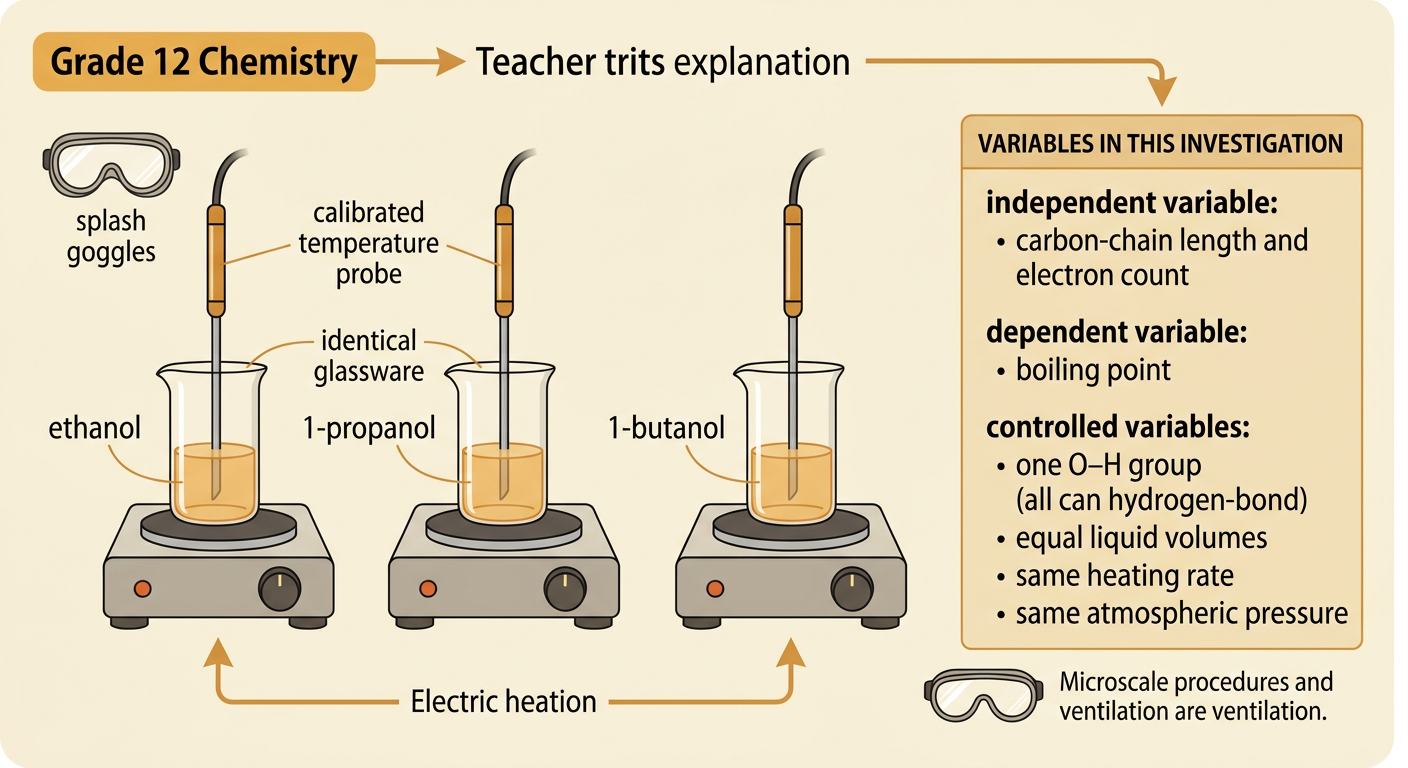
Design a fair comparison by changing one structural feature while controlling other variables. One investigation could compare the normal boiling points of ethanol, 1-propanol, and 1-butanol. Each substance has one O–H group and can hydrogen-bond, but carbon-chain length and electron count increase across the series. Predict that boiling point will rise because dispersion forces become stronger. Use equal liquid volumes, identical glassware, the same calibrated temperature probe, the same heating rate, and the same atmospheric-pressure conditions. Record the stable temperature during boiling for at least three trials per substance, then calculate a mean and range. Follow instructor-approved microscale procedures, wear splash goggles, work with ventilation, and keep these flammable liquids away from flames and sparks. Alternatively, analyze reliable reference data if direct heating is not permitted. Graph carbon number against mean boiling point and evaluate uncertainty and possible measurement error.
Construct an Evidence-Based Explanation
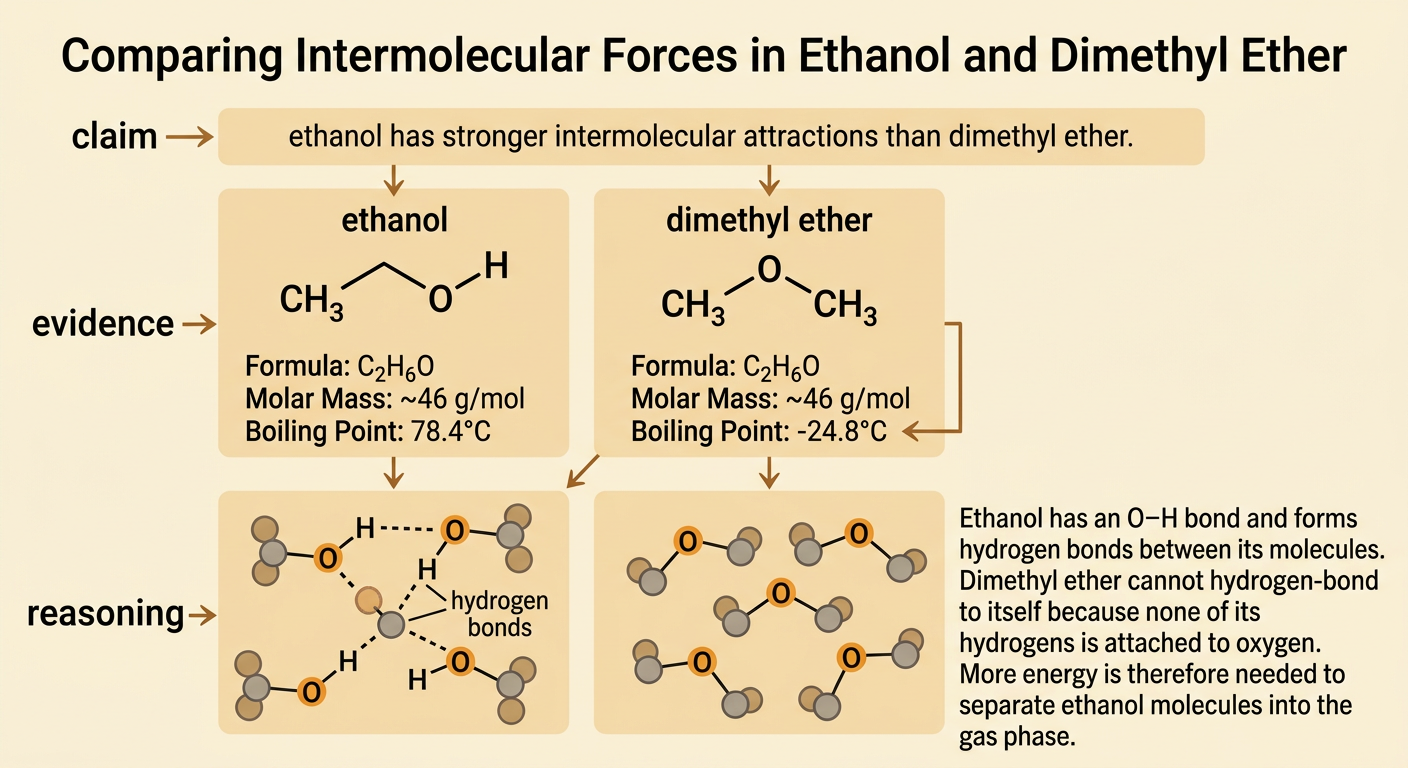
Build a scientific explanation with a claim, evidence, and reasoning. The claim directly answers the question about relative intermolecular-force strength or boiling point. Evidence should include specific structural observations and quantitative data from a table, graph, or investigation. Reasoning connects that evidence to particle behavior. For example: ethanol has stronger intermolecular attractions than dimethyl ether. Ethanol boils at 78.4°C, while dimethyl ether boils at −24.8°C, even though both have the formula C₂H₆O and nearly identical molar masses. Ethanol contains an O–H bond, allowing its molecules to form hydrogen bonds; dimethyl ether cannot hydrogen-bond to itself because none of its hydrogens is bonded to oxygen. More energy is therefore required to separate ethanol molecules into the gas phase. A strong explanation also considers alternatives, such as molar mass or branching, and explains why they do not adequately account for the observed difference.