Intermolecular Forces and Physical Properties
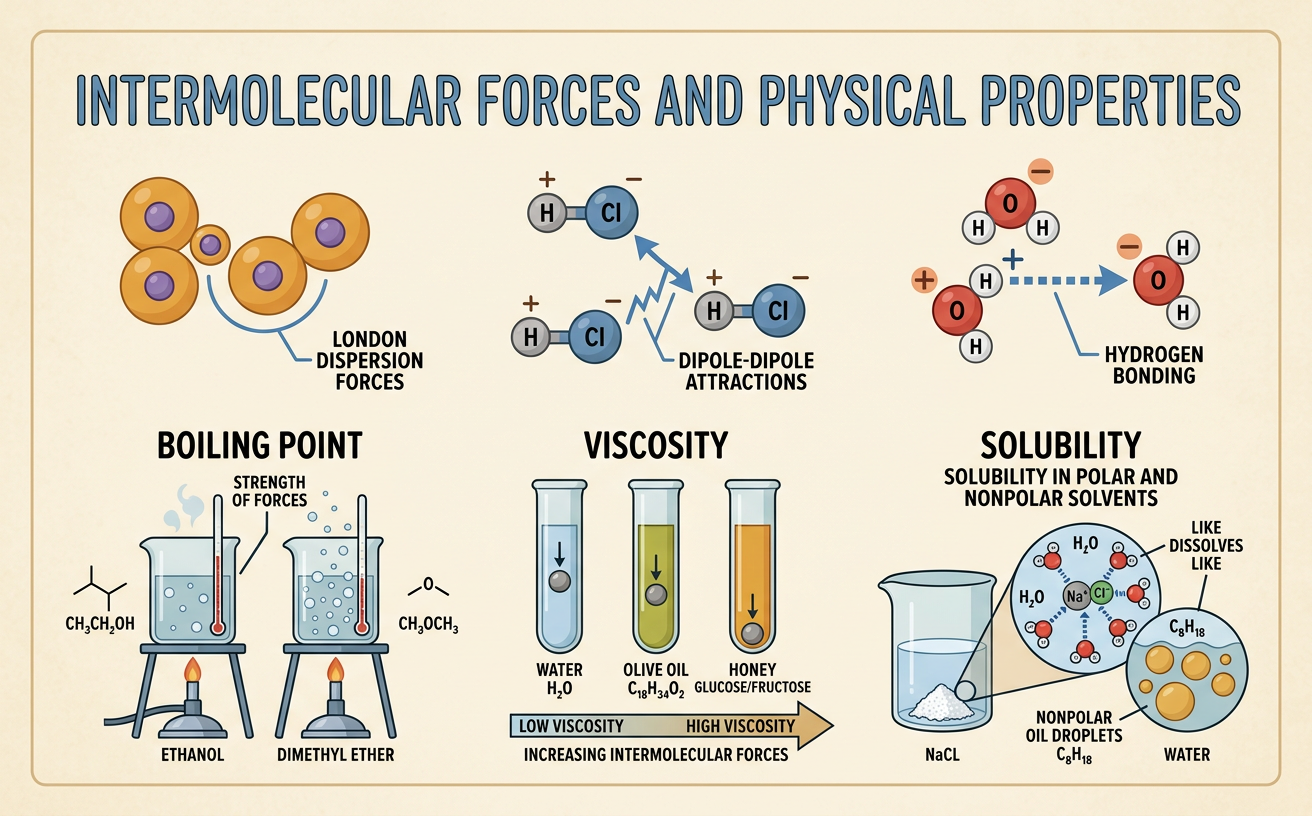
Students compare London dispersion forces, dipole-dipole attractions, and hydrogen bonding to explain differences in boiling point, viscosity, and solubility.
Illustrations are auto-generated and may be placeholders. They can be refreshed to match the narration.
Attractions Between Molecules
Intermolecular forces are electrical attractions between separate molecules. They are not the covalent bonds that hold atoms together within a molecule. These attractions result from uneven or changing distributions of electrons, which create full or partial charges that attract one another. Intermolecular forces are weaker than most covalent bonds, but many attractions acting together can strongly affect a substance’s behavior. For example, water molecules attract one another because the partially positive hydrogen atoms of one molecule are attracted to the partially negative oxygen atom of another. Energy is required to separate the molecules when liquid water boils. The water molecules move apart, but the covalent O–H bonds inside each molecule usually remain intact.

Types of Intermolecular Forces
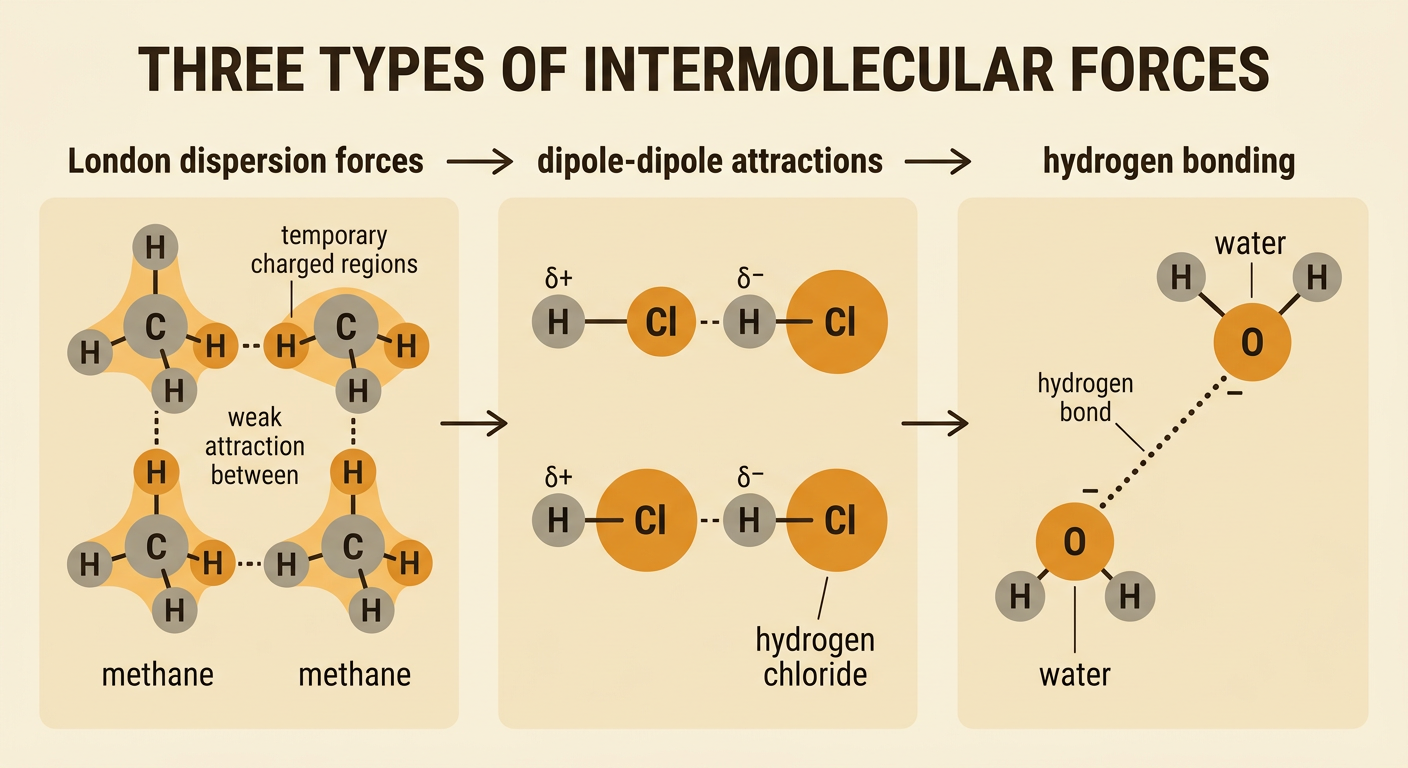
London dispersion forces, dipole-dipole attractions, and hydrogen bonding are three important intermolecular forces. London dispersion forces arise from temporary changes in electron distribution and occur in every atom and molecule. They are the only intermolecular forces between nonpolar methane molecules. Dipole-dipole attractions occur between polar molecules: the partially positive end of one molecule attracts the partially negative end of another. Hydrogen chloride molecules show this attraction. Hydrogen bonding is an especially strong dipole-dipole attraction that occurs when hydrogen is covalently bonded to nitrogen, oxygen, or fluorine and is attracted to nitrogen, oxygen, or fluorine on another molecule. Water forms hydrogen bonds. A substance may experience more than one type of force; water, for example, has dispersion forces, dipole-dipole attractions, and hydrogen bonding.
Polarity and Molecular Structure
Molecular polarity depends on both bond polarity and molecular shape. A polar bond forms when bonded atoms attract shared electrons by different amounts. However, the bond dipoles in a molecule can either reinforce or cancel one another. Carbon dioxide has two polar C=O bonds, but its linear, symmetrical shape makes the bond dipoles point in opposite directions and cancel. Therefore, carbon dioxide is nonpolar overall. Water also has polar O–H bonds, but its bent shape prevents the bond dipoles from canceling. Water is polar, with a partially negative region near oxygen and partially positive regions near the hydrogen atoms. Lewis structures and molecular shape diagrams help students predict whether a molecule has a permanent dipole and which intermolecular forces it can experience.

Effects on Physical Properties
Intermolecular forces influence boiling point, viscosity, vapor pressure, and solubility. Stronger attractions generally require more energy to separate molecules, producing a higher boiling point and lower vapor pressure when similar substances are compared. Strong attractions can also increase viscosity because molecules resist flowing past one another. Glycerol is more viscous than ethanol partly because each glycerol molecule has three O–H groups that can form an extensive hydrogen-bonding network. Solubility depends on whether attractions between solute and solvent particles can replace the attractions within each pure substance. Polar water dissolves polar ethanol because the two substances form hydrogen bonds. Nonpolar vegetable oil does not mix well with water because oil cannot form equally favorable attractions with water. This pattern is often summarized as “like dissolves like.”

Comparing Substances Using Evidence
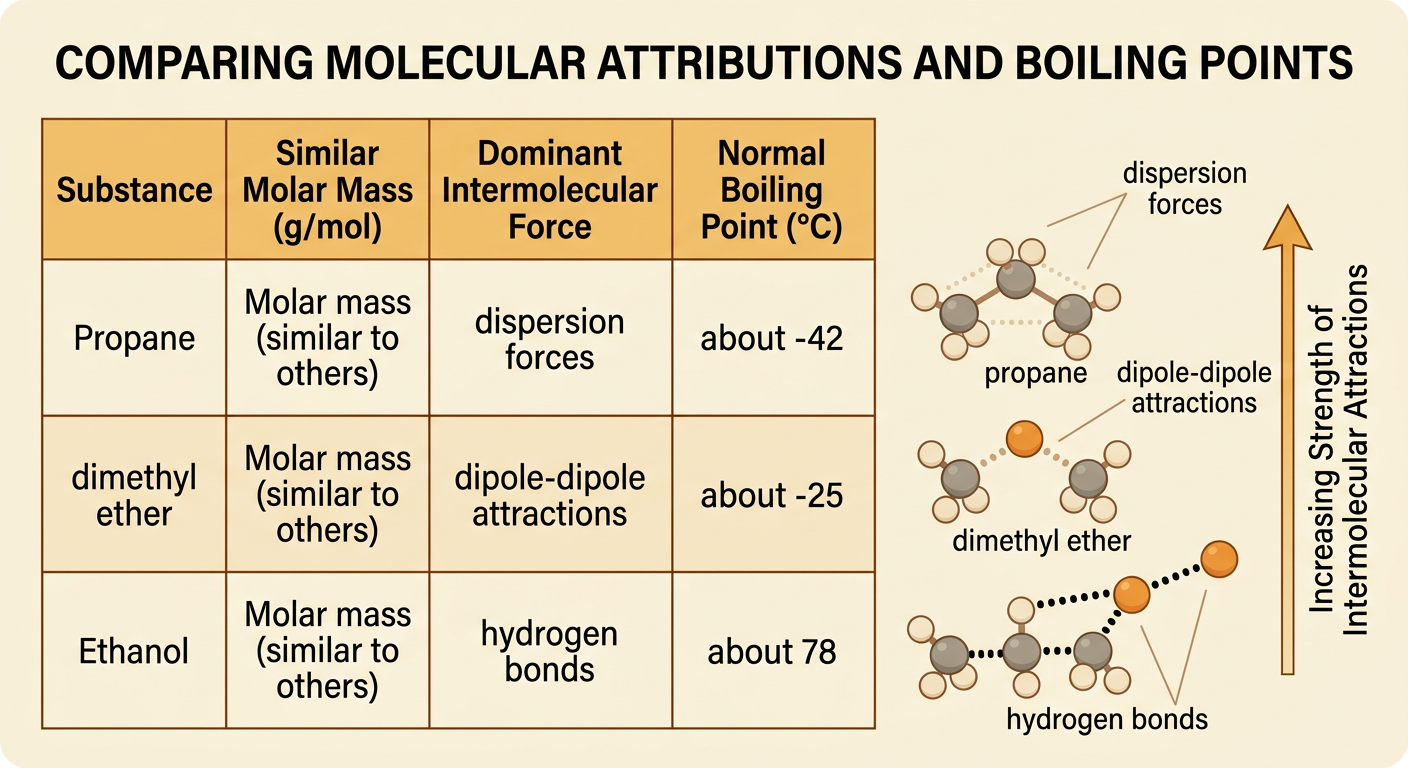
Scientists infer intermolecular force strength by comparing substances while considering molar mass, shape, and polarity. Propane, dimethyl ether, and ethanol have similar molar masses, but their normal boiling points are about −42°C, −25°C, and 78°C, respectively. Propane is nonpolar and relies mainly on dispersion forces. Dimethyl ether is polar, so it also has dipole-dipole attractions. Ethanol can form hydrogen bonds, providing evidence for its much higher boiling point. A precise argument might claim that ethanol has the strongest intermolecular attractions of the three, cite its boiling point as evidence, and explain that more energy is needed to overcome hydrogen bonding. In an investigation, students could compare evaporation rates or flow times of safe liquids, repeat trials, control temperature and volume, organize results in a table, and use the data to support or revise a claim.