
Intermolecular Forces and Physical Properties
Students use particle-level models and physical-property data to explain how intermolecular forces influence boiling point, viscosity, and surface tension.

Illustrations are auto-generated and may be placeholders. They can be refreshed to match the narration.
Attractions Between Molecules
Molecules contain charged particles, so nearby molecules can attract one another electrically. These attractions are called intermolecular forces. They act between molecules, unlike covalent or ionic bonds, which hold atoms together within a substance. Even a nonpolar molecule can develop a temporary uneven electron distribution that attracts a neighboring molecule. In polar molecules, partially positive and partially negative regions create additional attractions. During boiling, molecules gain enough energy to separate from one another; their internal covalent bonds usually remain intact. For example, boiling liquid water separates H2O molecules without breaking them into hydrogen and oxygen atoms. The curved surface of a water droplet also provides visible evidence of attractions pulling water molecules toward one another.

Types of Intermolecular Forces
London dispersion forces occur in every atom and molecule because electrons constantly move and create temporary partial charges. These forces become stronger when particles have larger, more easily distorted electron clouds. Dipole-dipole forces occur between polar molecules, whose permanent partial charges align so opposite regions attract. Hydrogen bonding is a particularly strong dipole attraction when hydrogen is covalently bonded to nitrogen, oxygen, or fluorine and is attracted to one of those atoms on another molecule. Water forms hydrogen bonds because it contains O–H bonds. Hydrogen chloride molecules have dipole-dipole attractions, while nonpolar methane molecules rely mainly on dispersion forces. Ion-dipole attractions can also form between ions and polar molecules, such as sodium ions surrounded by water in a salt solution.

Comparing Force Strengths
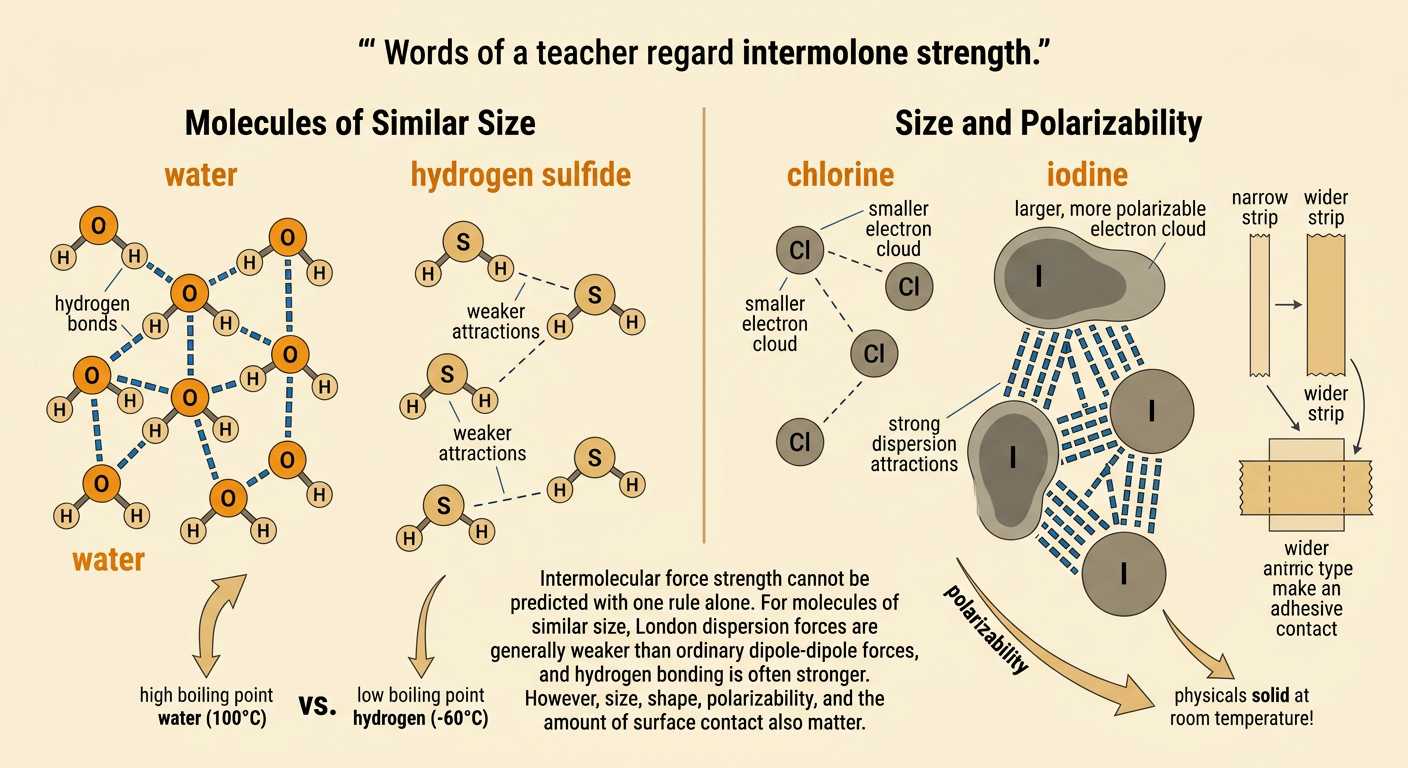
Intermolecular force strength cannot be predicted from one rule alone. For molecules of similar size, dispersion forces are generally weaker than ordinary dipole-dipole attractions, and hydrogen bonding is often stronger. However, molecular size, shape, polarizability, and the number of contact points also matter. Water boils at 100°C, while hydrogen sulfide boils near −60°C, even though both molecules have bent shapes. Water’s O–H groups form strong hydrogen bonds, but hydrogen sulfide does not form comparable hydrogen bonds. Large nonpolar molecules can still have substantial attractions: iodine is a solid at room temperature because its large electron clouds produce strong dispersion forces. A fair comparison should therefore examine both molecular structure and measured physical properties rather than simply naming the force type.
Effects on Physical Properties
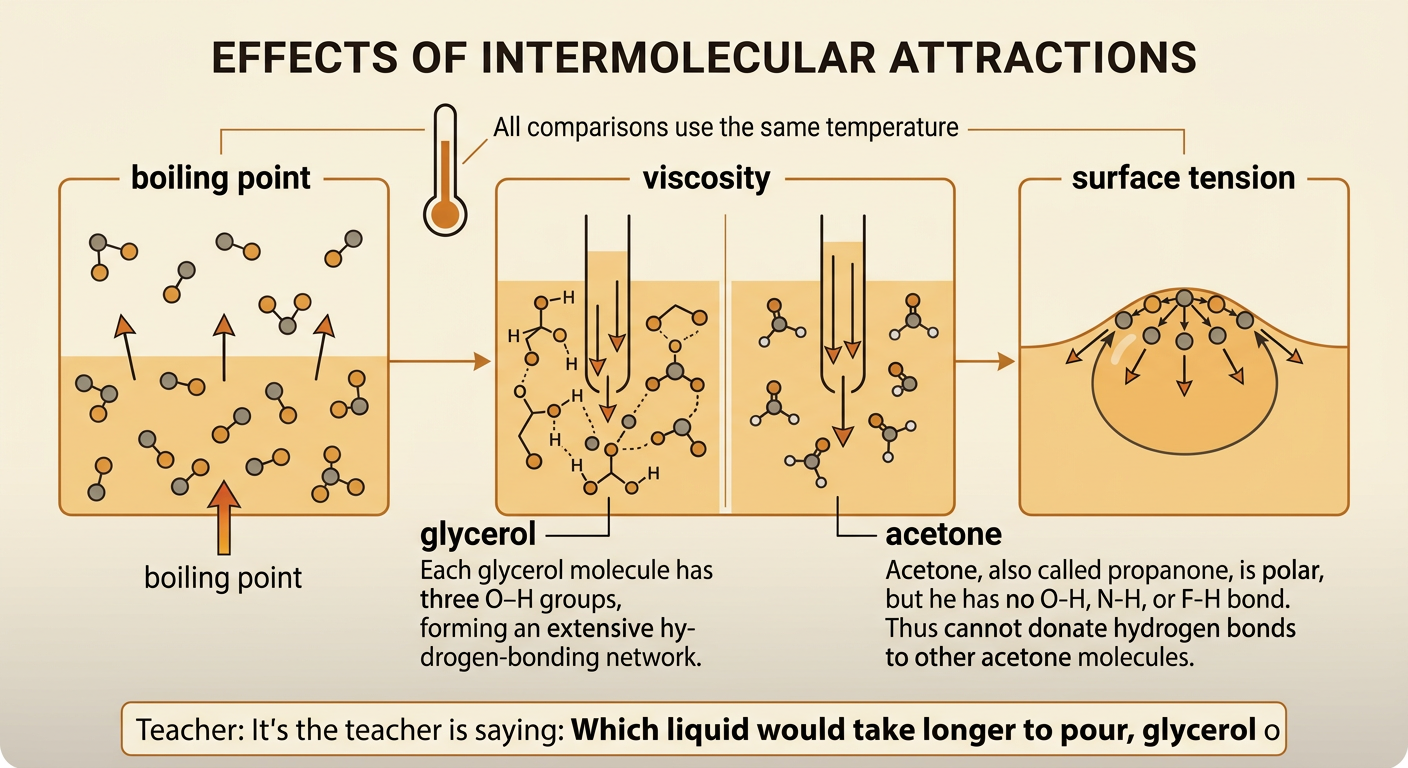
Stronger intermolecular attractions generally increase boiling point because more energy is needed to separate molecules into a gas. They also tend to increase viscosity, which is a liquid’s resistance to flowing. Molecules that strongly attract or become entangled have more difficulty sliding past one another. Surface tension results because molecules at a liquid’s surface experience a net inward attraction from neighboring particles. Stronger cohesion usually produces greater surface tension and more rounded droplets. Glycerol, which has three O–H groups per molecule, forms an extensive hydrogen-bonding network and flows much more slowly than acetone. Acetone is polar but cannot donate hydrogen bonds to other acetone molecules because it lacks an O–H, N–H, or F–H bond. Temperature must be controlled because warmer liquids usually have lower viscosity and surface tension.
Analyzing Property Data
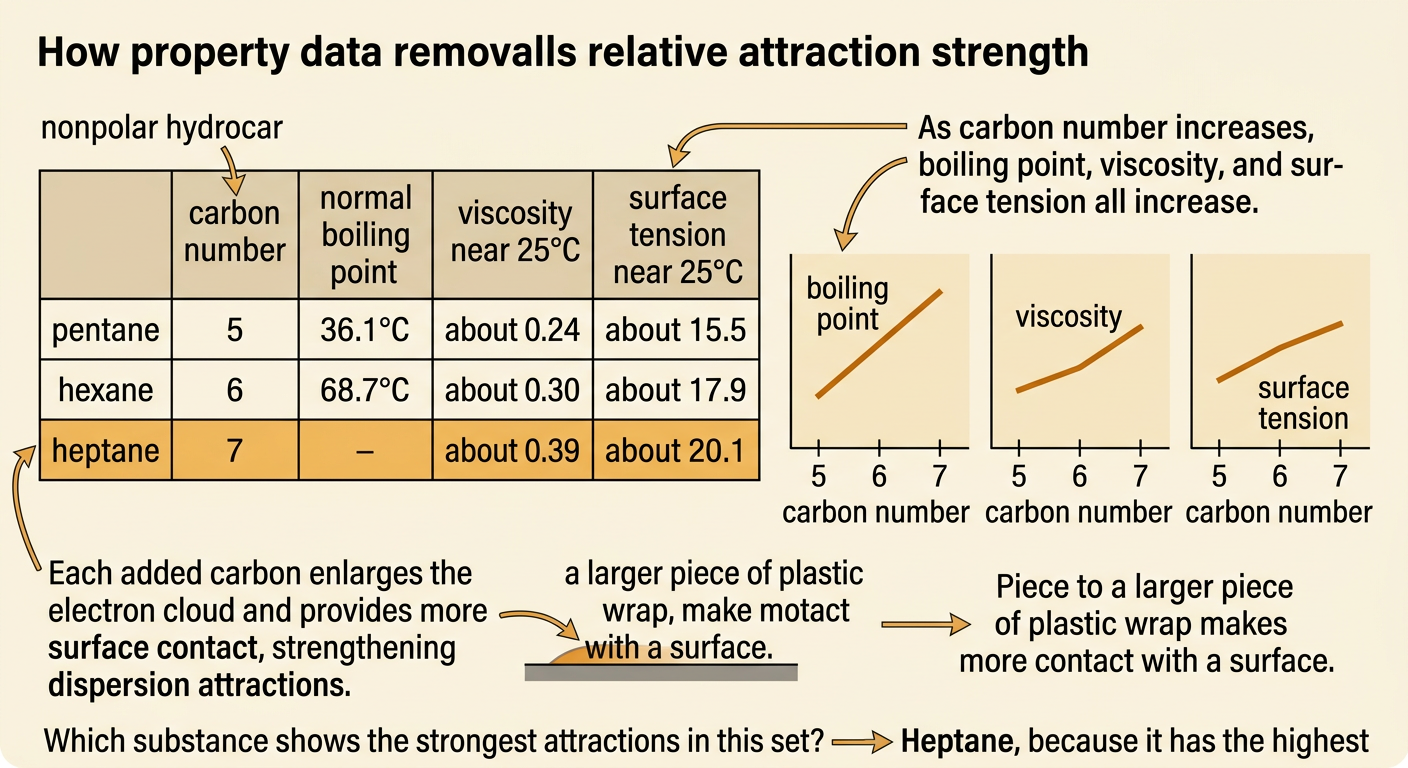
Property data can be used to infer relative attraction strength when other variables are controlled. Consider three nonpolar hydrocarbons. Pentane has a normal boiling point of 36.1°C, viscosity of about 0.24 mPa·s, and surface tension of about 15.5 mN/m. Hexane measures 68.7°C, 0.30 mPa·s, and 17.9 mN/m. Heptane measures 98.4°C, 0.39 mPa·s, and 20.1 mN/m. The viscosity and surface-tension values are measured near 25°C. All three substances rely mainly on dispersion forces, but each added carbon increases electron-cloud size and surface contact. Graphing carbon number on the horizontal axis shows all three properties increasing. This visual trend supports the inference that dispersion attractions become stronger from pentane to heptane.
Claim, Evidence, and Reasoning
A scientific explanation can be organized as a claim, evidence, and reasoning. Suppose students compare water and propanone, commonly called acetone. A suitable claim is that water has stronger intermolecular attractions. Evidence includes water’s normal boiling point of 100°C and surface tension near 72 mN/m at 25°C, compared with about 56°C and 24 mN/m for propanone. The reasoning connects these measurements to particle structure: each water molecule can participate in several hydrogen bonds, creating a strong network. Propanone has dipole-dipole and dispersion attractions, but pure propanone molecules cannot donate hydrogen bonds because they have no O–H bond. Students should identify measurement conditions and avoid claiming that one data value proves the conclusion. Understanding volatility also helps chemists and communities evaluate solvent evaporation, worker exposure, and contributions to local air-quality problems.
