
Intermolecular Forces, Physical Properties, and Solvent Selection
Students connect molecular polarity and intermolecular forces to boiling point and solubility data, then apply evidence to select an effective and safer solvent.

Illustrations are auto-generated and may be placeholders. They can be refreshed to match the narration.
Polarity and Molecular Attractions
Molecular polarity results from unequal sharing of electrons and the three-dimensional arrangement of bonds. A bond is polar when one atom attracts bonding electrons more strongly than the other. Bond dipoles may reinforce or cancel one another. For example, water has polar O–H bonds and a bent shape, so it has a net dipole. Carbon dioxide has polar C=O bonds, but its linear, symmetrical shape makes the bond dipoles cancel. Polar molecules attract nearby molecules through positive and negative partial charges. These electrical attractions are weaker than covalent bonds, but together they strongly affect bulk properties. When comparing substances, first examine bond polarity, molecular shape, and net molecular dipole. Then use measured properties, such as boiling point or solubility, as evidence for the relative strength of attractions between particles.

London Dispersion, Dipole-Dipole, and Hydrogen Bonding
All atoms and molecules experience London dispersion forces because electrons constantly shift, creating temporary dipoles. Dispersion generally becomes stronger as electron clouds grow larger and as molecular surfaces make more contact. Dipole-dipole attractions occur between molecules with permanent dipoles. Hydrogen bonding is a particularly strong dipole-dipole attraction involving hydrogen covalently bonded to nitrogen, oxygen, or fluorine and a lone pair on nitrogen, oxygen, or fluorine nearby. Water exhibits dispersion, ordinary dipole-dipole attraction, and hydrogen bonding. Methane, a nonpolar molecule, exhibits only dispersion. Hydrogen chloride is polar and has dispersion and dipole-dipole attractions, but it does not meet the usual requirement for hydrogen bonding. A substance can have several force types at once; the strongest important attraction often has the greatest effect on its physical properties.

Predicting Boiling Points
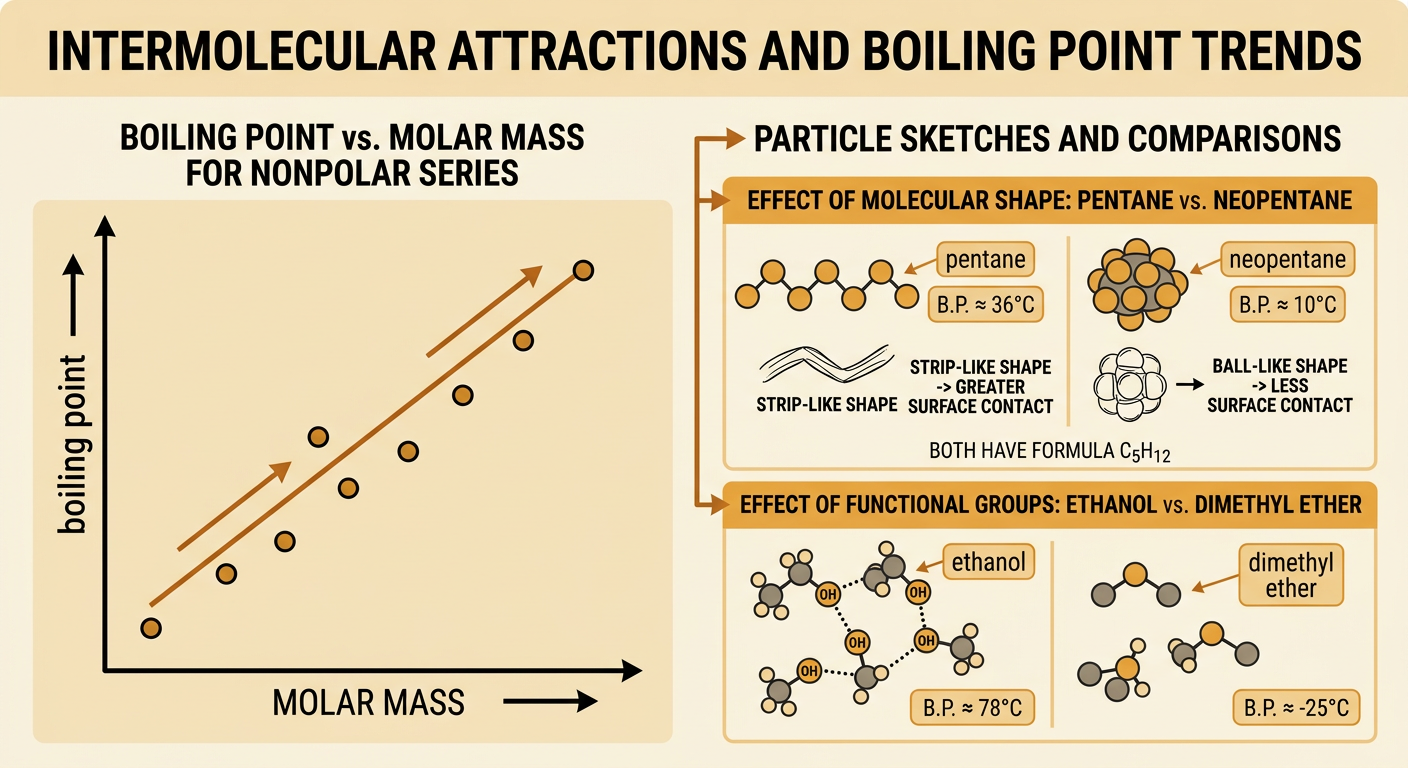
Boiling occurs when molecules gain enough energy to separate from one another and enter the gas phase. Stronger intermolecular attractions generally require a higher temperature to overcome, producing a higher boiling point. Molecular size and shape also matter. In a related series of nonpolar molecules, boiling point usually rises with molar mass because dispersion forces increase. Shape can change surface contact: straight-chain pentane boils near 36°C, while compact neopentane boils near 10°C even though both have the formula C5H12. Functional groups can create larger differences. Ethanol boils near 78°C, whereas dimethyl ether boils near −25°C; both have the formula C2H6O, but only ethanol molecules hydrogen-bond to one another. A scatterplot can reveal an overall relationship while outliers suggest differences in shape, polarity, or hydrogen bonding.
Explaining Solubility Patterns
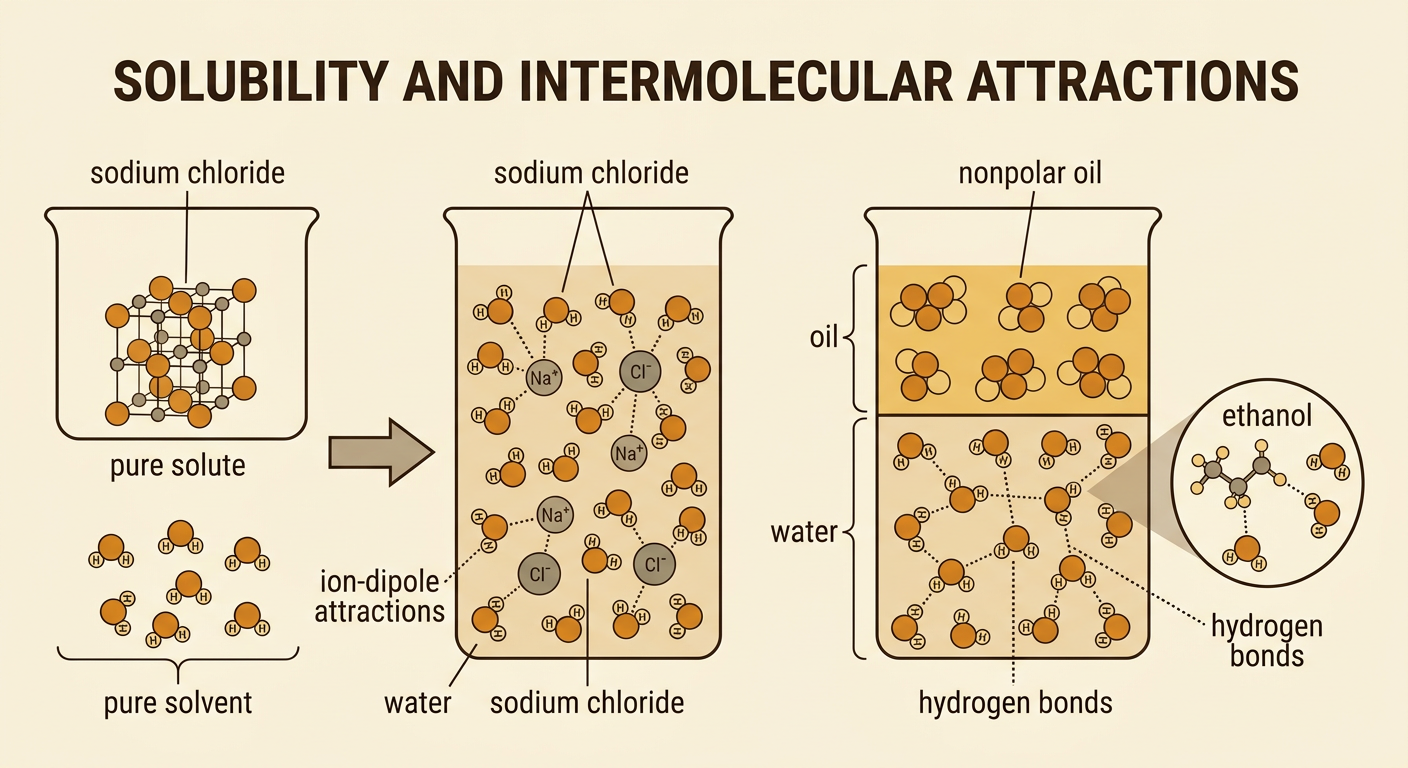
A solute dissolves when new solute-solvent attractions can compensate for attractions that must be disrupted within the pure solute and solvent. The phrase “like dissolves like” is a useful starting point: polar or ionic solutes often dissolve best in polar solvents, while nonpolar solutes often dissolve best in nonpolar solvents. Sodium chloride dissolves in water because water’s partial charges strongly attract and surround Na+ and Cl− ions. Oil does not mix with water because oil is nonpolar and cannot replace enough of water’s hydrogen-bonding attractions. Ethanol mixes with water because its polar O–H group hydrogen-bonds with water, while its small nonpolar carbon region also interacts through dispersion. To analyze a procedure, keep temperature, volumes, mixing time, and solute mass constant, then compare the measured amount dissolved in each solvent.
Evaluating Safer Solvent Choices
An effective solvent should dissolve or remove the target material, but performance is not the only criterion. Solvent selection should also consider toxicity, flammability, volatility, environmental persistence, purchase price, disposal cost, and the possibility of recovery and reuse. For example, a manufacturer might compare toluene and ethyl acetate for removing an adhesive. Equal adhesive samples could be treated with equal solvent volumes for the same time, and the mass removed could be measured. Safety data sheets and boiling-point data would provide additional evidence. Ethyl acetate may offer lower chronic health hazards than toluene, but it remains flammable and volatile, so ventilation and fire controls are still necessary. A decision matrix can assign weights to cleaning effectiveness, worker risk, cost, and waste. Marginal analysis asks whether each added benefit of a choice justifies its added financial, health, and environmental costs.
