
Interpreting Figurative Language and Allusions
Students analyze how figures of speech, literary allusions, and subtle differences among related words shape meaning in grade-level texts.

Illustrations are auto-generated and may be placeholders. They can be refreshed to match the narration.
Review Literal and Figurative Meaning
Literal language means exactly what the words state. If a student says, “The backpack weighs twenty pounds,” the sentence gives a direct, measurable fact. Figurative language uses words in an imaginative, nonliteral way to create an image, comparison, or feeling. When a student says, “My backpack weighs a ton,” the backpack does not literally weigh two thousand pounds. The exaggeration emphasizes that it feels extremely heavy. Context helps readers decide whether language is literal or figurative. Ask whether the statement is realistically possible and whether a nonliteral interpretation makes better sense. In the sentence “The icy wind bit my face,” wind cannot actually bite. The figurative verb “bit” helps readers imagine the wind as sharp, painful, and aggressive.

Identify Figures of Speech
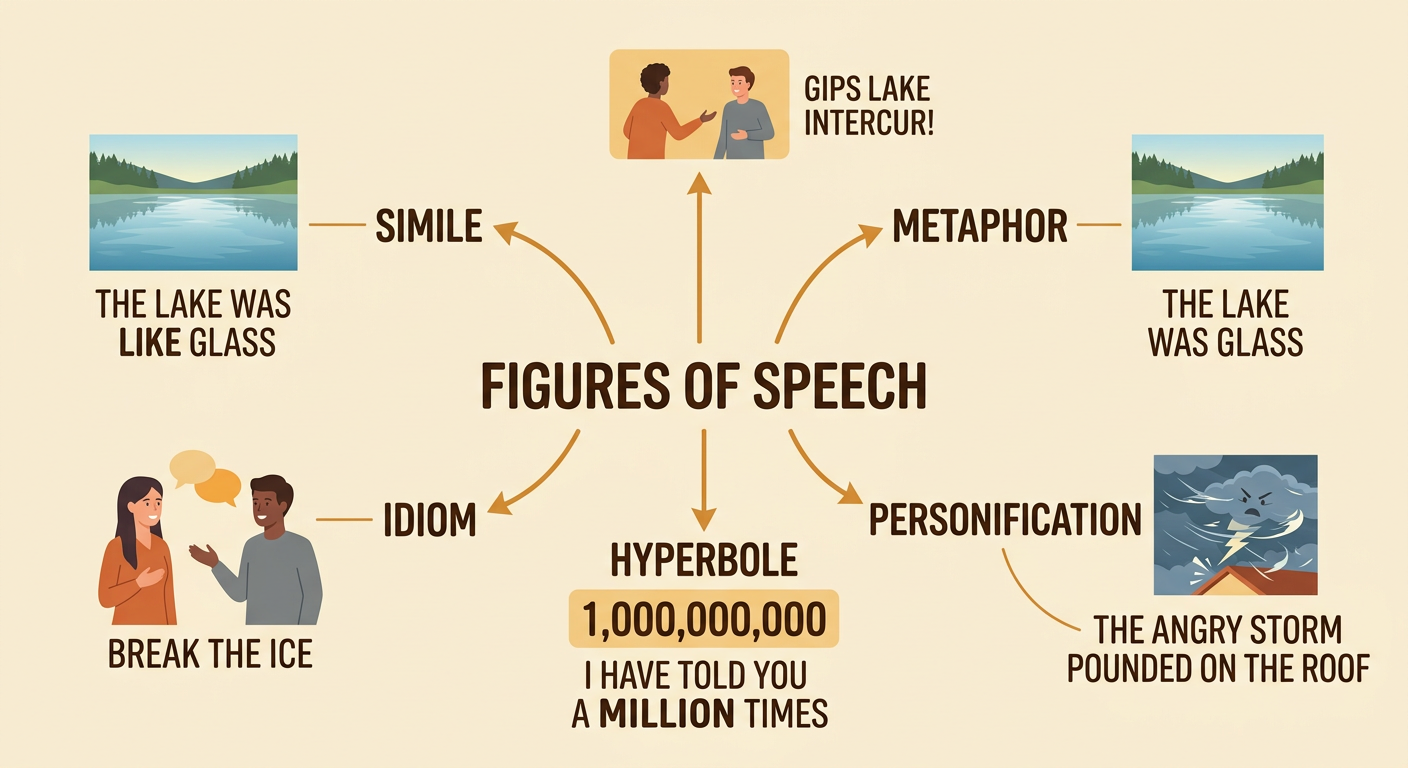
Figures of speech create meaning through comparison, exaggeration, sound, or human qualities. A simile compares unlike things using “like” or “as,” as in “The lake was like glass.” A metaphor makes a direct comparison: “The lake was glass.” Personification gives human qualities to something nonhuman: “The angry storm pounded on the roof.” Hyperbole is deliberate exaggeration: “I have told you a million times.” An idiom is an expression whose meaning differs from the meanings of its individual words. “Break the ice” means to reduce tension, not to crack frozen water. To identify a figure of speech, notice unusual wording, name the technique, and explain the implied meaning. Do not stop after labeling it. Explain that calling the lake “glass,” for example, emphasizes its smooth, still surface.
Decode Literary and Historical Allusions
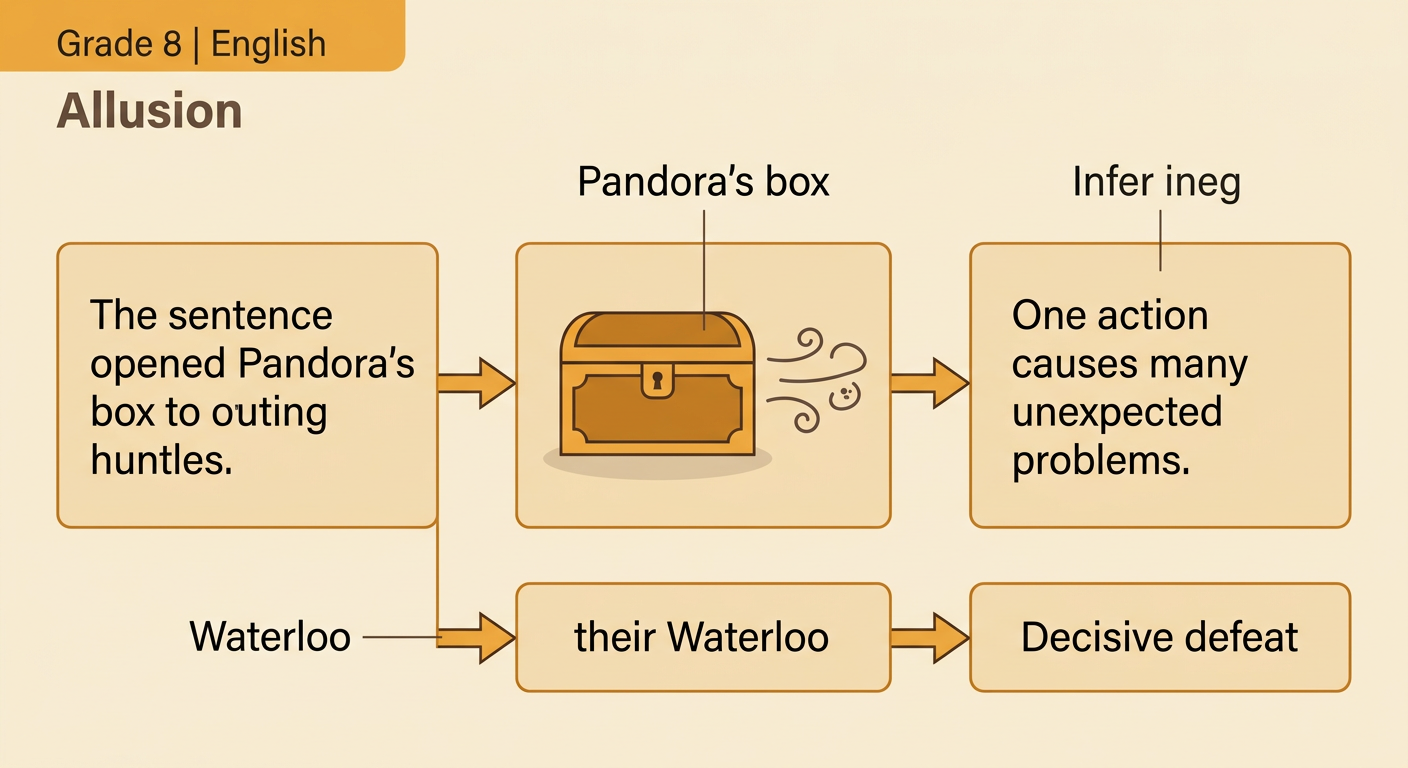
An allusion is a brief reference to a well-known person, event, place, story, or work. Writers expect readers to connect the reference with its original meaning. In the sentence “Opening the mysterious file was like opening Pandora’s box,” the writer alludes to a Greek myth in which Pandora opens a container and releases troubles into the world. The allusion suggests that one action may cause many unexpected problems. A historical allusion works similarly. Calling a difficult retreat “their Waterloo” refers to Napoleon’s final defeat at the Battle of Waterloo and suggests a decisive failure. To decode an allusion, identify the reference, recall or research its source, and connect an important feature of the source to the new context. Readers should use reliable references when the source is unfamiliar rather than guessing from the words alone.
Analyze Connotation and Nuance
Related words may share a denotation, or basic dictionary meaning, while carrying different connotations, or feelings and associations. “Slim,” “skinny,” and “scrawny” can all describe a person with little body fat, but they do not create the same impression. “Slim” is often positive, “skinny” may be neutral or mildly negative, and “scrawny” strongly suggests weakness. Nuance is a subtle difference in meaning or intensity. Consider the verbs “glanced,” “looked,” and “stared.” A person who glanced looked briefly, while a person who stared looked steadily for a longer time. Writers select among related words to establish tone and reveal attitudes. When analyzing a word, consider its denotation, emotional association, intensity, and context. Avoid treating connotations as fixed rules because a word’s effect can change depending on the sentence, speaker, audience, and culture.

Explain the Effect on Meaning
A strong analysis explains how a writer’s language choice affects meaning, tone, imagery, or the reader’s response. Begin by identifying the figure of speech, allusion, or nuanced word. Then interpret it in context and describe its effect. Consider the sentence “After the final whistle, silence swallowed the stadium.” The personification does more than state that the crowd became quiet. The verb “swallowed” creates an image of silence spreading suddenly and completely. It also produces a stunned or gloomy tone, suggesting that the crowd may be reacting to a painful loss. A complete explanation might say, “By personifying silence as something that can swallow a stadium, the writer emphasizes the crowd’s sudden, complete shock and creates a somber tone.” Support the explanation with specific words from the text and connect those words to a reasonable interpretation rather than making a general claim such as “It makes the writing better.”
