
Interpreting Irony, Satire, and Ambiguity
Students analyze how an author uses irony, satire, and ambiguity to communicate meanings that differ from or extend beyond what is directly stated.

Illustrations are auto-generated and may be placeholders. They can be refreshed to match the narration.
Literal Meaning vs. Intended Meaning
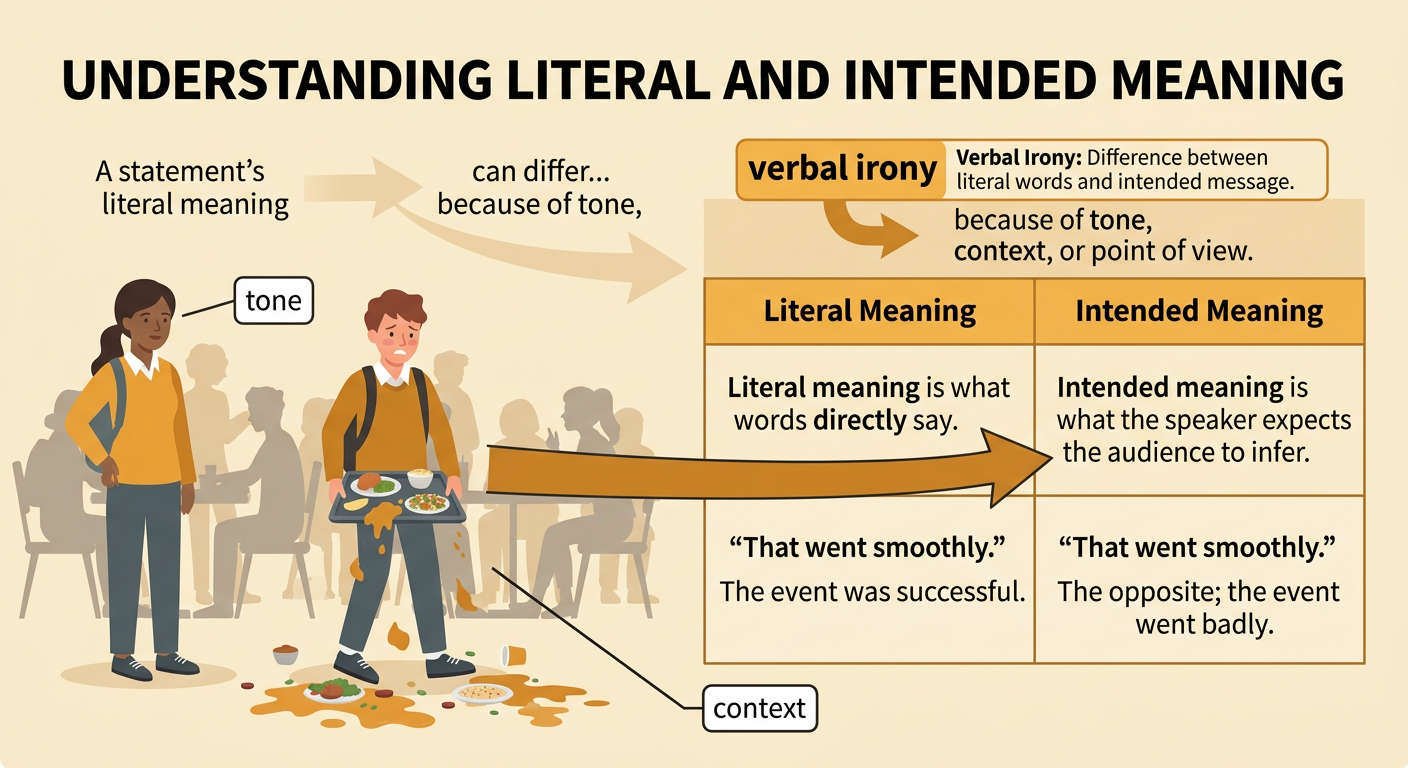
A statement’s literal meaning is what its words directly say. Its intended meaning is the idea the speaker or author expects the audience to infer. Tone, context, and point of view can create a gap between the two. For example, after a character drops a tray of food in a crowded cafeteria, a friend says, “That went smoothly.” Literally, the friend claims that the event was successful. However, the obvious failure and the contrast between the words and the situation show that the friend means the opposite. This is verbal irony. Readers should not assume that every statement is sincere. Instead, they should ask whether the stated idea fits the circumstances, the speaker’s attitude, and the text’s larger purpose. Recognizing the difference between stated and intended meaning helps readers interpret humor, criticism, and character relationships.
Types of Irony
Irony occurs when appearance, expectation, and reality do not match. Verbal irony happens when a speaker’s intended meaning differs from the words spoken. A student looking at a huge homework packet might say, “This will take only a minute.” Situational irony occurs when an outcome sharply contradicts a reasonable expectation. For example, a fire station winning a safety award and then accidentally setting off its own sprinkler system would be situationally ironic. Dramatic irony occurs when the audience knows important information that one or more characters do not. In a play, viewers might see a thief hide behind a curtain while a character announces that the room is empty. The character’s confidence creates tension because the audience knows the truth. To identify the type, determine whether the mismatch involves words, an event’s outcome, or unequal knowledge.

Recognizing Satire and Understatement
Satire uses humor, exaggeration, irony, or ridicule to criticize human behavior, social practices, or institutions. Its purpose usually extends beyond making readers laugh; it encourages them to notice a problem. For example, a fictional school might improve attendance by replacing every class with a daily roll call. The absurd solution satirizes policies that value statistics more than learning. Understatement presents something as less serious or important than it really is. After a tornado tears the roof from a house, a character might say, “We may need a few repairs.” The mild wording emphasizes the enormous damage through contrast. To recognize satire, identify the target of criticism and ask what change the author may be encouraging. To recognize understatement, compare the restrained words with the actual scale of the situation. Both techniques depend on readers noticing that the surface statement is incomplete or deliberately distorted.

Analyzing Contextual Clues
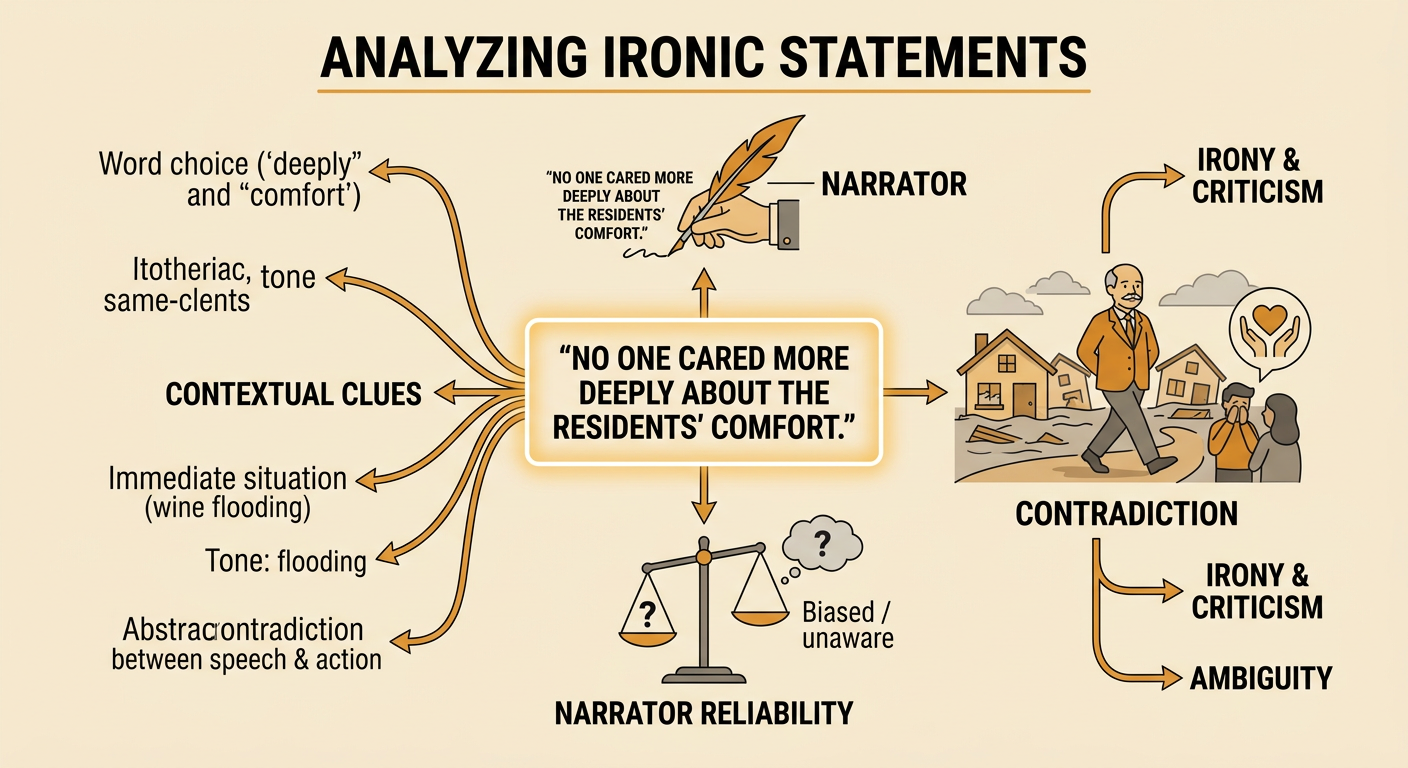
Contextual clues help readers decide whether a statement is sincere, ironic, satirical, or ambiguous. Useful clues include the immediate situation, word choice, punctuation, tone, character relationships, earlier events, and contradictions between speech and action. Suppose a narrator describes a wealthy mayor stepping around flooded homes and says, “No one cared more deeply about the residents’ comfort.” The mayor’s behavior conflicts with the narrator’s praise, suggesting irony and possible criticism. Readers should also consider the narrator’s reliability. A biased or unaware narrator may state an opinion that the author expects readers to question. Ambiguity occurs when a detail supports more than one reasonable interpretation. Rather than forcing a single answer, readers should gather evidence for each possibility. A strong analysis explains which clues shape the interpretation and acknowledges uncertainty when the text intentionally leaves the meaning open.
Explaining the Author’s Intended Meaning
An effective explanation of intended meaning makes a claim, cites specific evidence, and explains the difference between what is stated and what is implied. Begin by naming the technique, such as verbal irony, satire, or understatement. Then quote or paraphrase the relevant words and describe the context that changes their meaning. For example, an author calls a factory’s polluted river “a shining achievement of progress” while describing dead fish along its banks. A strong analysis might explain that the phrase is verbal irony because the environmental damage contradicts the positive description. The irony also creates satire by criticizing a definition of progress that ignores harmful consequences. Finally, connect the technique to the author’s purpose, tone, or theme. Avoid merely saying, “The author is being sarcastic.” Explain how textual details support that conclusion and what readers are meant to understand beyond the literal words.
