
Interpreting Satire, Irony, and Understatement
Students analyze how an author uses satire, irony, sarcasm, or understatement to communicate criticism beyond the literal meaning of a text.
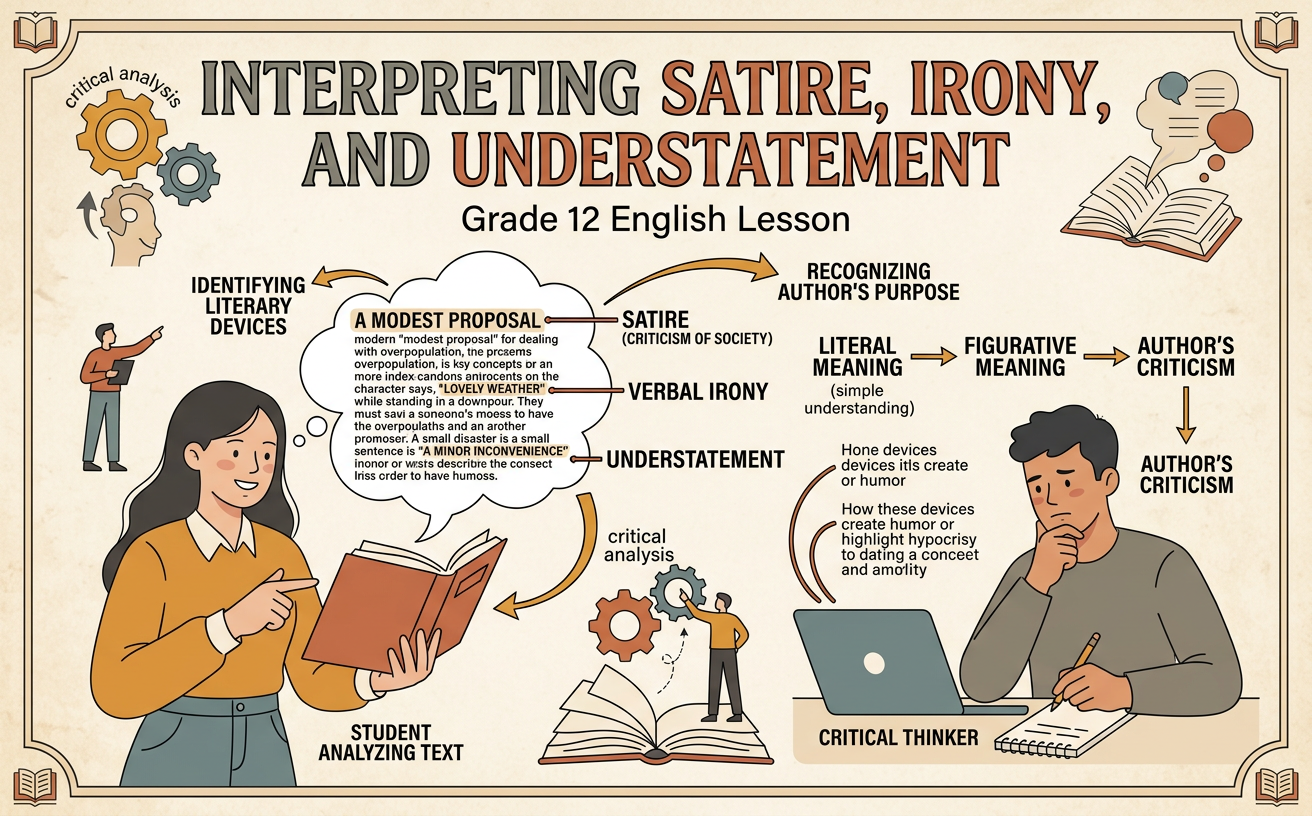
Illustrations are auto-generated and may be placeholders. They can be refreshed to match the narration.
Literal Meaning Versus Intended Meaning
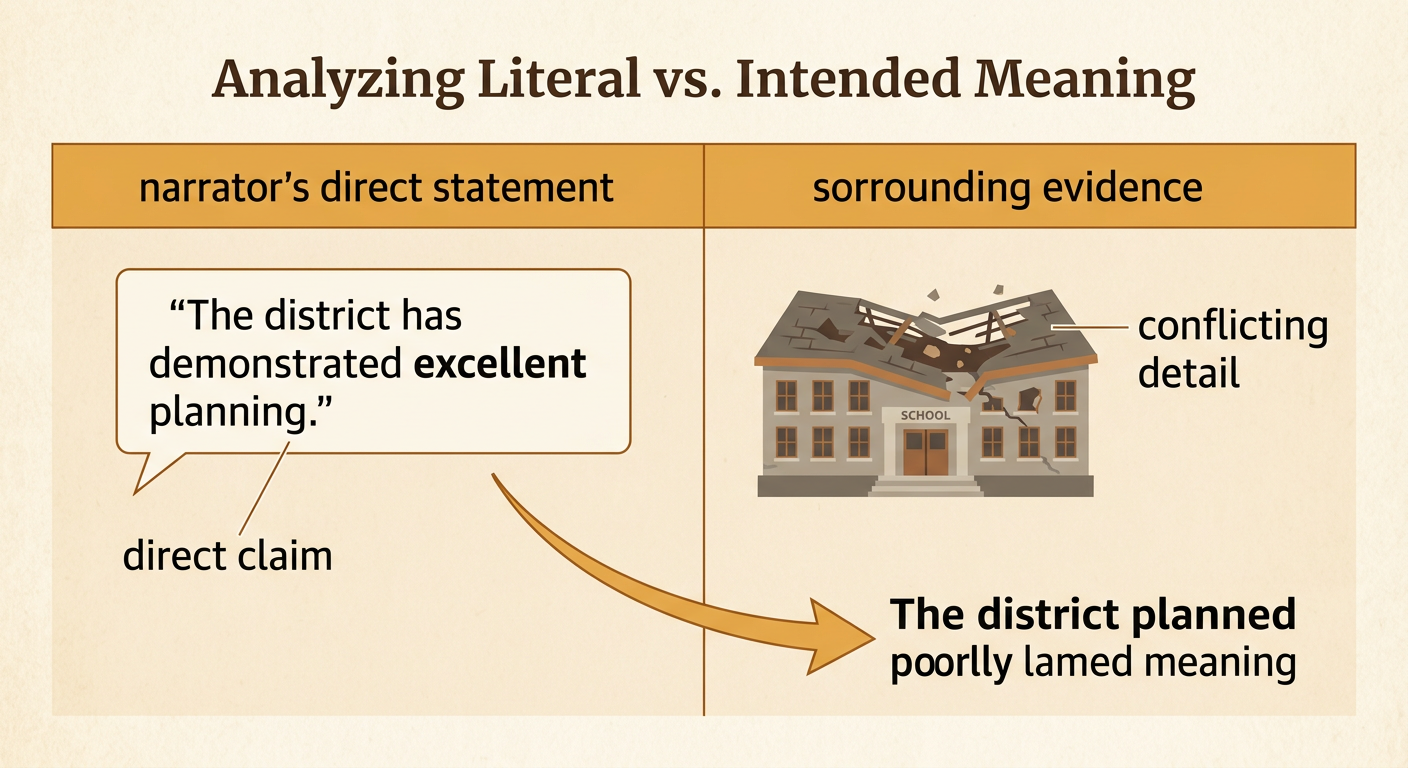
Literal meaning is what a text directly states; intended meaning is the idea the author expects readers to infer. These meanings often differ in satire, irony, sarcasm, and understatement. Suppose a narrator describes a collapsing school roof by saying, “Our district has once again demonstrated its excellent planning.” Literally, the narrator praises the district. However, the damaged roof contradicts that praise, signaling criticism of poor planning. To interpret the statement, identify the direct claim, notice details that conflict with it, and infer a meaning that fits the whole passage. Diction, tone, exaggeration, and contradictions can reveal that words should not be accepted at face value. Readers should support an inferred meaning with textual evidence rather than assuming that every surprising statement is ironic.
Recognizing Satirical Techniques
Satire uses humor, ridicule, or distortion to criticize human behavior, institutions, or social problems. Authors may build satire through several techniques. Verbal irony says one thing while meaning another. Sarcasm is a pointed, often mocking form of verbal irony. Exaggeration enlarges a flaw until it becomes absurd, while understatement deliberately makes a serious matter seem minor. Imagine an article proposing a yearly parade to honor the city’s potholes because they “give every drive the excitement of an obstacle course.” The proposal is absurd, the praise is ironic, and the description exaggerates the driving experience. Together, these techniques criticize the city’s failure to repair roads. Recognizing satire requires more than finding humor; readers must identify the target of the criticism and explain how the technique exposes that target’s weakness.

Examining Context and Point of View
Context and point of view help readers decide whether a statement is sincere or ironic. Context includes the surrounding events, historical circumstances, audience, genre, and other details in the text. Point of view identifies who speaks and what that speaker knows, values, or wants. A fictional company president might announce, “Employees will be thrilled to begin our new eighteen-hour shifts.” The president’s confident language presents the policy as positive, but exhausted workers and unsafe conditions elsewhere in the story undermine that claim. The author may be using the president’s limited or self-serving viewpoint to criticize exploitation. Readers should not automatically treat a narrator or character as the author’s voice. Instead, they should compare the speaker’s claims with outcomes, other perspectives, and contextual evidence. This comparison reveals whether the text invites agreement, doubt, or rejection.

Citing Evidence of Implied Criticism
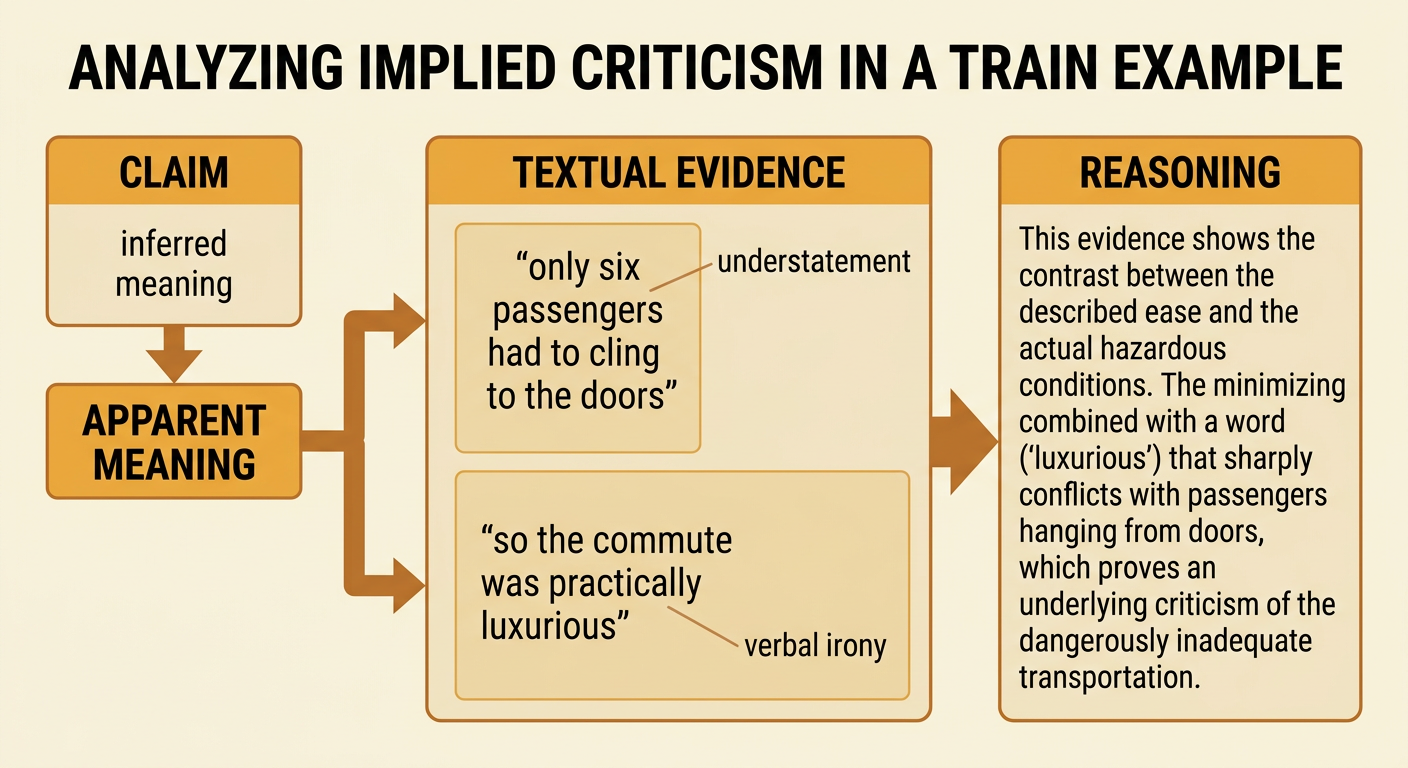
An analysis of implied criticism should connect a clear claim to specific textual evidence and reasoning. Begin by naming the apparent meaning and the inferred meaning. Then quote or paraphrase details that create the difference. For example, consider this sentence about an overcrowded train: “Only six passengers had to cling to the doors, so the morning commute was practically luxurious.” An analysis might claim that the narrator uses understatement and verbal irony to criticize inadequate public transportation. The phrase “only six passengers” minimizes a dangerous condition, while “practically luxurious” sharply conflicts with passengers clinging to doors. These details support the inference because they make the positive description impossible to accept literally. Strong analysis does not merely label a technique; it explains how particular words produce an implied judgment about the target.
Explaining the Author’s Purpose
After identifying implied criticism, readers should explain why the author uses it. A satirical purpose may be to expose hypocrisy, challenge accepted behavior, criticize an institution, encourage reform, or make readers reconsider an issue. Humor is often an effect, but it is not always the author’s final purpose. Imagine a graduation speaker praising students for mastering “the essential skill of completing every group project alone.” The ironic compliment may amuse the audience, but it also criticizes unequal participation and encourages greater responsibility. A strong purpose statement names the technique, the target, and the intended effect on readers. For example: The speaker uses verbal irony to criticize students who avoid shared work and to prompt the audience to value cooperation. This explanation moves beyond summary by connecting language choices to the author’s larger message.
