
Investigating Force, Mass, and Motion
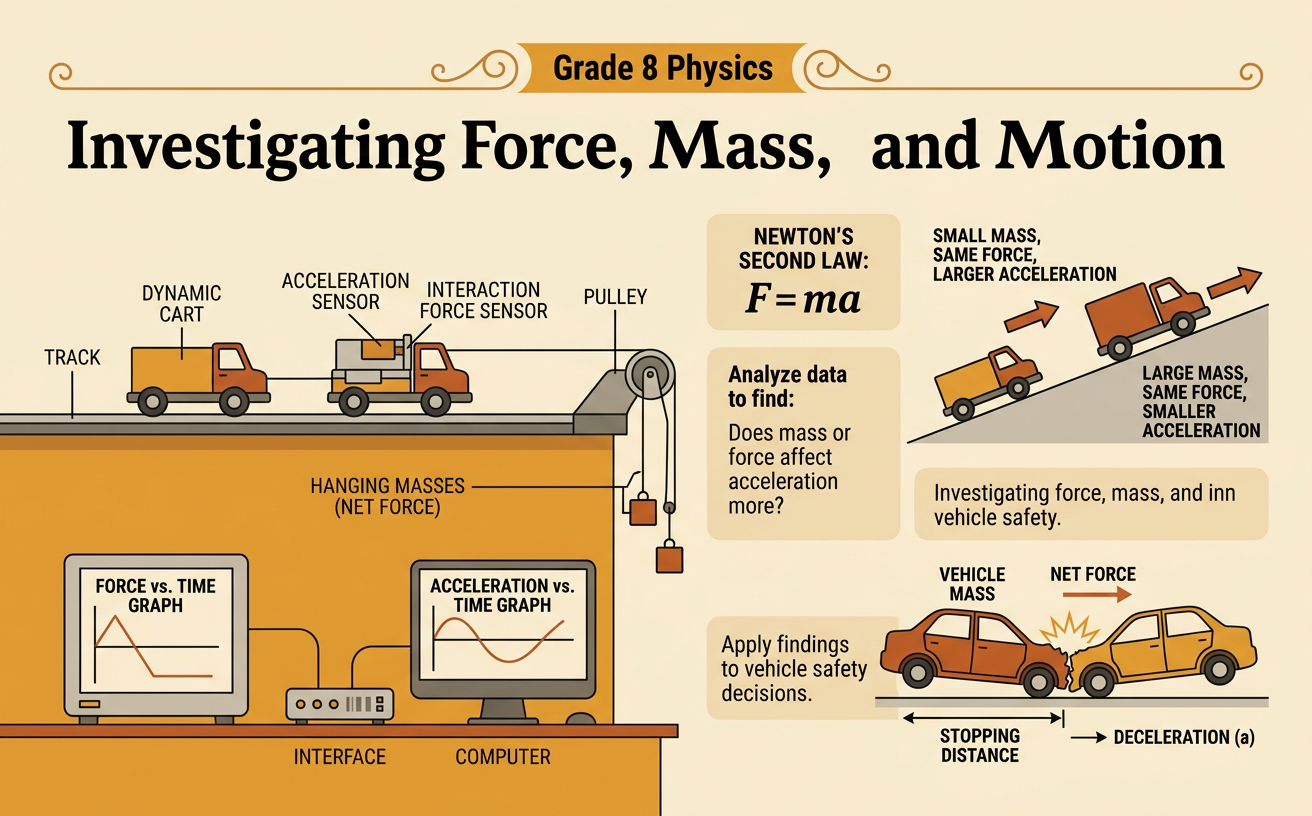
Students analyze experimental data to determine how an object's mass and the net force acting on it affect changes in its motion, then apply their findings to a vehicle-safety decision.
Illustrations are auto-generated and may be placeholders. They can be refreshed to match the narration.
Motion and Net Force
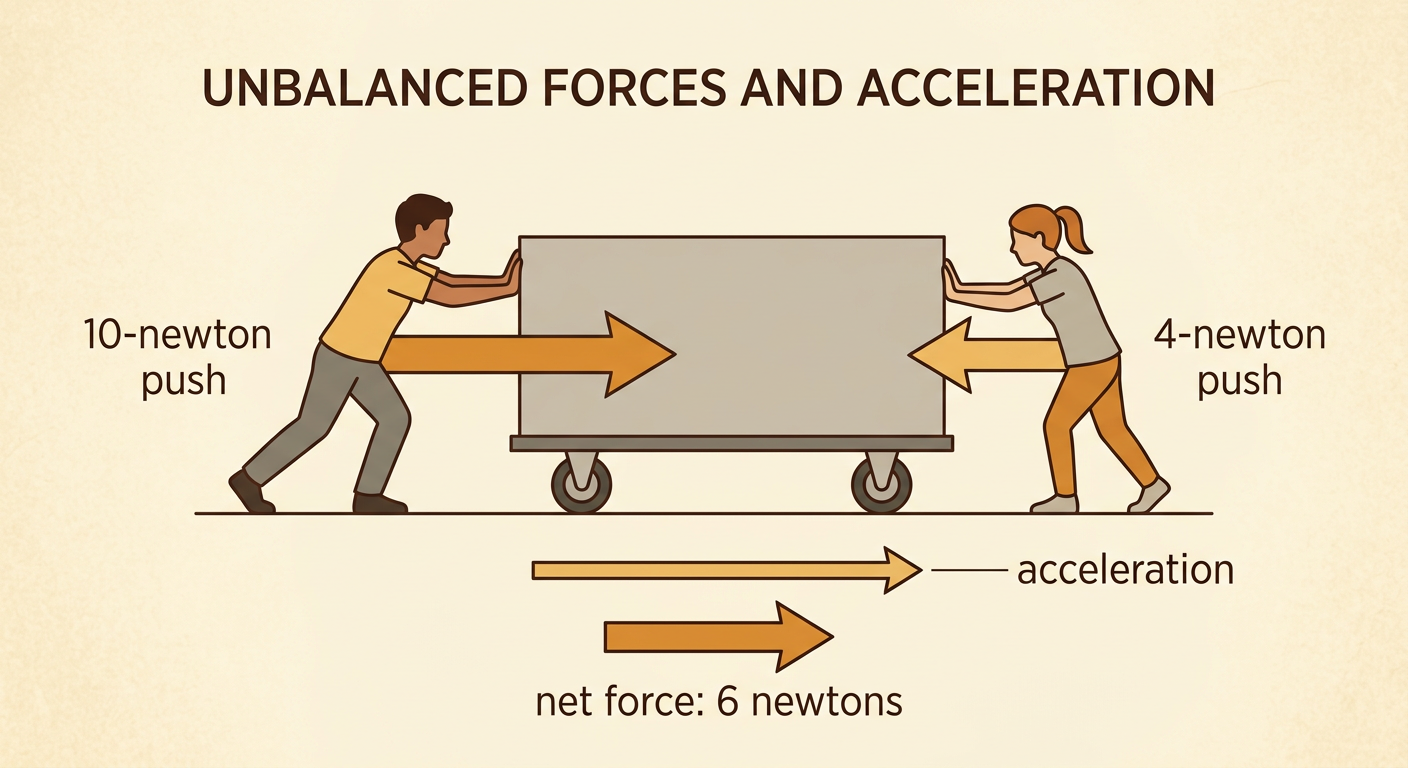
Motion changes when an object speeds up, slows down, or changes direction. This change in velocity is called acceleration. A force is a push or pull, and net force is the combined effect of all forces acting on an object, including their directions. Balanced forces produce zero net force, so they do not cause acceleration. Unbalanced forces produce a nonzero net force and change motion. The relationship can be written as F = ma, where net force equals mass times acceleration. For example, if two students push a cart in opposite directions with equal force, the net force is zero. If one student pushes with 10 newtons while the other pushes with 4 newtons, the net force is 6 newtons toward the stronger push, so the cart accelerates in that direction.
Investigation Setup
A fair investigation changes one variable at a time while other conditions remain constant. Use a low-friction cart, a level track, a force sensor, and a motion sensor. First, keep the cart's mass constant and test several pulling forces. Next, keep the pulling force constant and add measured masses to the cart. The independent variable is the factor deliberately changed: force in the first test and mass in the second. Acceleration is the dependent variable because it is measured as the cart responds. Use the same track, starting position, pulling direction, and measuring method in every trial. Repeat each condition at least three times and calculate the mean acceleration. For example, test a 1.0-kilogram cart with forces of 0.5, 1.0, and 1.5 newtons. Keep hands and loose objects away from the moving equipment.

Collecting Force and Motion Data
Record measurements with units in an organized data table. For each trial, include total mass, net force, and acceleration. Acceleration can be found from the change in velocity divided by the elapsed time. Suppose a 1.0-kilogram cart has measured net forces of 0.5, 1.0, and 1.5 newtons. Its mean accelerations might be 0.48, 0.97, and 1.46 meters per second squared. Small differences from ideal values can result from friction or measurement uncertainty. In a second set of trials, apply a constant 1.0-newton net force. Masses of 0.5, 1.0, and 2.0 kilograms might produce accelerations of 1.95, 0.97, and 0.49 meters per second squared. Repeat trials rather than changing unusual results. Note possible errors, such as an unlevel track, an inconsistent pull, or a sensor that was not reset.

Graphing and Interpreting Results
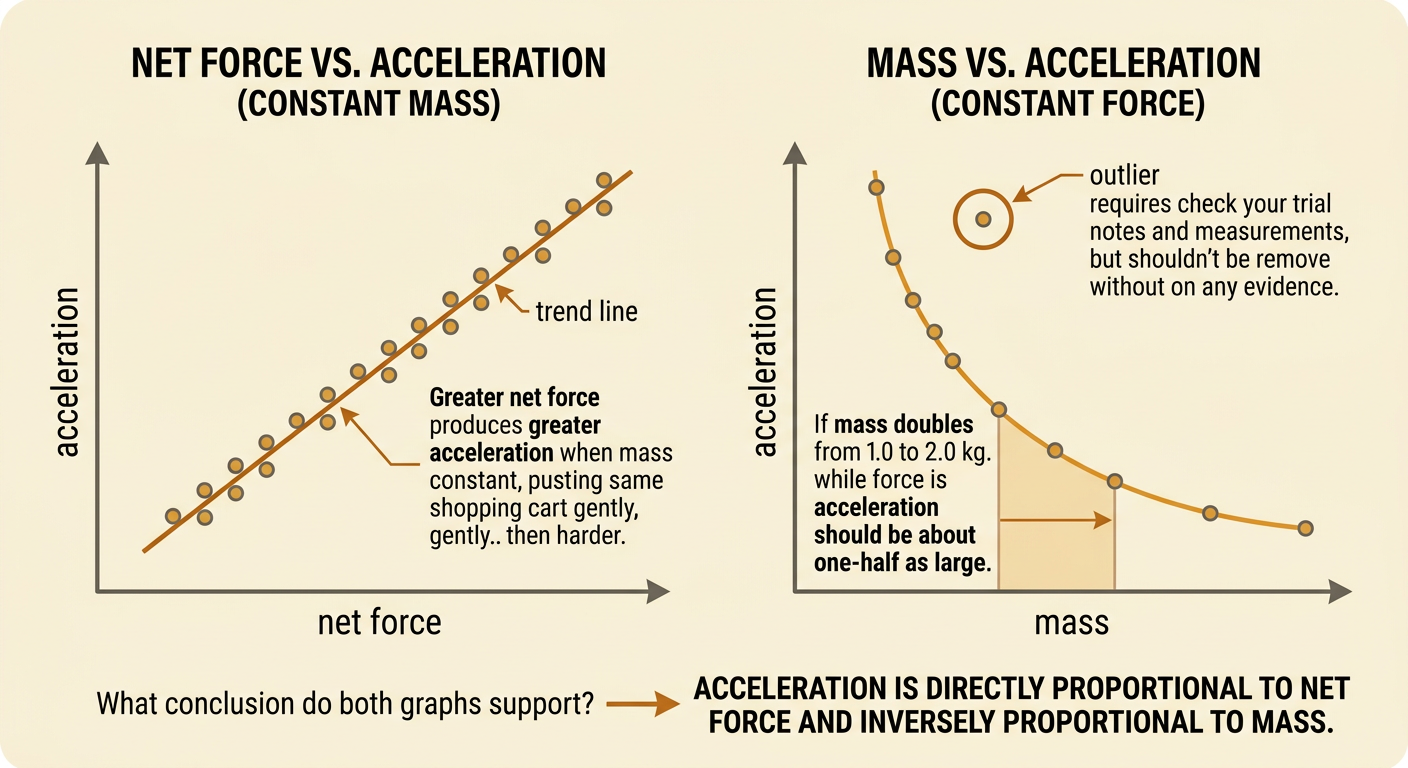
A scatter plot helps reveal relationships between paired measurements. For the constant-mass trials, place net force on the horizontal axis and acceleration on the vertical axis. Plot each force-acceleration pair, then draw a trend line that follows the overall pattern. The points should rise from left to right, showing that greater net force produces greater acceleration when mass stays constant. For the constant-force trials, place mass on the horizontal axis and acceleration on the vertical axis. These points should fall as mass increases, often forming a downward curve rather than a straight line. For example, doubling mass from 1.0 to 2.0 kilograms should reduce acceleration to about one-half when net force is unchanged. Investigate any outlier by checking trial notes and measurements, but do not remove it without evidence. Use the overall trends to support a conclusion consistent with F = ma.
Applying Evidence to Vehicle Safety
The investigation can inform decisions about vehicle safety. A loaded vehicle has more mass than the same vehicle when empty. According to F = ma, a greater net braking force is needed to give the heavier vehicle the same deceleration. For example, a delivery van carrying heavy cargo may require more stopping distance if its brakes and road conditions provide limited braking force. Individuals can reduce risk by following cargo limits, securing loads, maintaining brakes and tires, and leaving more following distance when carrying extra mass. Communities and companies can consider driver training, vehicle inspections, cargo rules, and automatic emergency braking. Evaluate each option using evidence, cost, practicality, and who benefits. A reasonable recommendation might combine enforced cargo limits with regular brake inspections because these actions address both vehicle mass and available braking force. Experimental cart results support the physics principle, while real safety decisions also require road tests and reliable crash data.
