
Investigating Friction on Different Surfaces
Students test how far an object slides across different surfaces and use evidence to explain how friction affects motion.
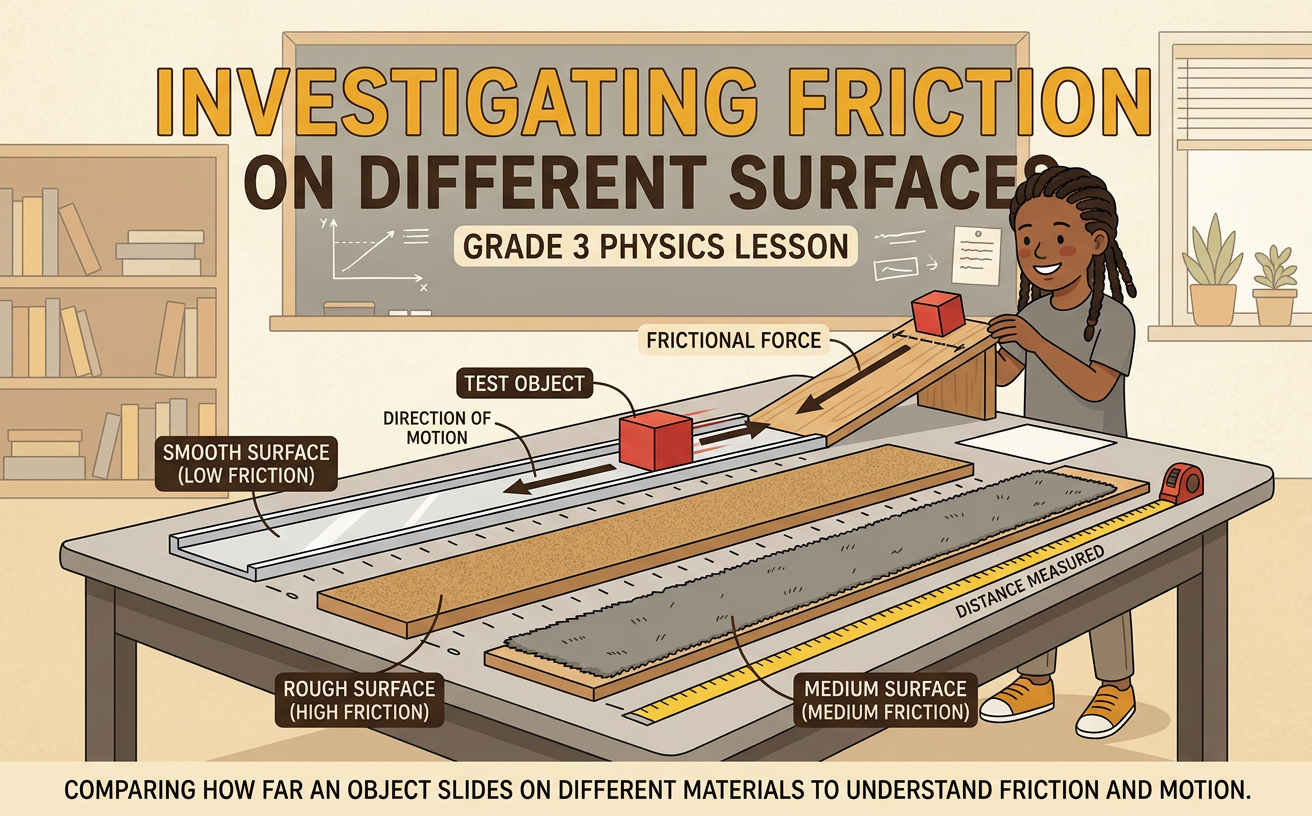
Illustrations are auto-generated and may be placeholders. They can be refreshed to match the narration.
What Is Friction?
Friction is a force that acts when two surfaces touch. It works against sliding motion. Imagine pushing a toy block across the floor. After your hand stops pushing, friction between the block and the floor slows the block until it stops. Friction can be helpful. It lets your shoes grip the ground so you can walk without slipping. It can also make motion harder, such as when you drag a heavy box. The amount of friction depends on the surfaces that are touching. A block may slide differently on carpet than on a smooth tabletop. In this investigation, you will observe friction by measuring how far the same object slides across different surfaces.

Compare Smooth and Rough Surfaces
Surfaces have different textures. A smooth surface has few noticeable bumps, while a rough surface has many bumps and uneven places. Rough surfaces often create more friction than smooth surfaces, but the materials also matter. For example, a wooden block may slide far across a smooth plastic sheet but stop quickly on rough carpet. The tiny parts of the carpet and block catch and press against one another, making sliding harder. On the plastic, there may be less resistance to motion. You cannot decide how much friction a surface has just by looking at it. Testing provides better evidence. Compare surfaces such as wax paper, cardboard, felt, and sandpaper while using the same sliding object.

Plan a Fair Sliding Test
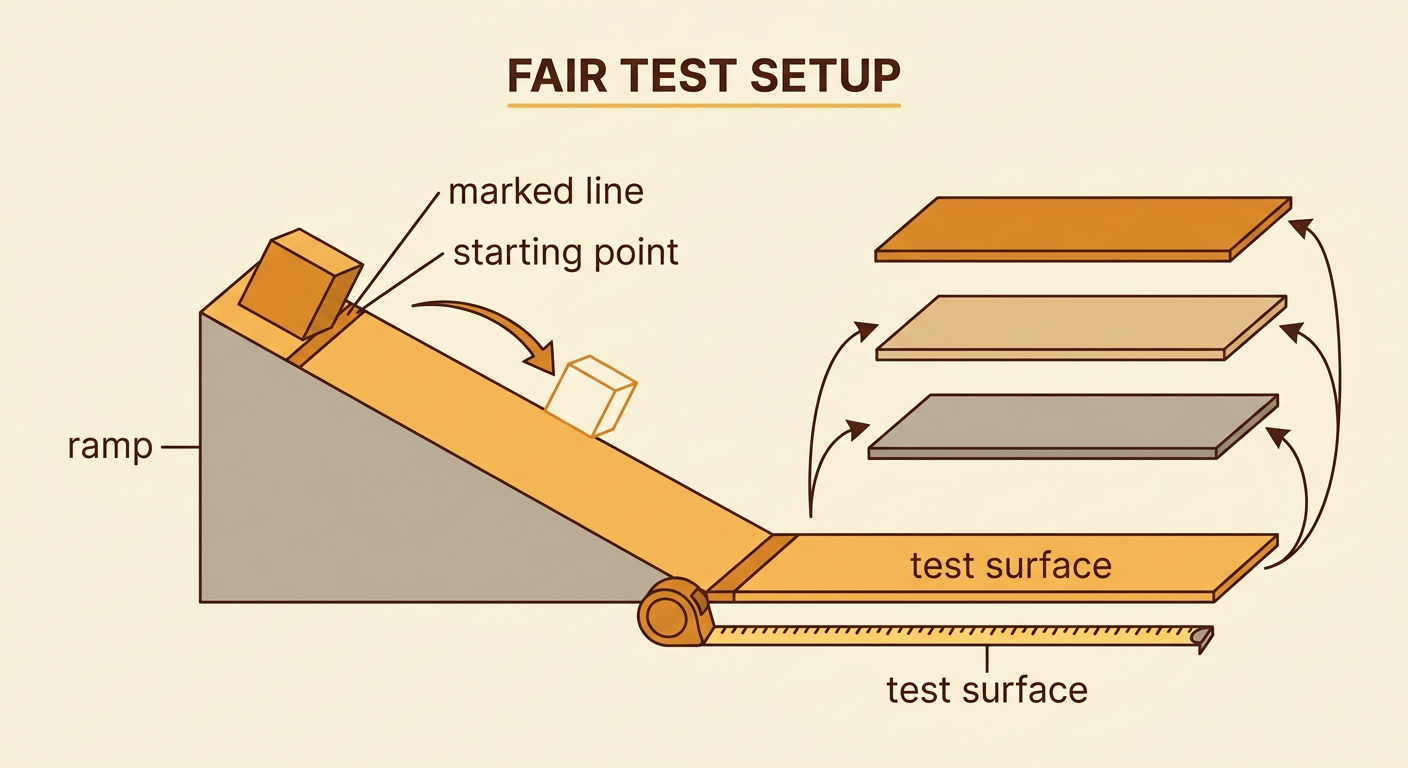
A fair test changes only one important factor at a time. In this investigation, change the surface but keep the object, ramp, starting point, and release method the same. Place a block at a marked line on a ramp. Let go without pushing so gravity starts each trial in the same way. The block should leave the ramp and slide across a flat test surface. Tape each surface firmly so it does not wrinkle or move. Test one surface at a time, and repeat each test at least three times. Before beginning, predict which surface will let the block slide farthest. Write a simple procedure that another group could follow. Keep hands and feet away from the moving block, and test only lightweight, safe objects.
Measure and Record Distances
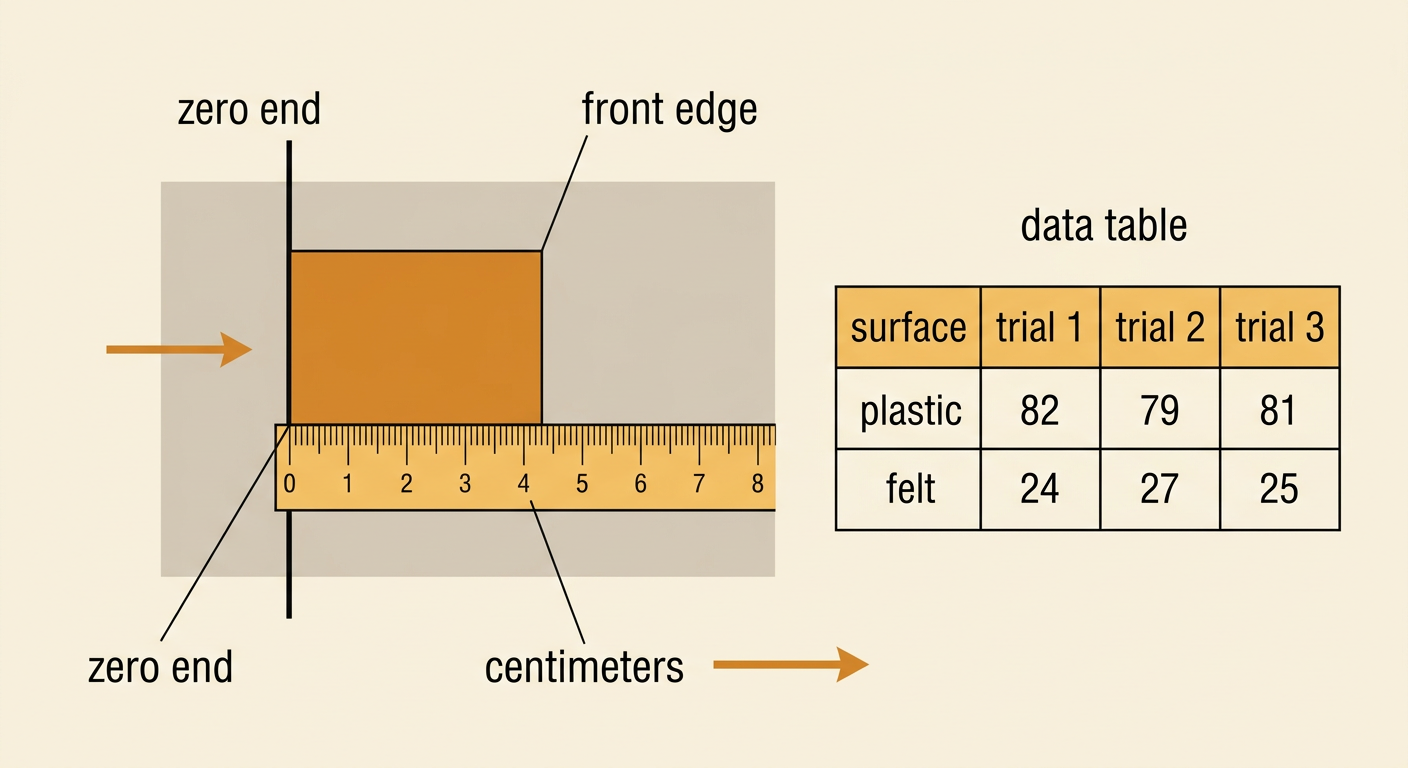
Careful measurements turn observations into useful evidence. Place the zero end of a measuring tape at the line where the block enters the test surface. Release the block and wait until it stops completely. Measure in centimeters from that line to the front edge of the stopped block. Always use the same edge so your measurements can be compared. Record the surface and distance in a data table after every trial. For example, a block might travel 82, 79, and 81 centimeters on plastic but 24, 27, and 25 centimeters on felt. Repeat trials because small differences can happen each time. Look for the overall pattern instead of choosing only one result. You may also make a bar graph showing a typical distance for each surface.
Explain Results with Evidence
Use your results to make an evidence-based explanation. Begin with a claim that answers the question. For example, you might claim, “Felt created more friction than plastic.” Next, give numerical evidence from several trials. You could write, “The block traveled about 80 centimeters on plastic but only about 25 centimeters on felt.” Then explain your reasoning: a shorter sliding distance shows that a stronger friction force slowed the block sooner. Check your conclusion using more than one source, such as your group’s measurements, the class data table, your observations, and a science book or trusted classroom source about friction. If another group found different results, compare the test methods and surfaces. A strong argument reports the evidence honestly and explains how it supports the claim.
