
Ionic and Covalent Bonding
Students use valence electrons and particle models to explain how ionic and covalent bonds form and to predict basic properties of the resulting compounds.
Illustrations are auto-generated and may be placeholders. They can be refreshed to match the narration.
Valence Electrons and Stability
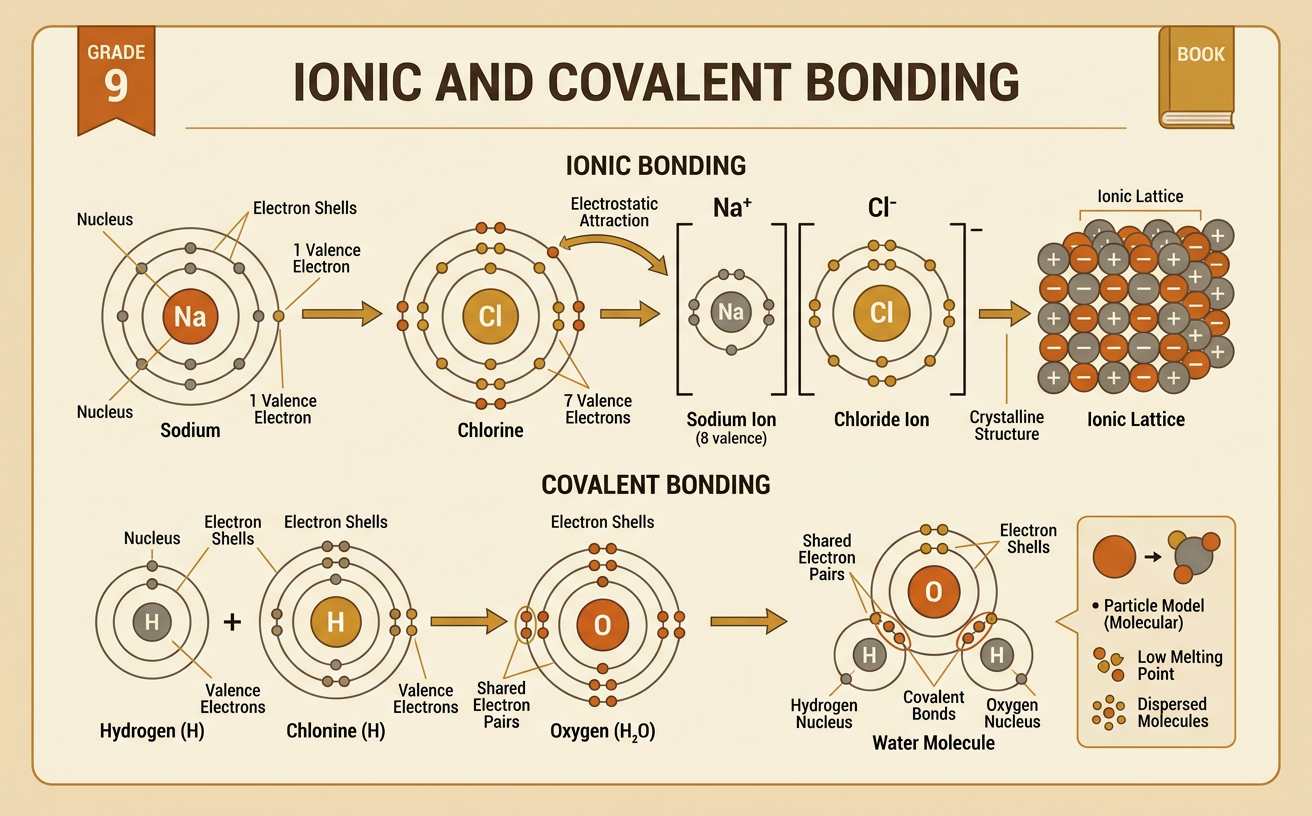
Valence electrons are the electrons in an atom’s outermost occupied energy level. They largely determine how an atom reacts and bonds. For main-group elements, an element’s periodic table group helps predict its valence electrons. Sodium has one valence electron, chlorine has seven, and neon has eight. Atoms often gain, lose, or share electrons to reach a lower-energy arrangement like that of a nearby noble gas. This pattern is commonly called the octet rule because many stable atoms have eight outer electrons. Hydrogen and helium are stable with two. The octet rule is useful but has exceptions, so it should be treated as a model rather than an absolute law. Lewis electron-dot diagrams represent valence electrons as dots around an element symbol, making bonding patterns easier to compare.

Electron Transfer in Ionic Bonds
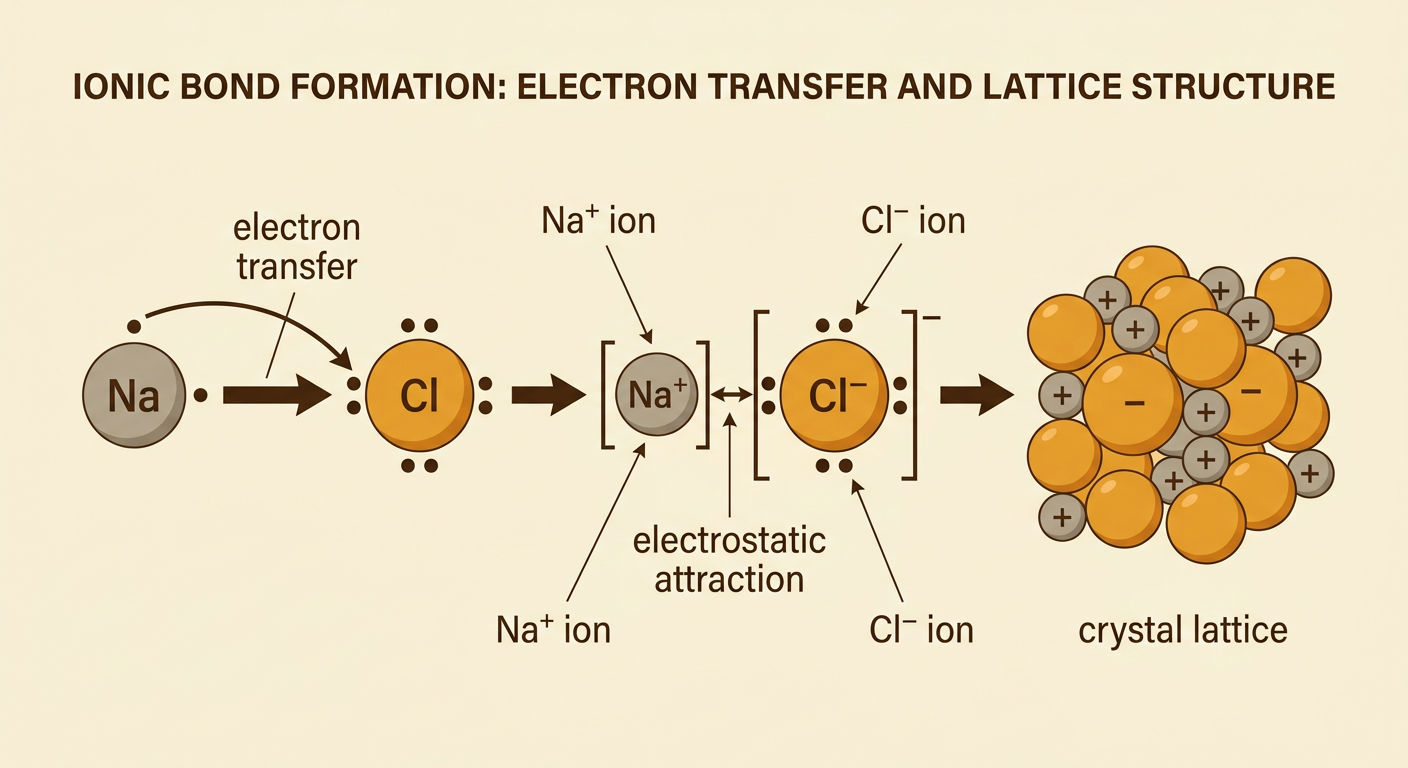
An ionic bond forms after electrons are transferred from one atom to another, producing oppositely charged ions. For example, a sodium atom transfers its one valence electron to a chlorine atom. Sodium then has 11 protons but only 10 electrons, so it becomes a positively charged Na+ ion. Chlorine has 17 protons and gains an eighteenth electron, so it becomes a negatively charged Cl− ion. Both ions now have filled outer energy levels. The electrostatic attraction between Na+ and Cl− holds them together in an ionic compound. In solid sodium chloride, many ions form a repeating three-dimensional crystal lattice rather than separate NaCl molecules. Overall, the compound is electrically neutral because the total positive charge equals the total negative charge.
Electron Sharing in Covalent Bonds
A covalent bond forms when atoms share one or more pairs of valence electrons. Sharing allows each bonded atom to count the shared electrons as part of its outer energy level. In a water molecule, oxygen has six valence electrons, and each hydrogen has one. Oxygen shares one electron pair with each hydrogen, forming two single covalent bonds. Each hydrogen reaches a stable total of two outer electrons, while oxygen reaches eight. Oxygen also retains two unshared pairs, called lone pairs. Unlike an ionic crystal, water consists of individual H2O molecules. The electrons are not always shared equally: oxygen attracts the shared electrons more strongly than hydrogen, making the O–H bonds polar. Covalent bonding most commonly occurs between nonmetal atoms.

Modeling Bond Formation
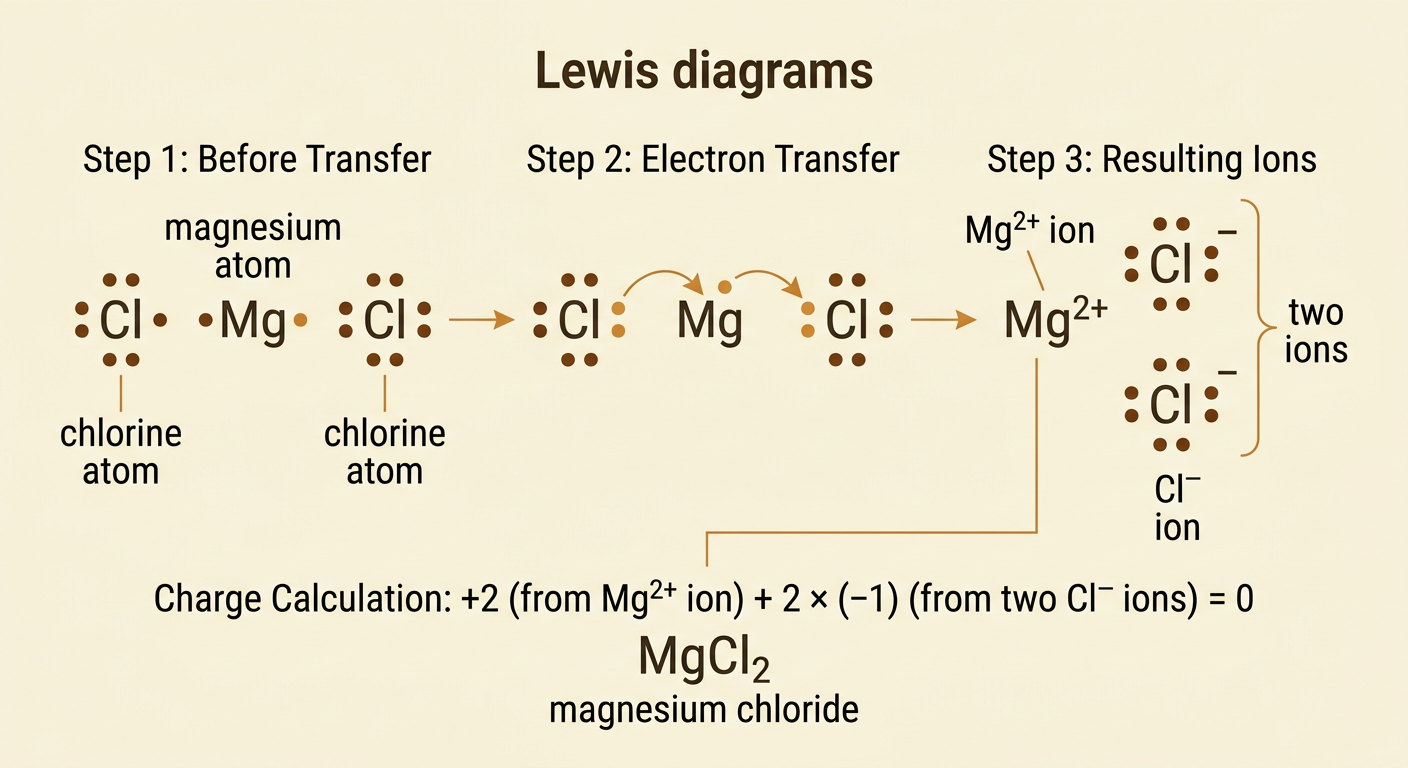
A particle model should show both electron changes and the number of particles required for a neutral compound. Consider magnesium chloride. A magnesium atom has two valence electrons, while each chlorine atom has seven. Magnesium transfers one electron to each of two chlorine atoms. The products are one Mg2+ ion and two Cl− ions, giving the neutral formula MgCl2 because +2 plus two charges of −1 equals zero. A useful model can be translated into words: one magnesium atom loses two electrons, and two chlorine atoms each gain one electron. Lewis diagrams clearly track outer electrons and charge, but they do not show actual particle size, distance, motion, or the full three-dimensional lattice. Stating these strengths and limitations makes the explanation more accurate.
Comparing Compound Properties
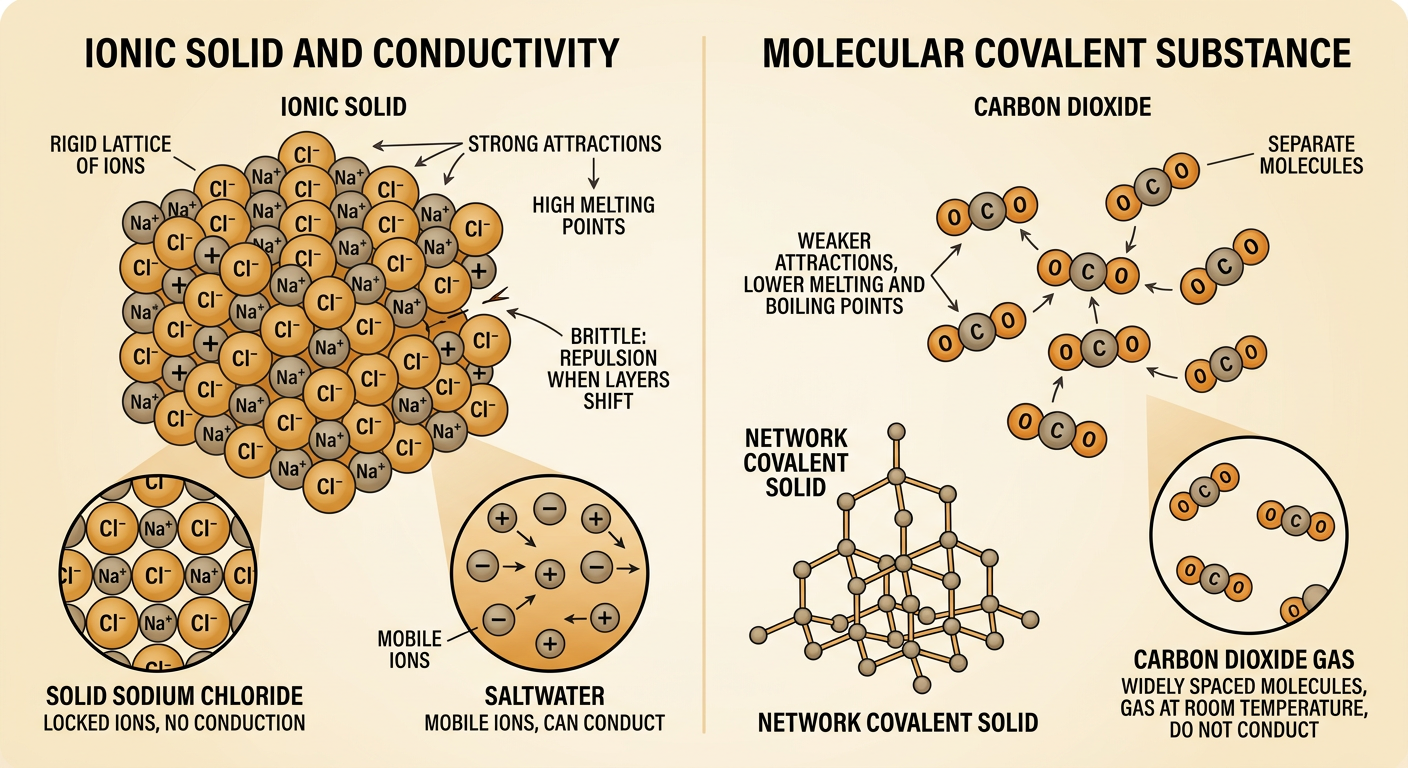
Bonding and particle arrangement help explain a compound’s observable properties. Ionic solids contain a rigid lattice of positive and negative ions. Their strong attractions usually produce high melting points. Ionic solids are brittle because shifting lattice layers can place like charges together, causing repulsion and fracture. Solid sodium chloride does not conduct electricity because its ions cannot move, but molten sodium chloride and saltwater conduct because the ions are mobile. Molecular covalent substances contain separate molecules. Attractions between molecules are often weaker than ionic attractions, so many have lower melting and boiling points and do not conduct electricity. Carbon dioxide, for example, is a molecular covalent substance and is a gas at room temperature. These are useful patterns, not universal rules; network covalent solids such as diamond have very high melting points.
Bond-Type Prediction Check
To predict bond type, first identify each element as a metal or nonmetal and examine its valence electrons. A metal combined with a nonmetal usually forms an ionic compound through electron transfer. Calcium has two valence electrons, while fluorine has seven, so calcium transfers one electron to each of two fluorine atoms and forms CaF2. Two nonmetals usually form covalent bonds by sharing electrons. Carbon has four valence electrons, and hydrogen has one, so carbon shares four electron pairs with four hydrogen atoms to form CH4. Electronegativity, an atom’s attraction for bonding electrons, provides additional evidence: a large difference favors ionic character, while a smaller difference favors covalent sharing. Bonding exists along a continuum, so the metal–nonmetal rule is a strong starting pattern but does not perfectly classify every substance.
